

More news on this day
Thousands of travellers have been stranded across major Middle Eastern hubs as tightening airspace restrictions and security concerns triggered at least 515 flight delays and 228 cancellations affecting carriers including FlyDubai, Emirates and Etihad Airways in cities such as Riyadh and Doha.
Get the latest news straight to your inbox!
Regional Conflict Pushes Gulf Airspace to Breaking Point
Publicly available information shows that the latest wave of disruption is tied to the wider conflict involving Iran and several Gulf states, which has led to repeated missile and drone attacks and intermittent closures of key corridors used by commercial airlines. Travel advisories issued in early March highlight constrained operations at airports in Saudi Arabia, Qatar, Kuwait and neighbouring countries, with some hubs temporarily limiting traffic to essential or rerouted services only.
Economic and security analyses of the ongoing Iran war note that airspace closures over the United Arab Emirates, Qatar, Kuwait, Bahrain and parts of Saudi Arabia have forced airlines to divert or cancel thousands of flights each day, creating knock-on effects for global networks far beyond the region. Carriers that rely on the Gulf as a connecting bridge between Europe, Asia and Africa have been especially exposed, with aircraft and crews out of position and tightly choreographed schedules collapsing under the strain.
These constraints have pushed air traffic management systems in the Gulf close to capacity even during short reopening windows, with congestion building quickly whenever routes partially resume. Aviation tracking data and regional media coverage point to repeated cycles of limited resumptions followed by renewed suspensions as security conditions fluctuate, making it extremely difficult for airlines to plan stable timetables.
For passengers, the consequence has been an extended period of uncertainty in which flights are confirmed one day and withdrawn the next. Many travellers who had already reached the region for work trips, religious pilgrimages or family visits have found themselves stuck in transit, with onward connections repeatedly delayed or removed from schedules as airlines respond to changing risk assessments.
Major Gulf Carriers Forced Into Rolling Schedule Cuts
Flag carriers and low-cost airlines based in the Gulf have been at the centre of the turmoil. Published coverage and airline communications describe widespread schedule cuts by Emirates and FlyDubai from Dubai, Etihad Airways from Abu Dhabi and Qatar Airways from Doha as airspace corridors used for both eastbound and westbound traffic were closed or heavily restricted.
Operational updates indicate that, on peak disruption days, hundreds of departures and arrivals at Gulf hubs were either cancelled outright or delayed for many hours while flight planning teams sought safe alternative routings around affected zones. In Riyadh, Jeddah and other Saudi gateways, reduced capacity and rerouted long-haul services intensified pressure on available slots, contributing to the tally of more than 500 delays and over 200 cancellations tied to the latest phase of the crisis.
Some regional and international airlines have opted to suspend services to key Gulf cities for extended periods, announcing full cancellations on selected routes for days or weeks at a time. Others have maintained so-called skeleton schedules, operating a small number of daily flights primarily to repatriate stranded travellers and reposition aircraft, while warning customers that additional last-minute changes remain possible.
Low-cost operators based in the United Arab Emirates and Kuwait have been especially vulnerable to the rapid shifts, as their point-to-point models rely on high aircraft utilisation and tight turnaround times. Even when airports have remained technically open, overloaded airspace and shifting overflight permissions have reduced punctuality to a fraction of normal levels, further swelling the ranks of delayed passengers.
Stranded Travellers Face Long Waits, Patchy Information
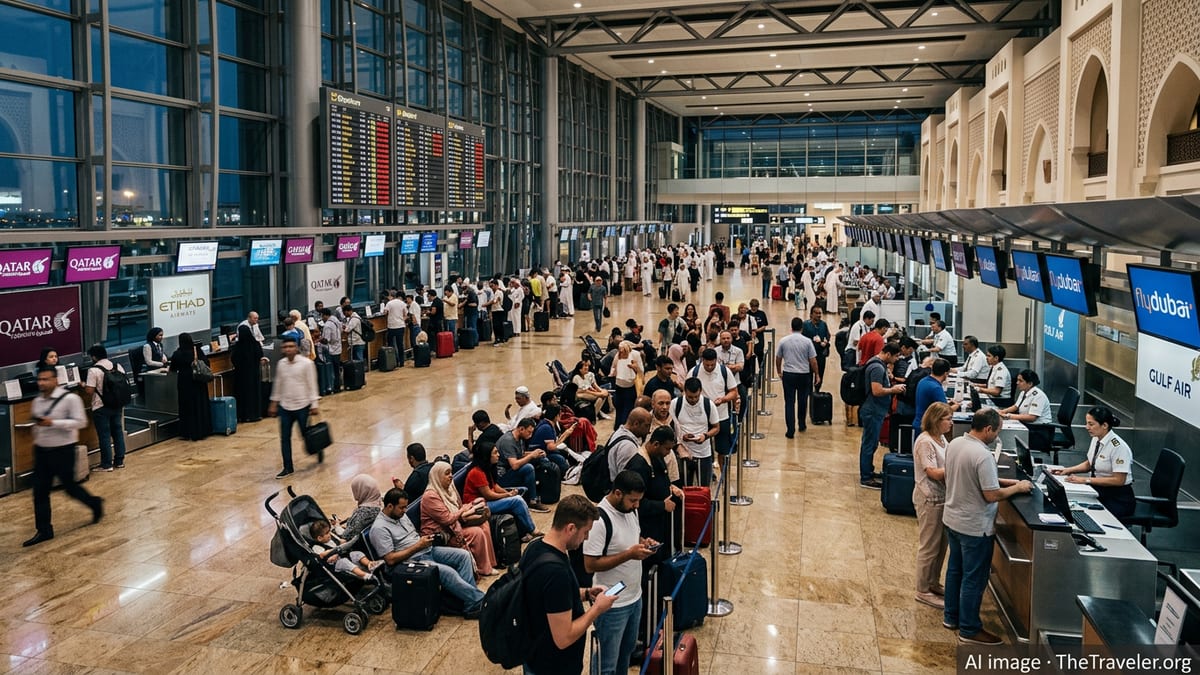
Reports from travellers across Doha, Riyadh, Kuwait City, Dubai and smaller regional airports depict crowded terminals, long queues at airline service desks and overnight stays on terminal floors or in hastily arranged hotel accommodation. With so many flights pushed back or cancelled at short notice, many visitors have found themselves in limbo, uncertain when they will be able to leave.
Social media posts and passenger accounts collected by travel forums describe families camped beside check-in areas, business travellers trying to rebook complex multi-leg itineraries, and migrant workers concerned about expiring visas as their return flights disappear from departure boards. In some cases, travellers have reported being rebooked multiple times only to see replacement services also cancelled as airspace restrictions were extended.
Given the scale of the disruption, airlines have struggled to keep customer communication channels functioning smoothly. Call centres, messaging apps and airport help desks have been inundated, with some passengers saying they waited hours for updates or were unable to reach their carrier at all. Published guidance from consumer advocates notes that this communication gap has left many travellers unsure of their rights to refunds, rerouting or care such as meals and accommodation during extended delays.
Nevertheless, there are signs of gradual stabilisation in certain markets as limited contingency routes open and airlines secure fresh overflight approvals. Some passengers have succeeded in leaving the Gulf via detours through secondary airports in Saudi Arabia or Oman, or by routing around the conflict zone with longer journeys via Europe or South Asia. These options, however, remain scarce and often come with substantial extra travel time.
Knock-On Impacts for Global Travel and Tourism
The Gulf’s role as a global connecting hub means that flight disruptions in Riyadh, Doha and other Middle Eastern cities are being felt far beyond the region. Data compiled by aviation analytics firms and referenced by travel-industry outlets shows that passengers as far away as Europe, North America and Southeast Asia have experienced cancellations or extended delays on itineraries that merely transited the Gulf, even when their origin and destination countries are far from the conflict.
Tour operators and corporate travel managers report having to rework itineraries built around Gulf stopovers, shifting clients to alternative routings via Istanbul, major European hubs or South Asian gateways where possible. This rebalancing has in turn increased pressure on those airports and airlines, with some carriers warning of reduced availability and higher fares on remaining routes as they attempt to absorb displaced demand.
Within the Middle East itself, the interruption has come at a crucial time for tourism, religious travel and major events. The spring period and the weeks around Ramadan and Eid typically see a surge in demand for flights into and through Gulf hubs. Current restrictions have led to hotel cancellations, postponed conferences and disrupted pilgrim and family travel, undermining revenue projections for airlines, airports and hospitality businesses across the region.
Economists tracking the broader fallout from the Iran war suggest that the aviation sector’s woes are feeding into a wider economic shock for the Gulf. Reduced air connectivity can dampen business confidence, cut into visitor spending and complicate logistics for sectors ranging from energy to high-end retail, amplifying the direct damage caused by strikes on infrastructure.
What Travellers Can Do If Their Middle East Flight Is Affected
Travel advisories from governments, consumer groups and travel platforms emphasise that passengers booked on routes touching Qatar, Kuwait, Saudi Arabia and neighbouring states should check their flight status frequently and avoid heading to the airport until their departure is confirmed as operating. Given that schedules are changing rapidly, travellers are being urged to rely on airline apps, official booking portals and airport information screens for the latest operational details.
Passenger-rights guidance notes that, where flights are cancelled, travellers are typically entitled to either a refund or rebooking on the next available service, though the exact rules vary by airline and jurisdiction and some protections may be limited when disruptions are caused by armed conflict or airspace closures. Many carriers serving the region have introduced temporary flexibility policies that allow passengers to change dates or routes without standard change fees, particularly for travel booked before the latest escalation.
Experts also caution that travellers should review their travel insurance policies carefully, as cover for war-related disruptions and government-imposed airspace closures is often restricted or excluded. Where policies do offer relevant protection, passengers may be able to claim for additional accommodation, meals or alternative transport costs incurred while stranded.
For those already in affected hubs such as Riyadh or Doha, contingency advice includes registering with national consular services where available, keeping accommodation options flexible and, where safe and legally permitted, considering overland alternatives to nearby airports with more stable operations. However, conditions on the ground can shift quickly, and travellers are being encouraged to prioritise official travel advisories and local safety guidance when making decisions about when and how to move.