

More news on this day
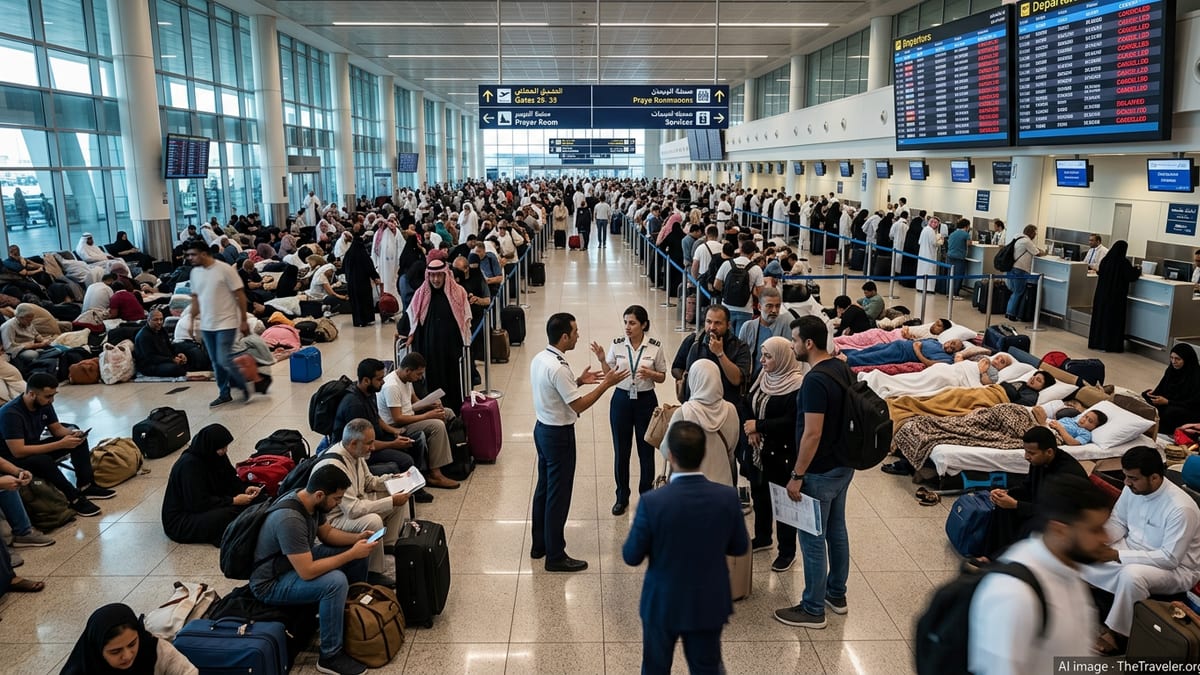
Thousands of passengers were left sleeping on terminal floors and queuing at packed service desks on Friday as a fresh wave of cancellations and rolling delays hit King Abdulaziz International in Jeddah, Cairo International and King Fahd International in Dammam, with at least 84 flights cancelled and more than 300 delayed amid ongoing airspace restrictions and security tensions across the Middle East.
Get the latest news straight to your inbox!
Airspace Closures Ripple Across Regional Hubs
The latest disruption comes after days of intermittent airspace closures and reroutings linked to heightened missile and drone activity over parts of the Gulf and Levant, which have forced airlines to skirt large swathes of Middle Eastern skies and compress traffic into a handful of still-open corridors. Aviation analysts say the result is a fragile network in which a single closure or interception can trigger hours of knock-on delays.
Travel advisories issued this week warn that airspace over several states remains subject to sudden shutdowns, with authorities prioritising military and emergency traffic when threats are detected. Airlines have responded by cancelling rotations outright, holding aircraft and crews out of position and thinning schedules at some of the region’s busiest hubs just as peak travel demand returns.
Operational updates from regional authorities indicate that while Riyadh’s King Khalid and Dubai International have seen partial resumptions after earlier suspensions, traffic remains constrained. With more long-haul services now funneled through Saudi and Egyptian hubs, any disruption at Jeddah, Cairo or Dammam quickly cascades onto onward flights to Europe, Africa, Asia and North America.
Industry consultants note that the pattern mirrors broader turmoil seen since late February, when carriers across Asia reported hundreds of cancellations and more than a thousand delays on routes touching the Middle East. They warn that even if no new airspace closures are announced, the system will likely remain unstable for days as airlines work through stranded passengers and reposition aircraft.
Passengers Face Long Queues, Thin Information
At Jeddah’s King Abdulaziz International, departing passengers on Friday described departure halls filled with families sprawled across the floor, lines snaking out from airline counters and prayer rooms repurposed as quiet waiting areas for elderly travelers. Many had already spent a night in the terminal after late‑evening departures to Doha, Istanbul and Nairobi were cancelled just before boarding.
Cairo International reported similar scenes, with passengers scheduled to fly to Muscat, Casablanca and Zurich confronted with last‑minute text messages notifying them of “operational cancellations” and advising them to contact call centers rather than approach already overstretched airport staff. For many, getting through proved difficult, with hold times stretching past an hour as airlines grappled with a surge in rebooking requests.
In Dammam, travelers bound for Riyadh, Abu Dhabi and Dubai found themselves caught in a different kind of limbo. While King Fahd International remains technically open, intermittent restrictions on certain corridors have forced airlines to hold flights on the ground while they secure revised routings. Several passengers reported sitting aboard aircraft for more than two hours before being told that their flights would not be departing that day.
With hotel capacity around the airports quickly exhausted, some carriers have shifted to offering meal vouchers and future travel credits instead of overnight accommodation. Stranded travelers voiced frustration at what they described as inconsistent treatment between airlines and a lack of clear information about when normal schedules might resume.
Global Routes to Europe, Africa and the US Disrupted
The immediate impact of Friday’s disruption was most visible on regional connectors, but the shockwaves extended far beyond the Gulf and Red Sea. Flight-tracking data showed major long-haul services from Jeddah and Cairo to New York and Chicago among those delayed or cancelled, complicating travel plans for business travelers and diaspora communities alike.
Key northbound links from the Middle East into Europe also suffered. Services to Amsterdam and Zurich operated with extended routing times and missed connections, while some flights to Istanbul and Alexandria were cancelled outright as aircraft and crews failed to arrive from earlier segments. For travelers attempting to connect between Africa and Asia via Gulf and Saudi hubs, options narrowed sharply.
Routes to East Africa and the Horn were particularly affected. Flights from Jeddah and Cairo to Addis Ababa and Nairobi saw significant delays as carriers juggled limited aircraft and re‑prioritised services. Travelers heading onward from those African hubs to Southern and West Africa reported missed connections and unexpected overnight stays after arriving hours behind schedule.
Even where flights operated, adjusted routings to avoid sensitive airspace added 30 to 90 minutes to typical block times. Airlines warned that extended flight durations would remain common as long as certain airspace segments remained restricted, reducing the number of daily rotations each aircraft could complete and amplifying the risk of further disruption.
Airlines Juggle Safety, Schedules and Reputational Risk
Airlines operating through Jeddah, Cairo and Dammam on Friday walked a tightrope between maintaining schedules, complying with shifting airspace directives and reassuring nervous customers. Several carriers opted to consolidate services on high‑demand routes to Doha, Muscat and Riyadh, cancelling secondary departures and moving passengers onto a single, larger aircraft once a safe routing was approved.
Others chose to suspend operations entirely on select city pairs, citing the need to protect crew duty times and avoid aircraft becoming stranded at airports with limited maintenance support. Aviation lawyers note that such decisions are likely to fall under force majeure provisions linked to security concerns, limiting the compensation available to passengers on many international tickets.
Regional regulators have urged travelers to check flight status repeatedly in the hours before departure and to avoid heading to the airport without confirmation that their flight is operating. Industry groups say that while carriers have improved crisis communication since previous regional flare‑ups, outdated contact details, patchy mobile coverage and language barriers continue to hamper efforts to reach every affected passenger in time.
Brand specialists warn that prolonged disruption could dent the reputations of some Middle Eastern hubs that have spent decades cultivating an image of seamless, 24‑hour connectivity. Even if airlines are not directly responsible for the airspace closures, travelers often conflate their experience at the airport with the performance of the carriers that serve it.
What Travelers Should Expect in the Coming Days
Looking ahead, aviation planners caution that Friday’s total of at least 84 cancellations and 316 delays across King Abdulaziz International, Cairo International and King Fahd International is unlikely to mark the end of the turmoil. With aircraft, crew and spare capacity all stretched, even routine issues such as technical inspections or local weather could tip already fragile schedules back into chaos.
Travel agents in the region report a surge in inquiries from passengers seeking to reroute via secondary hubs in Europe and South Asia, as well as from those postponing non‑essential trips. Some corporate travel managers are temporarily steering staff away from itineraries that rely on tight connections in the Gulf and western Saudi Arabia, instead building in longer layovers or preferring point‑to‑point options where available.
For leisure travelers booked to or via Doha, Muscat, Riyadh, Abu Dhabi, Dubai, Istanbul, Alexandria, Amsterdam, Zurich, Addis Ababa, Casablanca, Nairobi, New York or Chicago in the coming week, experts recommend monitoring flights closely, allowing extra time for check‑in and security, and packing essential medications and a change of clothes in carry‑on luggage in case of unexpected overnight stays.
While regional authorities stress that safety remains the overwhelming priority and that most airports continue to handle a significant number of arrivals and departures, they acknowledge that volatility is likely to persist. For now, passengers across the Middle East’s key hubs are being urged to treat published timetables as provisional rather than guaranteed as airlines navigate one of the most complex operating environments the region has seen in years.