

More news on this day
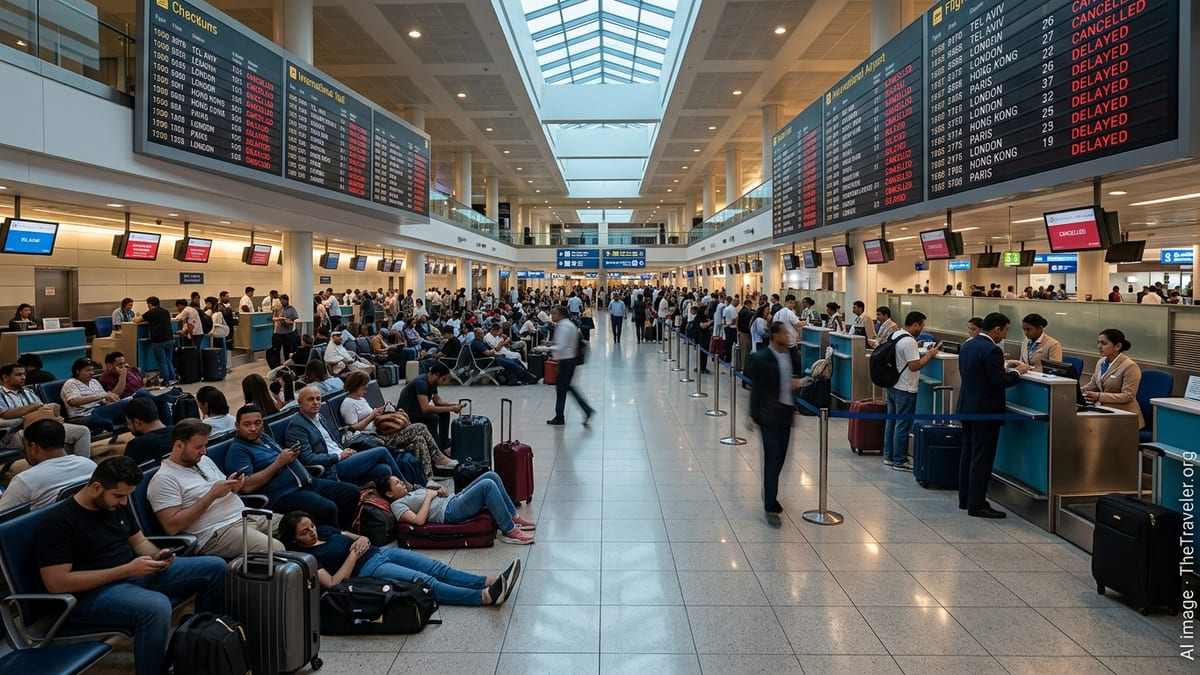
Thousands of air travelers across the Middle East remain stranded after a cascading wave of delays and cancellations hit major hubs in Saudi Arabia, the United Arab Emirates, Qatar, Egypt, Turkey and Israel, with regional and international carriers scrubbing or postponing more than 2,100 flights in recent days.
Get the latest news straight to your inbox!
Conflict-Linked Airspace Closures Ripple Across the Region
The latest disruption follows a sharp escalation in the regional conflict involving Iran, Israel, the United States and Gulf states, which has triggered extensive airspace closures and operational restrictions over and around the Arabian Peninsula. Publicly available aviation advisories describe large sections of airspace above Qatar, the United Arab Emirates, Bahrain, Kuwait and parts of Saudi Arabia and Israel as restricted or closed to routine commercial traffic, compelling airlines to divert, delay or cancel services on an unprecedented scale.
According to open-source tracking and industry analyses, the closures and route bans have removed thousands of daily flights from the global network, with Middle Eastern hubs among the hardest hit. Dubai, Abu Dhabi, Doha and Kuwait City have all reported extended operational interruptions, while knock-on congestion is affecting secondary airports from Cairo and Jeddah to Amman, Beirut and Muscat as rerouted or diverted aircraft vie for limited slots.
In addition to the direct impact of closed skies, damage from recent Iranian missile and drone strikes on airports in the UAE and Qatar has further limited capacity. Flight disruption summaries indicate that facilities at Dubai International and Abu Dhabi International have been operating under emergency procedures or partial shutdowns, constraining both arrivals and departures and exacerbating the backlog of stranded passengers.
The combined effect has been a sharp contraction in connectivity across the wider Middle East, particularly along routes linking Europe, Asia and Africa that normally rely on Gulf and Levant hubs. Industry observers note that the region, long promoted as a seamless transfer corridor, has been forced into an emergency posture more commonly associated with localized natural disasters than a sustained geopolitical crisis.
Major Gulf Carriers Slash Schedules and Pivot to Relief Flights
Flag carriers and low cost operators based in the Gulf have been at the center of the disruption. Emirates, Qatar Airways, Saudia and FlyDubai, along with Etihad and other regional airlines, have collectively cut deep into their regular schedules, with data collated from flight tracking dashboards showing at least 1,335 flights delayed and 818 cancelled across key Middle Eastern gateways over a compressed several day period.
Qatar Airways has kept normal commercial operations largely suspended at Doha’s Hamad International Airport following repeated airspace closures and nearby missile activity, while gradually introducing limited repatriation services. Public updates describe a tightly controlled schedule of outbound relief flights to major European hubs, pre-allocated to passengers whose original journeys were disrupted earlier in the crisis, rather than open sales to new travelers.
Emirates and FlyDubai, whose networks are heavily concentrated at Dubai International, have adopted a similar dual-track approach, canceling or deferring large portions of their timetables while mounting special services to move stranded customers out of the United Arab Emirates and reposition aircraft. Social media posts, airline advisories and traveler accounts describe once-busy departure boards dominated by “cancelled” notices, punctuated by a handful of relief flights heavily oversubscribed by passengers who have already endured days of uncertainty.
Saudia and other Gulf and Levant carriers, including Royal Jordanian and Middle East Airlines, have also trimmed or rerouted flights serving Amman, Beirut, Jeddah, Riyadh and Dammam as airspace corridors shift from hour to hour. Schedules to Tel Aviv, Cairo, Muscat and secondary Gulf airports have been especially volatile, complicating efforts by airlines to provide reliable information to travelers with onward connections.
Cairo, Amman, Beirut and Muscat Buckle Under Passenger Backlogs
With primary hubs across Qatar and the UAE operating at sharply reduced capacity, secondary and regional airports have become pressure valves for the disrupted network. Cairo, Amman, Beirut and Muscat, along with Jeddah, Riyadh and various smaller Gulf gateways, have experienced days of heavy congestion as diverted aircraft and displaced passengers converge on facilities not designed to serve as long-term holding points for large numbers of international travelers.
Reports from regional media and passenger forums describe terminal floors crowded with families camped beside their luggage, improvised sleeping areas near closed check-in counters, and extended queues at immigration and customer service desks. In Cairo and Amman, where Egyptair and Royal Jordanian maintain sizeable operations, a patchwork of partial departures, short-notice cancellations and last minute equipment changes has left many travelers unsure whether to remain airside or attempt to arrange surface transport and accommodation on their own.
Beirut’s Rafic Hariri International Airport and Muscat International in Oman are also under strain. Airlines using these airports as diversion points have had to juggle scarce parking stands, crew duty time limits and fuel supply constraints while simultaneously managing distressed passengers seeking rebooking or refunds. Industry briefings indicate that airport operators are working to keep essential services such as power, air conditioning and security screening running smoothly, but acknowledge that amenities are stretched by crowds far above normal throughput.
The challenges are compounded by the interconnected nature of many itineraries involving the Middle East. Travelers bound for destinations as varied as Southeast Asia, East Africa and Western Europe have found themselves unexpectedly marooned in transit points, with onward legs canceled and alternative routes either full, circuitous or significantly more expensive than their original tickets.
Knock-On Effects for Global Networks and Tourism
The crisis in Middle Eastern airspace is reverberating well beyond the immediate region. Airlines in Europe, Asia and Oceania have cancelled or rerouted services that would normally overfly the Gulf, with some carriers suspending flights to key destinations outright. Publicly accessible schedule data and news coverage highlight cases where long haul routes from hubs such as London, Frankfurt, Mumbai and Sydney have been forced into lengthy detours or placed on temporary hold.
Tourism boards and industry analysts are warning that prolonged instability across Middle Eastern hubs could reshape travel patterns for months to come. The Gulf’s role as a central interchange enabling one-stop connections between continents has underpinned visitor flows to destinations from the Indian Ocean to southern Africa. With those seamless connections now in doubt, tour operators and corporate travel managers are exploring alternative routings via southern Europe, Central Asia or North Africa, often at the expense of longer journey times and higher fares.
Air cargo is also feeling the strain. Freight operators and combination carriers that normally move high value goods through Dubai, Doha and Abu Dhabi are contending with reduced belly capacity on passenger aircraft, restrictions on overflight and occasional damage to airport infrastructure. Logistics specialists caution that supply chains that rely on just in time deliveries through the Gulf may experience delays and temporary shortages, notably in sectors such as electronics, fashion and pharmaceuticals.
Financial markets have already taken note, with airlines and travel-related stocks showing volatility in response to shifting headlines about missile strikes, airspace advisories and tentative reopening plans. Analysts referenced in business press coverage say that while the industry is more resilient than during earlier shock events, the combination of higher fuel prices, rerouting costs and lost traffic poses a significant challenge if disruptions persist deep into the busy northern summer season.
Stranded Passengers Face Uncertainty, Limited Options and Changing Rules
For travelers on the ground, the crisis is playing out in long waits, uncertain information and a patchwork of consumer protections that vary by country and carrier. Public guidance from travel advisory services and consumer organizations urges passengers to monitor airline apps and airport notices closely, keep receipts for any out of pocket expenses and familiarize themselves with applicable compensation rules in their departure or destination markets.
European regulations offer robust rights for eligible flights departing from or operated by carriers based in the European Union, but many services to and from the Middle East fall outside those frameworks. Guidance published by legal and financial information providers notes that when cancellations are clearly linked to armed conflict or government ordered airspace closures, airlines often classify events as extraordinary circumstances, limiting mandatory compensation even as they retain obligations to offer rerouting or refunds.
Travel insurers are also reassessing coverage. Policy documents and expert commentary suggest that some basic policies exclude acts of war or conflict related disruption, leaving travelers to absorb the cost of extended hotel stays and rebooked tickets. More comprehensive plans may offer partial relief, but claim processes can be slow, particularly when tens of thousands of people are affected at once.
As airlines gradually introduce repatriation and relief flights from Doha, Dubai, Abu Dhabi and other hubs, competition for seats is intense. Many of these services are being allocated first to passengers whose original journeys were cancelled at the height of the airspace closures, leaving newly stranded travelers further back in the queue. With the broader security situation still fluid, industry observers caution that recovery will likely unfold in phases, with irregular operations and residual disruptions continuing long after the most acute wave of cancellations and delays has passed.