

More news on this day
Thousands of travellers across the Middle East are facing extended airport stays, missed connections and rapidly changing itineraries as nearly 300 flights are cancelled and more than 1,500 delayed across key hubs including Dubai, Jeddah, Doha, Cairo and Istanbul, according to emerging operational data and regional aviation reports.
Get the latest news straight to your inbox!
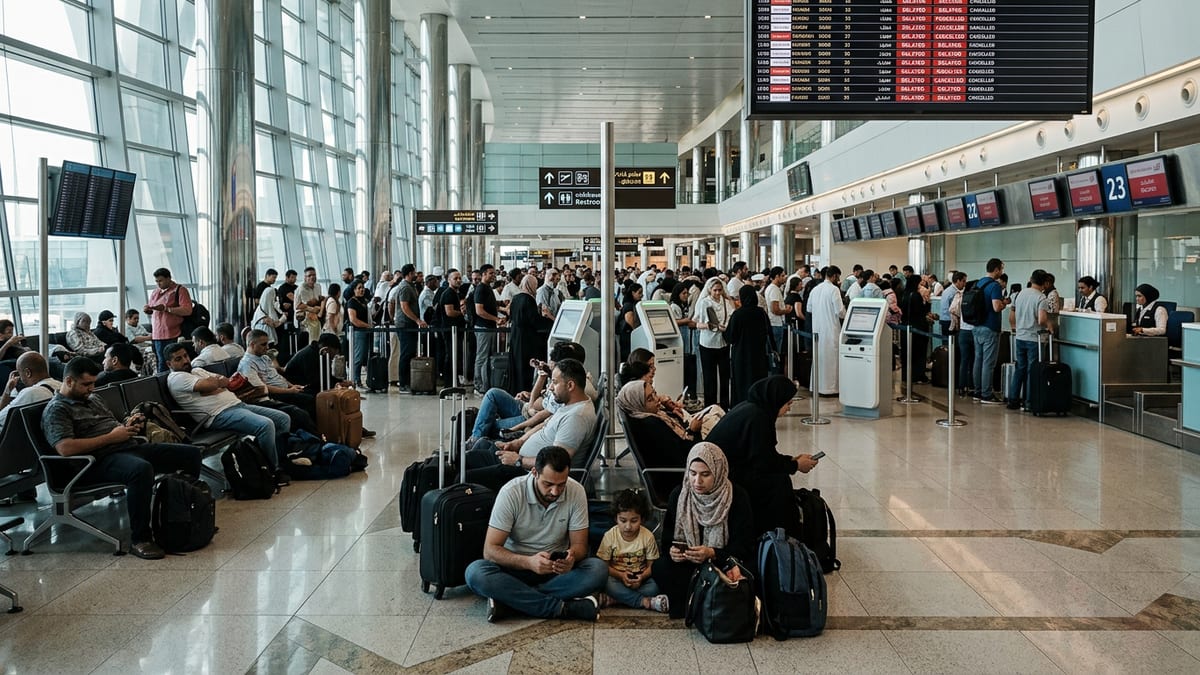
Wide-Ranging Disruptions Hit Major Middle East Gateways
Operational updates from airlines and airport schedule data indicate that at least 293 flights have been cancelled and around 1,504 delayed across the region within a short window, severely disrupting movements through the Middle East’s busiest hubs. The impact stretches across the United Arab Emirates, Qatar, Bahrain, Saudi Arabia and Turkey, with secondary effects felt on connecting routes to Africa, Europe and Asia.
Dubai, Abu Dhabi and Doha, normally among the world’s most reliable long-haul transit points, have seen waves of cancellations and rolling delays as carriers attempt to rework schedules around airspace restrictions and congestion. Publicly available departure boards and airline status pages show frequent changes to departure times, with many services marked as “disrupted” or removed from displays at short notice.
The knock-on effect is particularly acute for passengers booked on complex itineraries involving multiple stops. With aircraft and crews out of position, flights that technically have open air corridors are still being rescheduled or consolidated, compounding backlogs at immigration halls, transfer desks and rebooking counters.
Emirates, Saudia, Gulf Air and Regional Carriers Forced to Cut Services
Flag carriers and regional airlines centered in the Gulf and wider Middle East are among the most heavily affected. Emirates has trimmed or temporarily suspended a range of services to and from destinations such as Jeddah and Cairo, while operating a reduced schedule on other routes as airspace gradually reopens in stages. Flight-status posts compiled by travellers show multiple Emirates departures listed as cancelled or significantly retimed in recent days.
Saudi Arabia’s Saudia has faced similar disruption across its network, particularly on services touching Jeddah and other key Saudi cities. Public flight information shows cancellations on routes that usually serve heavy religious and labor traffic, adding pressure at already busy terminals as passengers seek alternative departures or refunds.
In Bahrain, Gulf Air has also been forced to curtail regular operations. Published customer updates describe suspended or rerouted flights from Bahrain International Airport, with some services temporarily shifted to operate via alternative Saudi airports to maintain a minimal level of connectivity. Other regional airlines, including low-cost operators based in the UAE and Turkey, are adjusting timetables on a rolling basis as the situation evolves.
Passengers Stranded in Jeddah, Cairo, Istanbul and Doha
Among the hardest-hit airports are Jeddah, Cairo, Istanbul and Doha, all of which function as critical junctions for religious travel, labor migration and tourism between the Middle East, Africa, Europe and South Asia. Reports from passengers and airport data suggest crowded terminals, long queues at service counters and challenges finding hotel rooms as the number of stranded travellers grows.
In Jeddah, where Saudia and other carriers manage intense seasonal flows of pilgrims and workers, cancellations and delays have produced lines at ticket offices and rebooking desks that extend deep into terminal concourses. Travellers report repeated schedule changes, with flights appearing as scheduled before later being flagged as disrupted or removed entirely.
Cairo and Istanbul, both major crossroads for budget and full-service airlines, are experiencing similar patterns. Delayed departures and missed connections are forcing passengers to remain airside for extended periods, in some cases overnight, while they wait for updated information. In Doha, one of the region’s most important long-haul hubs, revised schedules and a reduced number of active flights are leading to congested transfer zones and limited rebooking options on short notice.
Airspace Restrictions and Operational Constraints Behind the Numbers
Aviation analysts note that the current wave of disruption is closely tied to recent airspace closures and restrictions across parts of the Middle East, which have narrowed the available corridors for commercial jets. Publicly accessible notices to air missions and airline travel advisories outline temporary bans or limitations over several countries, forcing carriers to cancel some flights outright and send others on extended detours.
These restrictions create ripple effects far beyond the immediately closed routes. With alternative paths becoming crowded and flight times lengthening, aircraft utilization drops and crews quickly run into duty-time limits, making it difficult for airlines to maintain pre-disruption schedules. As a result, carriers are consolidating flights, prioritizing certain trunk routes and trimming frequencies on secondary services.
Operational data compiled by flight-tracking services and traveller forums shows that even as some airspace segments begin to reopen or ease restrictions, the backlog of disrupted rotations continues to strain schedules. Airlines are effectively running a rolling recovery operation, adjusting day by day as new constraints or opportunities emerge.
What Travellers Are Experiencing on the Ground
For individual travellers, the statistics of 293 cancellations and 1,504 delays translate into missed family events, disrupted business trips and extended stopovers in unfamiliar cities. Passenger accounts collected across public platforms describe a patchwork of experiences, from relatively smooth rebookings onto later flights to multi-day waits for available seats.
Many travellers report difficulty contacting airlines through call centers or online channels due to high demand, leading some to seek assistance directly at airport ticket counters despite advisories in some locations urging passengers not to come to the airport unless their flight is clearly confirmed as operating. Others describe receiving cancellation notices only hours before or even after scheduled departure times, complicating efforts to secure accommodation and onward travel.
Travel experts monitoring the situation advise passengers with upcoming itineraries through the affected hubs to check flight status frequently, keep flexible plans where possible and prepare for sudden changes, even if a service is still showing as scheduled. With carriers across the UAE, Qatar, Bahrain, Saudi Arabia, Turkey and neighboring states still rebuilding networks after the latest wave of disruption, the region’s normally efficient aviation system is expected to take time to fully stabilize.