

More news on this day
Thousands of travellers across the Middle East and beyond remain stranded after at least 246 flights were suspended and more than 500 delayed, as carriers including Gulf Air, Saudia, EgyptAir, Pegasus Airlines and Flydubai scaled back operations amid ongoing regional security tensions and rolling airspace closures.
Get the latest news straight to your inbox!
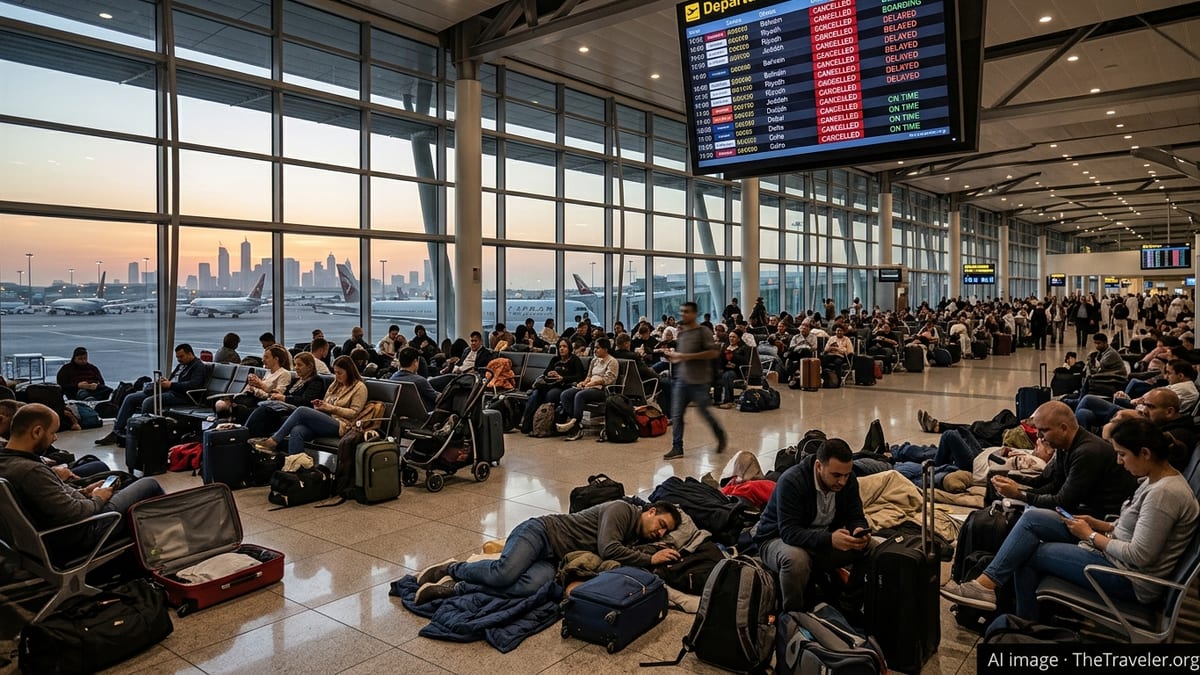
Widespread Cancellations Across Key Gulf and Levant Hubs
Published coverage in recent days shows a patchwork of airspace closures stretching from Iran and Iraq to Israel, Kuwait, Qatar and parts of the United Arab Emirates, triggering a sharp reduction in commercial traffic through some of the world’s busiest transit hubs. Data cited by regional media and aviation analytics firms indicates that thousands of flights have been cancelled since the latest escalation began in late February, with a significant share affecting routes in and out of Bahrain, Saudi Arabia, the UAE, Egypt and Qatar.
Within this broader disruption, at least 246 individual flights operated by carriers such as Gulf Air, Saudia, EgyptAir, Pegasus Airlines, Flydubai and several regional competitors have been suspended on short notice, either because airspace was temporarily closed or because airlines opted to avoid particular corridors. Delays affecting more than 500 additional services have compounded the impact, as aircraft and crews were left out of position and schedules had to be rebuilt around safer but longer routings.
Airports in Dubai, Abu Dhabi, Doha, Manama and Kuwait City, which normally function as high-frequency interchange points between Asia, Europe and Africa, have seen periods where regular commercial operations all but stopped. In some instances, tracking data showed near-zero civilian traffic over large swathes of airspace at peak disruption, before a cautious and partial resumption of flights began.
While air traffic has started to recover in phases, industry assessments suggest that normal patterns remain far from restored. Many airlines are operating reduced schedules or ad hoc relief services, and travellers continue to report long waits, repeated rebookings and uncertainty about onward connections.
Thousands of Passengers Stranded in Bahrain, Saudi Arabia, UAE and Egypt
The combination of suspended routes and heavily delayed departures has left terminals packed with passengers unable to reach their destinations or even return home. Reports from Bahrain point to travellers stuck for more than a week after Gulf Air and other operators sharply curtailed services while awaiting updated clearances from aviation regulators and air navigation authorities.
In Saudi Arabia and the United Arab Emirates, major international gateways such as Riyadh, Jeddah, Dubai and Abu Dhabi have experienced rolling backlogs. Travellers transiting between Europe and Asia, or between South Asia and North America, have been especially affected, as itineraries that depend on Gulf and Levant hubs suddenly became unviable or were routed through alternative airports in Oman, Egypt or further afield.
Egypt has faced parallel pressures, with EgyptAir adjusting schedules on routes that typically cross contested or restricted airspace. Passengers connecting through Cairo have reported extended layovers and last-minute rerouting as the airline attempted to thread limited safe corridors that remain open between North Africa, the Gulf and Europe.
Budget and regional carriers have not been spared. Pegasus Airlines, Flydubai and others serving secondary cities across Turkey, the Caucasus, Iraq and the Eastern Mediterranean have been forced to cancel or delay large portions of their timetables whenever particular flight paths are deemed too risky or temporarily closed, further widening the pool of disrupted travellers.
Operational Strain on Gulf Air, Saudia, EgyptAir, Pegasus and Flydubai
Publicly available timetables and airline updates indicate that the current disruption has created significant operational challenges for carriers based in Bahrain, Saudi Arabia, the UAE, Egypt and neighbouring states. Gulf Air, which relies heavily on Bahrain’s role as a regional transfer hub, has had to repeatedly adjust schedules, consolidate frequencies and in some cases shift passengers to alternative departure points such as Dammam in eastern Saudi Arabia when conditions allowed.
Saudia has faced similar pressures as it reconfigures routes to avoid restricted airspace while maintaining essential domestic and religious travel links. Longer flight times on rerouted services add to fuel and crew costs, while knock-on delays can cascade through the network and limit available aircraft for subsequent rotations.
EgyptAir’s network, which bridges Africa, the Gulf and Europe, has been particularly sensitive to closures over Iraq, Syria and adjacent areas. When preferred airways are unavailable, flights may have to detour via the southern Mediterranean or Red Sea corridors, increasing block times and requiring adjustments to crew duty plans. This in turn can force cancellations when legal duty limits are reached.
For Pegasus Airlines, Flydubai and other low-cost operators whose business models depend on rapid aircraft turnarounds and high utilisation, prolonged groundings and irregular operations are especially disruptive. Reduced flight rotations per day and frequent last-minute changes undermine cost efficiencies and complicate the task of repositioning both aircraft and staff to where they are needed most.
Airspace Closures, Security Concerns and Patchy Reopenings
The immediate trigger for the current wave of cancellations has been a series of military strikes and counterstrikes involving Iran, Israel, the United States and regional actors, prompting several governments to close parts of their airspace as a precaution. Aviation tracking platforms and official notices to airmen have shown periods where no civilian flights were visible over Iraq, Israel, Kuwait, Qatar and sections of the Gulf, effectively severing key high-altitude corridors used by long-haul traffic.
In the United Arab Emirates, authorities announced a temporary and partial closure of airspace at the height of the escalation, which led to Dubai International, Abu Dhabi’s main airport and other facilities sharply reducing activity. Subsequent statements from airport operators indicated only a limited resumption of flights, with Emirates and Flydubai among those restoring a reduced schedule while still avoiding certain regions.
Bahrain and Kuwait have alternated between full and partial closures, according to regional media and airport advisories, each time prompting a fresh round of cancellations across airlines that depend on their airspace as a bridge between continents. Qatar’s airspace and Hamad International Airport in Doha have also been heavily affected, with reports indicating that Qatar Airways and other carriers paused most regular commercial flights for extended stretches before cautiously organising repatriation and relief services.
Across the region, the pattern has been one of incremental reopenings followed by renewed caution whenever the security outlook worsens. This unstable environment has made it difficult for airlines to publish reliable schedules more than a few days in advance, leaving travellers and travel agents to navigate an unusually fluid situation.
Knock-On Effects for Global Travel and What Passengers Can Expect
Because Gulf and Middle Eastern hubs serve as critical junctions between Europe, Asia, Africa and Oceania, the suspension of 246 flights and delays to hundreds more have had ripple effects far beyond the region’s borders. Long-haul services that would normally overfly the Gulf are being rerouted south over Oman, the Arabian Sea and Egypt, or redirected north through alternative corridors, extending flight times and creating congestion in remaining open airspace.
Airlines outside the region are also adjusting operations. Carriers in Europe and South Asia have temporarily halted or reduced services to affected airports, or replaced non-stop flights with connections via alternative hubs. This has increased demand on routes that remain available, pushing some fares higher and reducing flexibility for passengers seeking last-minute alternatives.
For travellers still due to fly through Bahrain, Saudi Arabia, the UAE, Egypt, Qatar or neighbouring countries in the coming days, publicly available advisories consistently recommend monitoring flight status closely and allowing extra time at the airport. Many airlines have introduced flexible rebooking and refund policies for tickets touching affected points, although specific options vary by carrier and fare type.
Industry observers note that while air traffic is likely to continue its gradual recovery if security conditions stabilise, the experience of the past weeks has underlined the vulnerability of global travel networks to regional flashpoints. For now, thousands remain in transit limbo as Gulf Air, Saudia, EgyptAir, Pegasus Airlines, Flydubai and their peers work to rebuild schedules cautiously, one corridor at a time.