

More news on this day
Escalating tensions involving the United States, Israel and Iran have triggered sweeping airspace closures across the Middle East, forcing more than 2,000 flight cancellations and leaving travelers stranded from the United Arab Emirates to Israel and Lebanon as hotels scramble to absorb the sudden surge in displaced guests.
Wave of Cancellations Hits Key Gulf and Levant Hubs
In recent days, aviation across West Asia has been thrown into turmoil as the United Arab Emirates, Saudi Arabia, Bahrain, Kuwait, Lebanon, Israel and several neighboring states have moved to shut or partially restrict their airspace. The measures follow a sharp escalation in military strikes between the United States, Israel and Iran, prompting civil aviation authorities to halt or severely curtail commercial operations on safety grounds.
Data from global flight tracking and analytics firms shows the scale of the disruption. Across Saturday and Sunday alone, cancellations in the wider Middle East region topped 2,000 flights, with some estimates placing the total higher as airlines continued to adjust schedules in real time. Major hubs in Dubai, Abu Dhabi, Doha, Manama, Kuwait City, Tel Aviv and Beirut have all seen large portions of their traffic either grounded or diverted.
The impact is most acute in the Gulf, where the likes of Emirates, Etihad Airways, Qatar Airways, Flydubai, Gulf Air and Kuwait Airways serve as vital connectors between Europe, the Americas, Asia and Africa. With these carriers forced to suspend large numbers of services, the disruption is rippling far beyond the region, affecting itineraries and missed connections for passengers who never intended to set foot in the Middle East.
In Israel and Lebanon, where airspace closures have been particularly strict at times, carriers have parked aircraft and held crews on standby while authorities reassess risk levels. Regional airlines are operating a patchwork of limited services when permitted, but many routes remain suspended, with no clear timetable for a full resumption of normal schedules.
Dubai, Abu Dhabi and Gulf Gateways Grind to a Halt
Dubai and Abu Dhabi, usually among the busiest international airports in the world, have been operating far below capacity after the UAE introduced temporary but sweeping restrictions on flights. Emirates confirmed that it had halted departures and many arrivals into Dubai for extended periods, while Etihad warned of ongoing disruption at Abu Dhabi’s Zayed International Airport as it suspended or rerouted services.
Qatar, Bahrain and Kuwait have taken similar steps, closing or tightly limiting their airspace and forcing airlines based there to cancel hundreds of flights. Qatar Airways has announced successive waves of suspensions to and from Doha, while Bahrain’s Gulf Air and Kuwait Airways have pulled back significant portions of their schedules to comply with airspace closures and conflict-zone overflight bans.
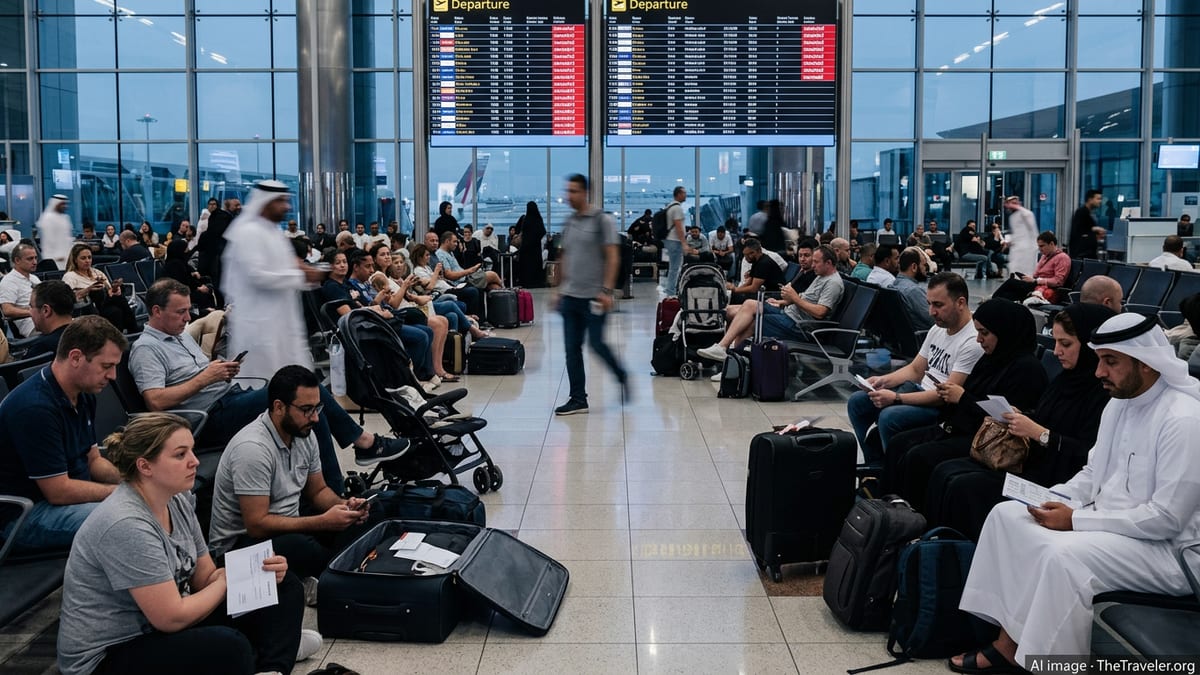
For travelers, the result has been confusion and long waits. Many passengers report learning of cancellations only after arriving at the airport, as airlines rush to keep pace with fast-changing airspace notices. Terminal departure boards at key hubs flicker with red lines of canceled flights, while rebooking desks are drawing long queues of frustrated travelers seeking alternative routes.
Airlines stress that passenger and crew safety remains the overriding priority, pointing to international guidance that restricts civilian flights near active conflict zones. Carriers are working with aviation authorities to evaluate new routings that avoid closed or high-risk airspace, but in many cases such alternatives are not yet feasible or would add uneconomical flying time and fuel burn.
Hotels Overrun as Stranded Travelers Seek Shelter
On the ground, the shock has been felt most immediately by hotels and airport-area properties that have suddenly found themselves at or beyond capacity. In Dubai, Abu Dhabi, Doha, Manama and Kuwait City, front desks report a rush of walk-in guests holding airline vouchers or simply seeking any available room after missed connections and last-minute cancellations.
Industry executives say occupancy in many airport and business hotels jumped dramatically over the weekend and into Monday, with some properties effectively sold out. In destinations such as Dubai and Doha, where large numbers of passengers transit overnight, the sudden halt to onward flights has translated into hundreds of unplanned room nights as airlines place stranded customers and independent travelers scramble to secure accommodation.
Some hotel groups have activated crisis protocols, opening additional inventory, extending check-out times and coordinating with airline operations teams to process bulk check-ins. Staff have been redeployed from quieter city locations to airport hotels, and food and beverage outlets are reporting extended operating hours to cope with late-night arrivals of delayed passengers.
The situation is similar in Tel Aviv and Beirut, where carriers have canceled or dramatically reduced schedules in line with airspace restrictions. Local hotels near Ben Gurion Airport and Beirut–Rafic Hariri International Airport are hosting passengers waiting for clearance to depart, as well as business travelers and expatriates who have opted to remain in place rather than attempt complex rerouting via secondary airports.
Travelers Confront Uncertainty, Mounting Costs and Complex Rerouting
For individual travelers, the crisis has brought an array of logistical and financial headaches. With flights canceled at short notice and call centers overwhelmed, many passengers are relying on airline apps and airport announcements to learn whether they can travel. Some carriers are offering flexible rebooking, refunds or vouchers, but processing times are slow given the sheer number of affected customers.
Those who need to reach destinations urgently are piecing together complex detours via airports still operating outside the immediate conflict zone. Routes that might previously have involved a single connection in Dubai or Doha now require multi-stop journeys via Europe, Central Asia or North Africa, often on separate tickets and at premium last-minute fares. Travel agents describe a surge in requests for emergency itinerary changes and one-way tickets away from the region.
Travel insurance coverage varies widely, and not all policies include comprehensive protection for war-related disruption. As a result, some holidaymakers and business travelers are facing unexpected out-of-pocket costs for extra hotel nights, meals and replacement flights, even as they navigate the stress of being stranded far from home.
Families in transit have been particularly hard hit, with reports of passengers spending nights on terminal floors when nearby hotels have filled up. Airport authorities and airlines in several hubs have distributed water, snacks and basic amenities, but extended delays and uncertainty have left many travelers anxious about when they will be able to continue their journeys.
Outlook for the Region’s Aviation and Tourism Sectors
Aviation analysts warn that the disruption could have lasting repercussions for the region’s role as a global transit corridor if tensions persist. Gulf and Levant hubs have spent decades positioning themselves as efficient, safe and reliable waypoints between East and West. Prolonged airspace closures or repeated conflict-related shutdowns risk eroding that reputation, at least in the short term.
In the near term, airlines are expected to operate on heavily reduced and highly dynamic schedules, restoring flights only as and when airspace restrictions are lifted and risk assessments permit. Recovery flights to repatriate stranded travelers are likely to be prioritized once corridors reopen, while discretionary leisure capacity may take longer to return to normal.
The hotel and broader tourism sectors face a more mixed picture. While forced stopovers are temporarily boosting occupancy in some markets, forward bookings for holidays and conferences are already coming under pressure as governments update travel advisories and corporations review duty-of-care obligations for staff. Destinations that rely heavily on long-haul transit traffic via Gulf hubs could see softer arrivals if travelers choose routings that bypass the region entirely.
For now, aviation authorities and airlines in the UAE, Saudi Arabia, Bahrain, Kuwait, Lebanon, Israel and beyond are urging passengers with imminent travel plans to monitor official channels closely and to avoid heading to the airport without confirmed rebooking. With the situation evolving by the hour, both the skies and hotel lobbies of the Middle East are likely to remain crowded, but uncertain, for days to come.