

More news on this day
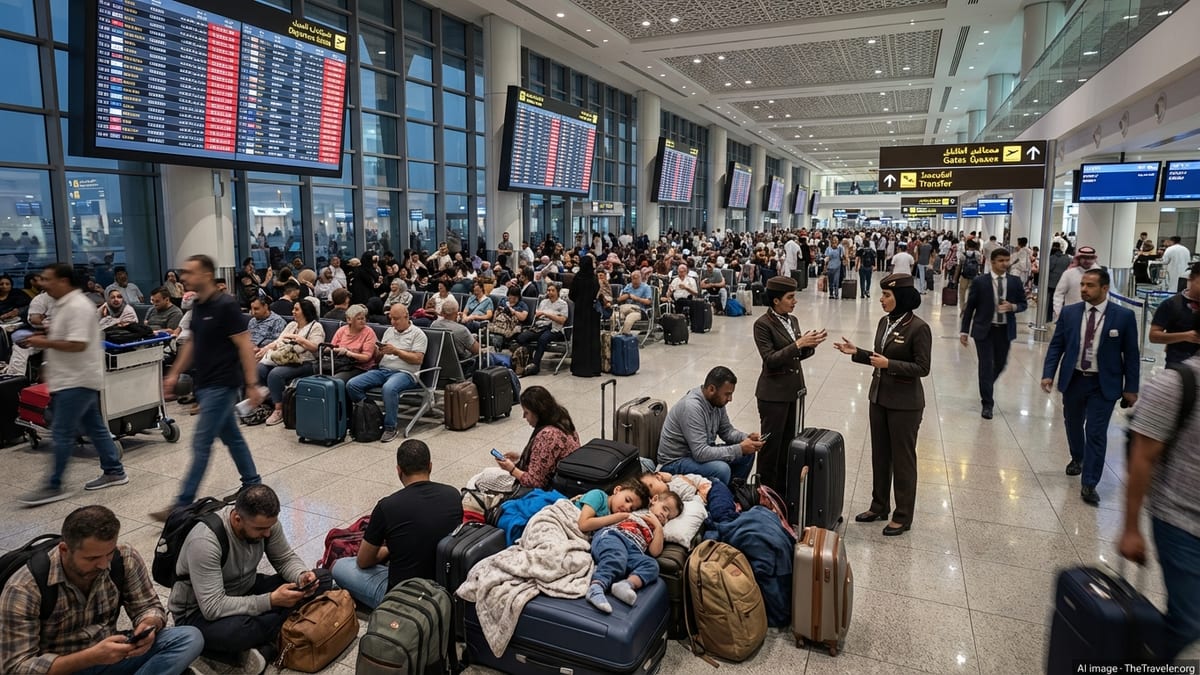
Thousands of air travellers have been left stranded across the Middle East as regional and international airlines suspend or delay hundreds of flights in response to airspace closures, security fears and infrastructure damage affecting key hubs in Bahrain, Saudi Arabia, the United Arab Emirates, Egypt, Qatar and neighboring states.
Get the latest news straight to your inbox!
Conflict-Linked Airspace Closures Ripple Across the Region
Published coverage of the ongoing Iran war indicates that widespread airspace closures across the Gulf have severely disrupted normal aviation patterns. Bahrain, Qatar, Kuwait and the United Arab Emirates, along with several neighboring states, have imposed sweeping restrictions on civilian air traffic following waves of missile and drone strikes targeting regional infrastructure. As air navigation capacity has been curtailed, airlines have been forced to ground or reroute services, with cancellations now running into the hundreds each day across the wider Middle East.
Analyses of the conflict’s economic impact describe a sharp downturn in aviation and tourism as airlines avoid conflict-affected skies and major hubs operate under emergency conditions. Dubai, Abu Dhabi and Doha, which usually function as high-volume connectors between Europe, Asia, Africa and the Americas, have been particularly hard hit. With these gateways constrained or closed for routine commercial traffic at various points in March, carriers have cancelled or delayed flights in large numbers and shifted long-haul routes north or south of the Gulf, adding time and cost for passengers and airlines alike.
According to publicly available assessments, Middle Eastern airports collectively account for a significant share of global air traffic, meaning that any regional shutdown has immediate consequences far beyond the Gulf. The current closures and restrictions have therefore led to knock-on disruptions as far away as Europe, South Asia and Australasia, with inbound and outbound journeys either suspended or operating on irregular, ad hoc schedules.
Industry advisories circulated to corporate travel clients in early March note that airlines are continually reevaluating their operations as the security picture evolves. Schedules that appear valid days in advance have in many cases been withdrawn at short notice, contributing to the growing number of stranded passengers and complicating efforts to estimate the full scale of the disruption.
Major Carriers Halt or Scale Back Operations
Regional flag carriers and low-cost airlines have responded to the crisis with a mix of full suspensions and sharply reduced timetables. Public travel bulletins and airline notices show that Gulf Air, Saudia, EgyptAir, Pegasus Airlines and Flydubai have all faced extensive operational constraints in recent weeks, with dozens of flights scrubbed on key routes each day. When combined with additional cuts by other regional and international carriers, observers estimate that well over 200 scheduled flights have been cancelled in a matter of days, alongside hundreds more delays.
In the United Arab Emirates, operational updates posted by carriers and discussed widely by travellers point to prolonged interruptions at Dubai International Airport and Abu Dhabi International Airport. Emirates and Flydubai initially suspended most services, before gradually restoring a limited number of flights under strict routing and timing controls. Even as some departures have resumed, passengers report repeated last-minute cancellations and rolling delays as airlines adjust to changing airspace permissions and slot availability.
In Saudi Arabia, advisories referencing King Khalid International Airport in Riyadh and other major airports describe an environment of “limited flights” with continuing delays and cancellations. Saudia has trimmed its regional and international schedules, while foreign carriers serving Jeddah and Riyadh have rerouted or paused operations in response to the same security concerns affecting the wider Gulf corridor.
EgyptAir has also been drawn into the turbulence as Cairo’s role as a connector between Africa, the Middle East and Europe comes under strain. Although Egypt has not imposed the same breadth of airspace closures as Gulf states, instability across eastern Mediterranean and Gulf routes has forced adjustments to timetables, particularly for services transiting toward Qatar, the UAE and Bahrain.
Passengers Stranded in Bahrain, UAE, Qatar and Beyond
The cumulative impact of these measures has been acutely felt by passengers stranded at major hubs and secondary airports across the region. Reports shared by travellers and highlighted in online forums describe overnight queues in Dubai, Abu Dhabi and Doha as passengers wait for scarce rebooking options. With entire waves of flights cancelled or heavily delayed, some travellers have remained in terminals or nearby hotels for days while airlines work through backlogs of disrupted itineraries.
Bahrain, home base of Gulf Air, has seen particular pressure on transfer passengers who would normally connect onward to South Asia, East Africa or Europe. When Gulf Air and partner airlines cancel or reschedule services at short notice, travellers often find that alternative routes are either sold out or subject to the same uncertainties, multiplying the number of people left in limbo.
In Qatar, closures and partial reopenings of air navigation, including restrictions around Hamad International Airport, have had a similar effect. Public reports indicate that standard commercial traffic was at times suspended entirely, with limited capacity preserved mainly for evacuation or emergency movements. Passengers with tickets on Qatar-linked routes have therefore faced cascading cancellations, even if their journeys originated far from the Gulf.
Knock-on effects are also visible in Egypt, Turkey and across the wider Eastern Mediterranean. Pegasus Airlines and other regional carriers that rely on east–west transit traffic have been forced to reroute or pause services linking Europe to the Gulf and South Asia. As many of these itineraries rely on tight connections, even modest schedule changes have left passengers stranded mid-journey in Istanbul, Cairo or other hub cities.
Long Delays, Limited Rebooking Options and Mounting Costs
Alongside outright cancellations, travellers are facing prolonged delays, in some cases exceeding 24 hours. Accounts shared by passengers reference being held in transit zones while waiting for clearance on revised routes or replacement flights that ultimately did not operate, compounding frustration and uncertainty. With airport hotels quickly filling and airline-provided accommodation stretched thin, many travellers have resorted to arranging their own lodging at personal expense.
Rebooking has also become a significant challenge. Publicly available guidance from airlines and travel management companies emphasizes that customers should not travel to the airport without written confirmation that their flight will operate, yet in practice many passengers report receiving cancellation notifications only after they have already checked in or arrived at departure halls. Call centres and online chat channels remain heavily congested, and some travellers describe waiting hours or days to secure alternative seats.
Where rebooking is possible, itineraries are often substantially longer and more complex than the original journeys, sometimes involving detours via northern routes that avoid conflict-affected airspace altogether. These changes not only extend travel times but may also introduce visa or transit requirements that passengers did not initially anticipate, further complicating their travel plans.
Consumer advocates observing the situation note that policies on refunds, vouchers and duty-of-care support vary widely between airlines. Some carriers have offered fee-free date changes and full refunds, while others have limited compensation to travel credits or have required passengers to initiate claims after the disruption, adding an administrative burden to an already stressful experience.
Uncertain Timeline for Recovery
With the regional security situation still fluid as of late March, aviation analysts caution that a full restoration of normal flight schedules across the Middle East is unlikely in the immediate term. The pace of recovery will depend on both the trajectory of the conflict and the speed at which damaged infrastructure and airspace management systems can be verified as safe for regular commercial use.
Public commentary from industry specialists suggests that even once broad airspace restrictions are lifted, airlines may take a cautious approach to ramping up operations. Carriers are expected to phase back capacity gradually, monitoring demand, insurance conditions and risk assessments before restoring pre-crisis frequencies on key routes through Bahrain, Saudi Arabia, the UAE, Egypt and Qatar.
In the meantime, travel advisories issued by government agencies and corporate travel managers continue to recommend that passengers avoid non-essential trips through the most affected hubs. Where travel cannot be postponed, travellers are urged to build in additional time, maintain flexible itineraries and monitor airline communications closely for last-minute schedule changes.
As thousands remain stranded or in transit limbo, the episode is reinforcing how central Gulf and neighboring hubs have become to global mobility. The suspension of 246 flights and hundreds more delays across multiple carriers in a short span underscores the vulnerability of international aviation networks to regional shocks, and the far-reaching consequences for travellers whose journeys happen to intersect with a rapidly evolving crisis.