

More news on this day
Thousands of passengers were stranded across the Middle East and at major global hubs on Tuesday as at least 1,802 flights were cancelled and 397 delayed worldwide, after escalating conflict involving the United States, Israel and Iran triggered sweeping airspace closures and forced airlines to rip up schedules overnight.
Airspace Closures Ripple From Gulf Hubs to Global Gateways
The disruption began after US and Israeli strikes on Iran on February 28 prompted Iran, Israel, Iraq, Kuwait, Qatar, Bahrain, Syria and the United Arab Emirates to close or severely restrict their airspace to civilian traffic. What started as a regional safety measure has rapidly morphed into the most severe shock to international aviation since the height of the Covid pandemic, with east–west corridors effectively severed.
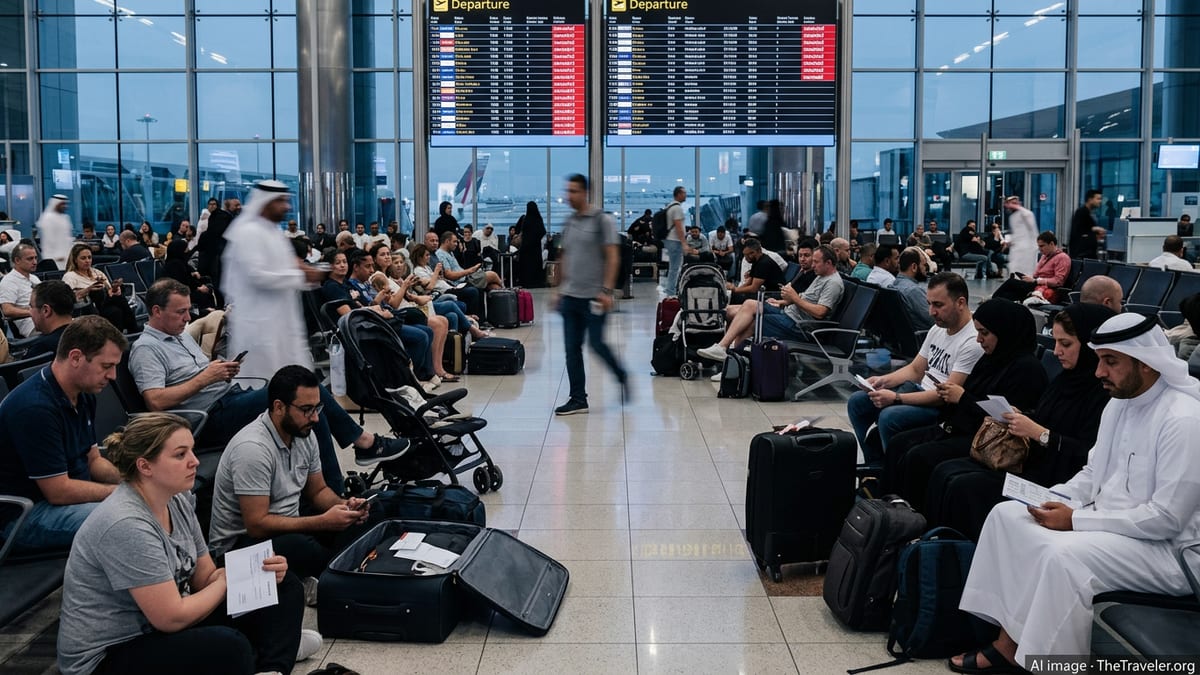
Key Gulf hubs that normally funnel millions of passengers each week have been hit particularly hard. Dubai International, Abu Dhabi’s Zayed International and Doha’s Hamad International have all seen the bulk of their scheduled operations suspended in recent days, leaving departure boards dominated by cancellations and anxious travelers camped out on terminal floors. Smaller regional airports from Sharjah and Ras Al Khaimah to Riyadh and Kuwait City are reporting similar scenes.
The effects are radiating far beyond the region. With Middle Eastern airspace largely closed and Russian skies already off limits to many Western carriers, long haul services between Europe, Asia and North America are being rerouted through narrow corridors over the Caucasus and parts of North Africa. Aviation analysts warn that the combination of longer flight times, higher fuel burn and complex crew logistics will keep delays elevated even after airspace gradually reopens.
“We are now seeing systemic disruption rather than isolated cancellations,” one senior network planner at a European carrier said. “When aircraft and crews are in the wrong place, it can take days before the operation stabilizes again, even if restrictions ease.”
Global Airlines Slash Routes as Safety Concerns Mount
Major airlines have moved quickly to prioritize safety, cancelling services and avoiding conflict zones. Emirates, Saudia and Etihad have curtailed large parts of their regional and long haul networks, pausing most operations to and from their home hubs while operating a limited number of special flights to repatriate stranded travelers and move essential cargo.
European carriers are taking similarly drastic measures. British Airways has halted flights to Tel Aviv and several Gulf destinations and warned customers of rolling cancellations across its Middle East schedule. KLM has suspended services to Dubai, Riyadh and Dammam through at least March 5, while sister airline Air France has cancelled flights to Dubai and Riyadh on multiple days as it steers clear of the most congested airspace.
Swiss and other Lufthansa Group airlines have suspended flights to Dubai and a string of cities including Tel Aviv, Beirut and Amman into next week, joining a roster of European and Asian carriers that now stretches from Turkish Airlines and Finnair to Wizz Air and Garuda Indonesia. Schedules that remain are often subject to last minute rerouting, with detours adding hours to journeys and forcing unscheduled refuelling stops.
North American carriers have also pulled back. United Airlines and Delta Air Lines have cancelled services to Tel Aviv and curtailed flights that would normally traverse the Gulf region, while Air Canada has suspended flights to Dubai and Tel Aviv into late March on safety grounds. American Airlines has temporarily halted at least one key Doha service, underscoring how even carriers without large Middle East networks are being drawn into the turmoil.
Airports From Dubai to Chicago Strain Under the Pressure
Inside terminals, the disruption is most visible in the human crush. At Dubai International on Monday and Tuesday, long queues snaked around airline service desks as families, business travelers and transit passengers sought answers that frontline staff often could not yet provide. Many reported sleeping in chairs or on terminal floors as hotel availability dried up near the airport.
Similar scenes have unfolded in Riyadh and other Saudi gateways, where Saudia and international partners have cancelled waves of flights to destinations across the Gulf, Europe and Asia. In Beirut and Kuwait City, passengers crowded around information screens showing back to back cancellations, a tableau replicated across many of the region’s airports.
The chaos has spilled into Europe and North America as well. In Munich and Paris, dozens of departures and arrivals tied to the Middle East have been scrubbed, forcing misconnected passengers onto already full transatlantic and intra European services. At major US hubs including Dallas Fort Worth and Chicago O’Hare, knock on effects from aircraft and crew imbalances have led to additional delays and cancellations on routes far removed from the conflict zone.
Airports and ground handlers say they are struggling to cope with the mix of stranded transfer passengers, returning residents and vacationers whose trips have been cut short. With call centers saturated, many travelers are turning up at airports unannounced, hoping for space on any outbound flight, which in turn is increasing crowding and tension in departure halls.
Stranded Travelers Face Uncertain Timelines and Rising Costs
For individual travelers, the crisis is being felt in missed weddings, canceled business meetings and holidays that have ended in days long waits at airports. Many passengers booked on nonrefundable tickets are discovering that rebooking options are limited or that only vouchers are being offered, even as last minute fares on alternative routes climb sharply.
Some airlines, including Emirates, British Airways and KLM, have introduced more flexible policies, allowing date changes without additional fees or offering refunds for itineraries touching the region over the coming weeks. However, capacity on alternative routings is thin, and in many cases there is simply no viable path between certain city pairs without traversing closed airspace.
Travel insurers are now fielding a surge in claims related to missed connections and extended hotel stays, but coverage terms vary widely. Policies that exclude war and civil unrest may not reimburse all expenses, leaving some travelers facing significant out of pocket costs. Travel agents report that clients are asking detailed questions about future coverage and about how quickly they can be repatriated if conditions worsen.
For now, authorities and industry groups are urging calm and patience. Passengers are being advised to monitor airline apps and official notifications closely, avoid heading to airports until they have confirmed rebookings, and prepare for the possibility of multi day disruptions, even in regions far from the Middle East.
Slow, Partial Reopenings Offer Only Modest Relief
There are tentative signs of movement. On Monday and Tuesday a small number of flights began departing from the United Arab Emirates, with Emirates, Etihad and Flydubai operating limited services aimed primarily at clearing backlogs and repositioning aircraft and crews. Aviation authorities in the Gulf have described these as tightly controlled operations, subject to rapid change if the security picture deteriorates.
Analysts caution that a full scale resumption of normal schedules remains distant. Each airline must reassess routes not only for security but also for commercial viability, given longer flying times and higher fuel costs associated with detours. With nearly 2,000 flights into and out of the wider Middle East cancelled in just a few days and hundreds more delayed, aircraft and crew rotations are scattered across three continents.
Network planners say that once airspace restrictions ease, carriers will likely prioritize trunk routes linking major hubs before gradually restoring secondary destinations. That could mean extended disruptions for smaller markets in South Asia, Africa and Eastern Europe that typically rely on Gulf and Levantine hubs for their long haul connections.
Until then, the global aviation system will continue to operate in crisis mode, with airlines publishing rolling updates, regulators issuing new security guidance on an almost daily basis and passengers around the world bracing for further cancellations at short notice.