

More news on this day
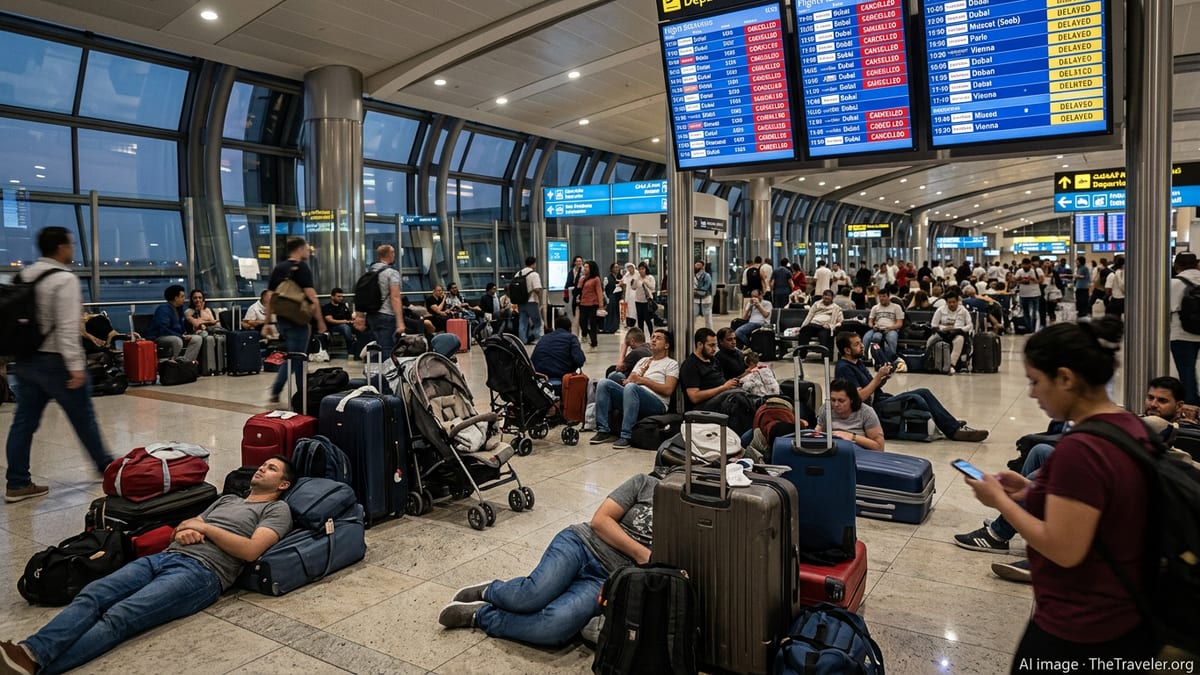
Thousands of travellers across the Middle East and beyond are facing days of disruption as nearly 300 flights are cancelled and more than 1,500 delayed, with airspace closures and security concerns forcing widespread schedule cuts in the United Arab Emirates, Qatar, Bahrain, Saudi Arabia, Turkey and neighbouring states.
Get the latest news straight to your inbox!
Airspace Closures Ripple Across Regional Hubs
Publicly available flight-tracking data and aviation analytics indicate that conflict-related airspace restrictions are continuing to severely disrupt commercial aviation across the Gulf and wider Middle East. While large-scale shutdowns began in late February, the latest figures point to 293 cancellations and 1,504 delays over a 24-hour period affecting airlines that rely heavily on hubs such as Dubai, Doha, Jeddah, Riyadh, Manama, Cairo and Istanbul.
Countries including the United Arab Emirates, Qatar, Bahrain and Saudi Arabia have introduced partial or temporary airspace closures at various points in recent weeks in response to regional security threats. These measures have reduced available routes, forced aircraft onto longer detours and, in many cases, halted scheduled passenger services altogether on key corridors connecting Europe, Asia, Africa and Oceania.
In parallel, Turkey’s extensive network centered on Istanbul has experienced rolling delays and schedule reshuffles as carriers adjust routings around closed or risk-designated airspace. While Turkish airports remain operational, the knock-on effect of diversions, crew duty-time limits and aircraft being out of position has contributed to the rising tally of delayed departures and arrivals.
Industry observers note that the Middle East’s role as a global transit crossroads magnifies the consequences of each cancellation. A single suspended flight at a hub such as Dubai or Doha can strand hundreds of connecting passengers, triggering missed onward journeys to destinations in Europe, North America, South Asia and Australasia.
Major Carriers Slash Schedules and Reroute
Flag carriers and Gulf super-connectors have responded with sweeping schedule changes. Information published by airlines and airport operators shows that Emirates, Saudia, Gulf Air and other regional players have cancelled or curtailed services on multiple routes, particularly those transiting closed segments of airspace or flying near recent conflict zones.
Emirates has focused on limited operations from Dubai, concentrating resources on a reduced list of destinations while operating special repatriation flights to cities including Jeddah, Cairo and Istanbul. Publicly shared flight lists for early March show the carrier running select rotations for stranded travellers rather than its usual high-frequency global network.
Saudi Arabia’s Saudia has shortened or suspended several regional links, especially to Bahrain, Qatar and the United Arab Emirates, according to airline notices and port circulars. Gulf Air, based in Bahrain, has also been affected, as periodic restrictions on Bahrain’s airspace complicate both inbound and outbound movements and constrain the carrier’s ability to feed traffic through Manama.
Qatar Airways has faced some of the most acute disruption due to the closure and phased reopening of Qatari airspace. Publicly available statements and traveller reports indicate that standard commercial operations in and out of Doha have been repeatedly halted, with the airline intermittently operating relief and evacuation-style services while postponing most regular passenger flights.
Passengers Stranded in Jeddah, Cairo, Istanbul and Doha
Social media posts, aviation forums and regional media coverage depict crowded terminals and long queues at major airports as travellers scramble for alternatives. Jeddah’s King Abdulaziz International Airport, a key gateway for religious travel, has seen waves of disrupted passengers rebooked on limited services operated by Emirates, Saudia and Turkish Airlines as routing options narrow.
In Cairo, Egypt’s capital and Africa’s second-busiest aviation hub, network disruptions have intensified as Egypt-based carriers trim flights to Gulf destinations affected by airspace issues. Published updates indicate that services from Cairo to Dubai, Abu Dhabi, Sharjah and Doha have been among those suspended or heavily reduced, forcing travellers to seek indirect routings via still-open airports.
Istanbul, one of the world’s busiest transfer points, has become both a lifeline and a bottleneck. With many routes to the Gulf curtailed, Istanbul has absorbed diverted flights from carriers such as Emirates and Qatar Airways while Turkish Airlines manages its own complex rescheduling. The result has been delays cascading through the system as aircraft and crews struggle to return to normal rotations.
Doha’s Hamad International Airport has experienced some of the most visible fallout. After the closure of Qatari airspace in late February and early March, publicly available reports describe aircraft turning back mid-flight, extended terminal stays and hotel evacuations, followed by intermittent reopening under emergency conditions that prioritize evacuation and cargo movements over standard commercial journeys.
Knock-on Effects for Global Travel Networks
The disruption is no longer limited to passengers whose itineraries originate or end in the Middle East. Because many long-haul journeys from Europe, North America, Asia and Australasia depend on one-stop connections through Dubai, Doha, Abu Dhabi, Jeddah and Istanbul, airspace closures and cancellations are reverberating across global travel networks.
Data aggregated by aviation analytics firms and reported in international media suggest that, at the height of recent closures, thousands of flights per day touching the region were being cancelled or rerouted. Even as some airspace has partially reopened, the backlog of displaced travellers and the continuing risk of additional closures mean that delays and schedule changes remain common.
Carriers outside the region are reshaping schedules in response. European and Asian airlines have increased nonstop services on some routes to avoid transiting the Gulf, while others have lengthened flight times to detour around restricted zones. This has added operational costs and complexity, with knock-on effects for pricing, crew planning and aircraft utilization.
Travel agents and online booking platforms report that demand has shifted toward routings via alternative hubs in Europe, Central Asia and North Africa where available. However, capacity on these routes is limited and fares have risen sharply during peak disruption windows, leaving many travellers with few affordable options in the near term.
Uncertain Outlook Keeps Travellers on Edge
With regional tensions still elevated, the outlook for a swift normalization of flight operations remains unclear. Official aviation notices and risk assessments continue to warn of potential changes to airspace availability at short notice, reinforcing the possibility of further cancellations and rolling delays in the days ahead.
Airlines are advising passengers through public channels to monitor flight status closely, arrive early at airports that remain operational and remain flexible about routing and timing. In many cases, carriers are offering fee-free rebooking or travel vouchers, but seat availability on alternative services is increasingly constrained on popular routes.
For now, the combination of 293 cancellations, more than 1,500 delays and a volatile security environment has left thousands of passengers from leisure tourists to business travellers in limbo. Until airspace restrictions ease more consistently and major carriers can restore predictable schedules, the Middle East’s role as a reliable global aviation hub will remain under significant strain.