

More news on this day
Thousands of travelers remain stranded across Egypt and the United Arab Emirates as fresh figures reveal more than 90 flights canceled and over 100 delayed at Cairo and Dubai’s main international airports, disrupting services on major carriers including Qatar Airways, Emirates, Saudia, FlyDubai and Royal Jordanian and cutting off vital links to Jeddah, Doha, Riyadh and other regional hubs.
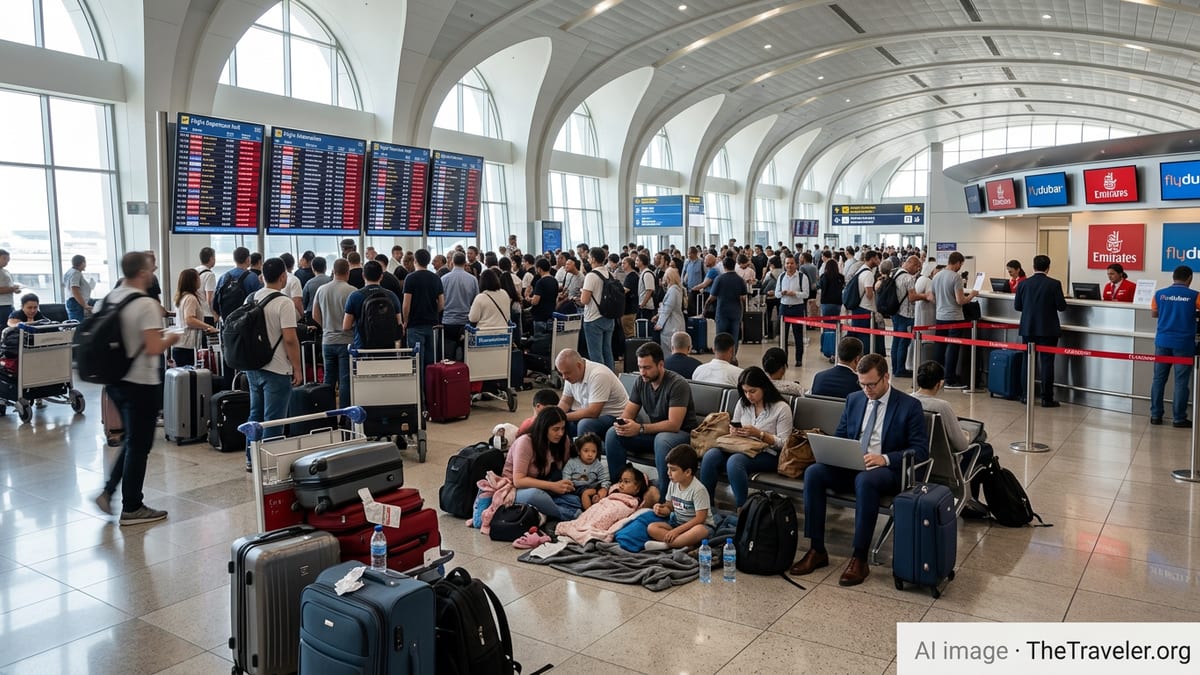
Conflict-Linked Airspace Closures Ripple Through Regional Hubs
The latest wave of disruption follows days of rolling airspace closures and tight operating restrictions across the Gulf and eastern Mediterranean, triggered by the escalating conflict involving Iran, Israel and the United States. Authorities in the UAE and Qatar have imposed strict safety corridors and capacity caps, forcing airlines to sharply trim schedules and cancel entire rotations through Dubai and Doha, two of the world’s most important transit hubs.
Industry data compiled by aviation analytics firms and regional media indicate that Cairo International Airport and Dubai International Airport together saw 92 flights canceled and 111 delayed over a recent 24 hour period as carriers struggled to navigate shifting airspace permissions and security assessments. Those figures sit atop a much larger wave of disruption across the wider Middle East in the past week, with more than a thousand flights canceled and hundreds more delayed at major airports from Riyadh and Kuwait City to Istanbul’s Sabiha Gökçen.
Because Dubai and Doha normally handle tens of thousands of long haul transit passengers daily, even partial shutdowns have a disproportionate effect. Airlines have been forced to reroute via secondary hubs where possible, adding hours to journeys, while many services from Europe and Asia into the region have been cut outright when safe routings could not be secured.
In Egypt, the airspace itself remains open, but EgyptAir and other carriers have been compelled to suspend or cut back services to multiple Gulf cities, turning Cairo into both a pressure valve and a bottleneck as diverted flights arrive and onward connections evaporate. Passengers bound for Jeddah, Riyadh, Doha and other Gulf gateways have found themselves effectively marooned in Cairo with no clear timeline for rebooking.
Major Carriers Slash Schedules and Prioritize Repatriation
Emirates, Qatar Airways, Saudia, FlyDubai, Etihad and Royal Jordanian are among the carriers most directly affected, with many operating under emergency schedules focused on limited repatriation flights rather than normal commercial services. Airlines are prioritizing passengers already stranded in Dubai, Doha and Cairo, while warning that new ticket sales on affected routes are heavily restricted or temporarily paused.
Emirates has resumed only a fraction of its usual departures from Dubai after an initial total shutdown, focusing on select long haul flights and regional links that can be operated within approved corridors. Low cost affiliate FlyDubai continues to run a reduced schedule, with several services to the Gulf, North Africa and parts of Europe still canceled or heavily delayed. Qatar Airways, similarly constrained by Qatar’s restricted airspace, has shifted to a core network of evacuation-style services to key capitals in Europe and Asia, leaving many secondary destinations on hold.
Saudi flag carrier Saudia has been more resilient thanks to relatively lower cancellation rates within Saudi airspace, but connectivity remains patchy. Routes linking Riyadh and Jeddah to Cairo and Dubai, usually among the busiest in the region, have been slashed, forcing passengers to hunt for scarce seats or accept multi stop itineraries via alternative hubs such as Muscat or Jeddah when seats become available.
Royal Jordanian and other regional operators, including Kuwait Airways and Air Arabia, have also adjusted schedules repeatedly as overflight permissions change. The result for travelers is a constantly moving target: a flight that appears confirmed in the morning may be delayed for hours, rerouted through a different country or canceled entirely by late afternoon.
Scenes of Confusion at Cairo and Dubai Terminals
Inside terminals, the human impact of the disruptions is stark. At Dubai International, one of the world’s busiest airports for international traffic, passengers have described terminal halls turned into makeshift waiting areas where travelers sleep on the floor between rows of seats, relying on airport food courts and pop up assistance desks for essentials while they wait for new flight assignments.
Announcements about cancellations and gate changes have often lagged behind real time developments, according to stranded passengers. Many report learning about canceled flights first through airline apps or flight tracking services before overhead screens or loudspeaker systems are updated, creating long queues at customer service counters and confusion over rebooking priorities.
At Cairo International Airport, scenes are only marginally calmer. Egypt’s open airspace has made Cairo a diversion point for some long haul services unable to reach Gulf hubs, but the sudden influx of transit passengers has strained both terminal capacity and airline operations. EgyptAir’s control center has shifted to what officials describe as emergency mode to manage suspensions on multiple regional routes, from Dubai and Abu Dhabi to Doha, Amman and several Gulf cities.
Travelers interviewed by local media at Cairo report spending 24 hours or more in the terminal while waiting lists for the few remaining flights to Jeddah, Riyadh and Doha grow longer by the hour. Temporary accommodation vouchers and meal coupons are being issued in some cases, but hotel availability near the airport is tightening as delays spill into multiple days.
Key Routes to Jeddah, Doha and Riyadh Severely Disrupted
The most heavily affected routes are those connecting Cairo and Dubai to Jeddah, Doha and Riyadh, which typically carry a high volume of both religious pilgrims and labor migrants, as well as business and leisure travelers. Partial closures of Gulf airspace have severed many of these direct corridors, forcing airlines either to cancel services outright or to attempt complex detours that significantly increase flying time and fuel costs.
Flights between Cairo and Doha have seen some of the highest cancellation and delay rates as Qatar Airways adjusts operations at Hamad International Airport and navigates constrained access to neighboring airspace. Services linking Dubai with Jeddah and Riyadh, normally among the strongest performers in the Emirates and FlyDubai networks, have likewise been cut back to a skeleton schedule, with priority given to repatriating citizens and residents.
Religious travel has been particularly hard hit. With Jeddah and Madinah serving as gateways for pilgrims heading to the holy cities, travel agencies in Egypt, Jordan and the wider region are scrambling to reroute groups whose itineraries have been upended. Some have arranged last minute routings via alternative Saudi airports or overland segments, but availability remains limited and costs are rising quickly.
Beyond the Gulf, knock on effects are being felt on long haul sectors that usually feed these hubs. European and Asian carriers that rely on code share agreements with Emirates, Qatar Airways or Saudia are being forced to reaccommodate passengers on entirely different routings, often via Istanbul, Athens or Muscat, where airspace and hub capacity remain comparatively more stable.
What Stranded Travelers Can Expect in the Coming Days
Aviation authorities and airline executives caution that the situation across Middle Eastern airspace remains highly fluid, with operational decisions tied closely to evolving military and diplomatic developments. While some carriers are gradually restoring a limited number of flights each day, schedules remain subject to last minute changes, and the backlog of stranded passengers is likely to persist through the coming week.
Industry analysts say that even if conflict related risks ease, rebuilding full hub operations at Dubai, Doha and Cairo will take time. Aircraft and crews are scattered across multiple continents, maintenance checks have been disrupted, and many wide body jets are out of position after days of diversions and emergency rotations. Airlines will have to carefully sequence aircraft and crew returns while keeping within crew duty time rules and safety margins.
For travelers still stuck in terminals, the most consistent advice from airports and airlines is to avoid heading to the airport without a confirmed, operating flight, and to remain in close contact with carriers through official apps, call centers and email alerts. Where local regulations permit, passengers on canceled flights should be entitled to refunds or free rebooking at a later date, though processing times may be lengthy given the scale of the disruption.
In the meantime, tourism boards and hotel operators in both Egypt and the UAE are attempting to cushion the blow, working with airlines to secure emergency accommodation and discounts for those unexpectedly stranded. But with cancellations and delays continuing to mount across the region, thousands of travelers heading through Cairo and Dubai face the prospect of extended, uncertain journeys before they can finally reach Jeddah, Doha, Riyadh and destinations beyond.