

More news on this day
Thousands of passengers were left stranded across the Middle East and at major international hubs on Sunday as at least 1,123 flights were canceled and 352 delayed, with widespread disruption hitting routes operated by Qatar Airways, Emirates, Etihad, Saudia, British Airways, KLM, Ryanair, United Airlines and other carriers.
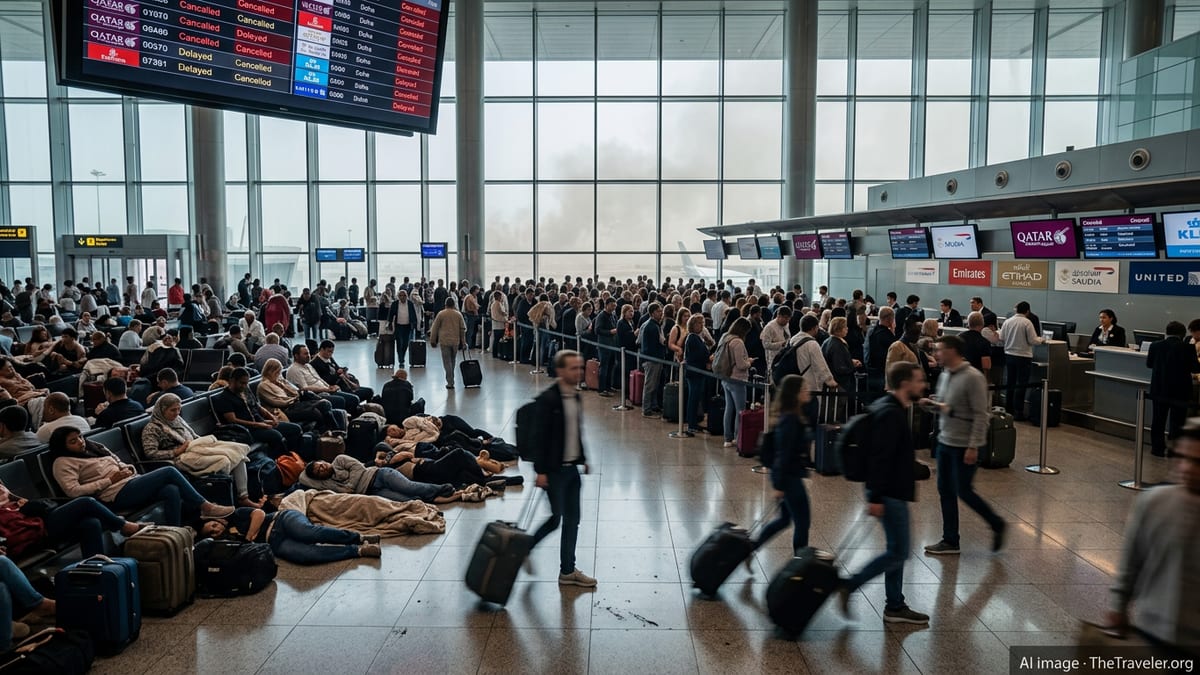
War-Linked Airspace Closures Push Global Networks to Breaking Point
The latest wave of disruption is the most visible sign yet of how the ongoing war involving Iran, the United States and Israel has spilled into global aviation, forcing airlines to reroute or cancel services across a vast swath of airspace from the Gulf to the eastern Mediterranean. Authorities in Iran, Iraq, Kuwait, Qatar, Bahrain and parts of the United Arab Emirates and Saudi Arabia have either fully or partially closed their skies in recent days, choking off some of the world’s busiest long-haul corridors.
Gulf mega-hubs such as Dubai, Abu Dhabi and Doha, normally among the most reliable springboards between Europe, Asia, Africa and the Americas, have seen schedules torn up. Carriers including Emirates, Etihad and Qatar Airways moved early to suspend regular operations, while mounting missile and drone threats around key airports have kept air traffic controllers on high alert and left airlines cautious about resuming normal service.
As the conflict widened through late February and early March, analysts estimate that more than half of all scheduled Middle East flights on some days have been canceled, with ripple effects reaching as far as London, Paris, Zurich, Miami and Dallas. Even airlines based far from the region, such as KLM, Ryanair, British Airways and United, have been forced to scrub or reroute services that rely on safe, predictable overflight corridors through the Gulf and surrounding states.
By Sunday, operations in parts of the United Arab Emirates and Saudi Arabia had begun a tentative recovery, but continuing restrictions around Qatar and neighboring states ensured that large numbers of aircraft and crew remained out of position, leaving networks vulnerable to further cascading delays.
Passengers Stranded in Hubs From Dubai and Doha to London and Paris
The sudden disappearance of flights stranded travelers in airport lounges and transit hotels across the region and beyond. In Doha, where Qatar Airways has largely halted scheduled passenger services while operating only a small number of repatriation flights, connecting passengers have reported being stuck for days as onward segments to Europe and North America repeatedly disappear from departure boards.
At Dubai International Airport, where Emirates has begun restoring a limited schedule after suspending regular services earlier in the week, long queues formed at rebooking desks as travelers tried to secure seats on the handful of departures still operating to Europe, Africa and Asia. Similar scenes have been reported at Abu Dhabi, Riyadh and Jeddah, where Saudia and Etihad have cautiously resumed selected routes while warning that last minute changes remain likely.
The disruption is not confined to the Middle East. In London, Paris, Istanbul, Zurich and other major European gateways, passengers heading to or transiting through the Gulf have faced abrupt cancellations as British Airways, KLM and other European carriers suspend flights to Dubai, Doha and Riyadh. In some cases, travelers found themselves stuck far from the conflict zone after their return connections via Middle Eastern hubs vanished, forcing airlines to arrange hotel accommodation and alternative routings where possible.
Transatlantic and transpacific networks have also come under strain. United Airlines and other U.S. carriers have adjusted schedules to and from key European and Gulf destinations, leading to disruption at American hubs including Miami and Dallas. For some passengers, that has meant being stranded at the starting point of their journey, while others have been left mid-journey in third countries as multi-leg itineraries unravel.
Relief Flights and Partial Recoveries Offer Only Limited Respite
In recent days, a patchwork of relief flights and partial resumptions has begun to emerge, but these measures have done little to ease the overall turmoil. Emirates and Etihad are operating limited outbound services from the United Arab Emirates, while Qatar Airways has focused on a narrow set of repatriation flights from Doha to major European capitals under temporary safety corridors agreed with regulators.
Regional carriers such as Saudia, flydubai, Oman Air and Air Arabia have announced highly restricted schedules, with many flights still suspended, particularly on routes that require overflying contested airspace. Some South and East Asian airlines have rerouted services around the Gulf altogether, adding hours to flight times and forcing them to cut frequencies or cancel marginal routes because of higher fuel costs and crew duty constraints.
For stranded travelers, the limited resumption has often translated into a scramble for scarce seats. Airlines have encouraged customers to rebook online or through call centers rather than at airports, but high call volumes and slow response times have left many frustrated. Travel agents in Europe, Asia and North America describe working through the night to reconfigure itineraries, frequently having to route passengers through secondary hubs in southern Europe, North Africa or Central Asia.
Even where passengers secure a replacement flight, the journey can be complex. With many Middle Eastern airports facing congestion, aircraft and crew shortages, and sudden security alerts, departure times are fluid and minimum connection windows unreliable. Aviation officials warn that until airspace restrictions are eased more broadly, travelers should expect irregular operations and be prepared for further last minute changes.
Financial Fallout for Airlines and Uncertain Rights for Travelers
The disruption is already translating into significant financial strain for airlines in and beyond the region. Long-haul carriers built around Gulf hubs have lost revenue from thousands of canceled flights at the same time as they face higher operating costs for rerouted services that must skirt closed airspace. European and Asian airlines, which rely on overflight rights through the Gulf to operate some of their most profitable routes, are also counting the cost of diversions, extended flight times and repositioning crews and aircraft.
Analysts say the situation will test the resilience of airline balance sheets coming just as parts of the industry were recovering from previous downturns. While some major players have reserves and state backing, smaller regional carriers and independent low cost airlines face tougher choices if the instability continues and demand for travel through the Middle East remains suppressed.
For passengers, the commercial and regulatory landscape is complex. In many jurisdictions, airlines are not required to pay cash compensation when cancellations are directly linked to war or government airspace closures that they cannot control. Travelers are generally entitled to refunds for unused tickets or to be rebooked when possible, but hotel stays, meals and incidental expenses often fall into a grey area, particularly for those stranded in third countries outside the reach of their home regulations.
Travel insurers are also scrutinizing claims. Policies that exclude war or acts of aggression may not cover all costs, leaving some travelers reliant on the goodwill of airlines or credit card protections. Consumer advocates are urging passengers to keep meticulous records of cancellations, receipts and communications with airlines in case disputes arise later.
What Travelers Should Do Now
Travel and safety agencies across North America and Europe continue to advise against nonessential travel through much of the region while hostilities and airspace closures persist. Governments have urged citizens already in affected countries to leave as soon as commercially feasible, warning that options could narrow rapidly if the conflict escalates or new restrictions are imposed.
Airlines and airports in Dubai, Doha and other hubs have stressed that passengers should not travel to the airport until they have verified that their flight is operating and their booking is confirmed. With schedules shifting hour by hour, even previously rebooked tickets can change at short notice, and check in counters are struggling to cope with large numbers of hopeful standby travelers.
Industry experts recommend that passengers monitor their bookings directly through airline apps and sign up for real time alerts, rather than relying solely on printed itineraries or third party confirmation emails. Those with flexibility are being encouraged to consider alternative routings that avoid the Gulf, even if that means longer journeys or overnight stops in Europe, North Africa or South Asia.
For now, the timeline for a full restoration of normal flight operations across the Middle East remains uncertain. While some carriers hope to return to near normal schedules in the coming days if security conditions allow, aviation authorities caution that any further escalation in the conflict could prompt new closures and another spike in cancellations, prolonging the ordeal for travelers already caught in an unprecedented web of global flight disruption.