

More news on this day
Thousands of passengers were stranded across the Middle East and on key global routes on March 11 and 12 as airspace closures and security restrictions prompted airlines and aviation authorities in Saudi Arabia, the United Arab Emirates, Qatar, Bahrain, Kuwait, Israel and other states to cancel more than 700 flights and delay nearly 300, snarling operations for carriers including Gulf Air, Royal Jordanian, Etihad Airways, Air France and KLM and disrupting connections as far afield as Dubai, Doha, Athens, Istanbul, Amsterdam and Miami.
Get the latest news straight to your inbox!
Airspace Closures Ripple Across Gulf Hubs
The latest wave of disruption follows a rapid escalation of conflict around Iran that has led to rolling airspace closures and severe restrictions over parts of the Gulf, Iraq and Israel. Authorities in the UAE, Qatar, Saudi Arabia, Bahrain and Kuwait have imposed varying levels of restrictions, forcing airlines to reroute or cancel services that normally rely on some of the world’s busiest transit corridors.
Dubai International and Abu Dhabi’s Zayed International have seen the sharpest impact, with local and foreign carriers trimming schedules and prioritizing repatriation and essential services. Hamad International in Doha, Bahrain International and Kuwait International are operating with curtailed movements, while Ben Gurion in Tel Aviv has experienced repeated shutdowns and diversions as airlines reassess security risks on an hour-by-hour basis.
Airport operators have urged passengers not to travel to terminals unless they hold confirmed bookings on flights that airlines have explicitly stated are operating. Entry controls at some Gulf hubs have been tightened to prevent overcrowding, with only ticketed travelers on active flights being allowed inside departure halls.
Industry data from flight tracking and passenger rights organizations indicates that since the start of March more than 700 flights touching Middle Eastern airspace have been cancelled outright, with hundreds more experiencing long delays as crews and aircraft are repositioned or held on the ground.
Major Carriers Cancel Routes and Thin Schedules
Flag carriers and global network airlines have responded with a patchwork of suspensions, diversions and reduced schedules. In the Gulf, Etihad and Qatar Airways are running limited timetables focused on core routes and repatriation flights, while maintaining waivers that allow free rebooking or refunds on affected itineraries. Gulf Air and Royal Jordanian have cancelled or trimmed services across Saudi Arabia, Kuwait, Bahrain and Israel, straining already tight regional connectivity.
In Europe, Air France has extended the suspension of flights to Dubai and Riyadh, while maintaining selected services via altered routings that avoid affected airspace. KLM has halted Amsterdam flights to several Gulf destinations and announced that it is not flying through the skies of Iran, Iraq and Israel or over parts of the wider Gulf region, complicating links between its Amsterdam hub and cities such as Dubai and Doha.
Other international airlines, including British Airways, Lufthansa, Cathay Pacific and Singapore Airlines, have either suspended services to key Gulf hubs or reconfigured Asia–Europe routes with longer detours over Turkey, the Caucasus or the Arabian Sea. These changes have created knock-on disruption for long-haul passengers booked through Istanbul, Athens and Amsterdam, where missed connections and rolling delays are now common.
With aircraft and crews out of position, carriers have also begun cancelling what would normally be routine downstream flights, affecting passengers whose journeys do not touch the Middle East directly but rely on aircraft coming from disrupted hubs.
Stranded Passengers Face Days-Long Waits in Dubai, Doha and Beyond
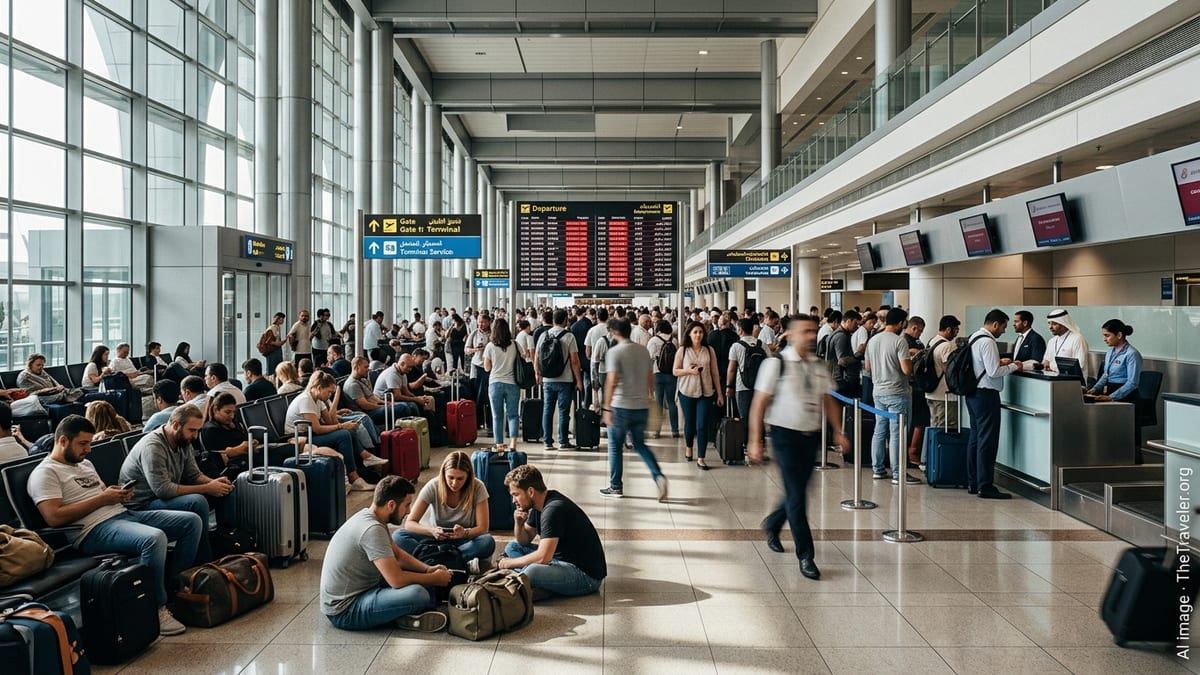
For travelers caught in the middle of the upheaval, the immediate reality is long queues, limited information and hotel rooms that are increasingly hard to find. At Dubai International, passengers reported waiting many hours to rebook as departure boards filled with red “cancelled” notices and only a handful of flights showed as operating. Similar scenes played out in Doha and Abu Dhabi, where airport authorities opened additional waiting areas and urged people to stay with their original airlines rather than attempting to rebook independently.
Transit passengers have been hit particularly hard. Many flew into Gulf hubs expecting quick onward connections to Europe, North America or Asia, only to discover that their next legs had been cancelled while they were in the air. With visa rules and entry restrictions differing by nationality, some travelers are being accommodated in nearby hotels, while others are confined to departure lounges for extended periods while airlines negotiate temporary entry permissions with local authorities.
Disruptions are not limited to the immediate region. Travelers have reported being stranded or heavily delayed in cities such as Athens, Istanbul, Amsterdam and Miami after their connecting flights through the Gulf were cancelled. In Europe, airports including Athens and Istanbul Sabiha Gökçen have seen elevated levels of cancellations and delays linked directly to the Middle East airspace shutdown, as airlines attempt to rebuild their schedules around longer routings and missing aircraft.
With demand for alternative routings far exceeding available seats, rebooking options via secondary hubs are limited. Some travelers have turned to complex itineraries involving multiple stops in Europe or Asia to skirt the restricted region, while others are choosing to wait in place for repatriation flights that airlines and foreign ministries are gradually arranging.
Knock-On Effects Reach Amsterdam, Athens, Istanbul and Miami
The shutdown of key Middle Eastern corridors has quickly reverberated through the global aviation system. Amsterdam’s Schiphol Airport, a major hub for east–west traffic, has seen cancellations and delays as Air France–KLM adjusts to the loss of direct routings through the Gulf and onward connections via Dubai and Doha. Longer flight times on rerouted Asia services are tying up aircraft for additional hours, reducing schedule flexibility and forcing last-minute cuts on some European and transatlantic sectors.
In the eastern Mediterranean, Athens and Istanbul have emerged as alternative waypoints for some carriers, but both cities are now wrestling with congestion and schedule instability. Travelers attempting to bypass the Gulf are encountering tight connections and overbooked flights, and weather-related issues or minor operational problems can quickly cascade into missed onward journeys to destinations such as Tel Aviv, Amman or Gulf capitals when those routes briefly reopen.
Across the Atlantic, the effects are subtler but still significant. Miami, a key North American gateway for both European and Middle Eastern carriers, has recorded a spike in delays and scattered cancellations as aircraft and crews arriving from Europe are impacted by longer detours or prior disruptions related to Middle East routings. Passengers connecting in Miami from Europe to Latin America and the Caribbean are experiencing schedule changes that trace back to disrupted flights over the Gulf region days earlier.
Aviation analysts note that the Middle East functions as a critical junction between Europe, Asia and Africa, and that extended closures in the region inevitably radiate outward, affecting schedules and aircraft availability across multiple continents even when airports remain open at the final destinations.
What Airlines and Governments Are Doing for Affected Travelers
Airlines and governments are now moving into a prolonged disruption management phase, combining limited commercial services with organized repatriation flights. Gulf carriers including Etihad and Qatar Airways are prioritizing passengers who were already ticketed and stranded when closures began, while flag carriers such as Air France and KLM are working with foreign ministries to secure overflight exemptions and coordinate special services for citizens stuck in the region.
Passenger rights differ widely depending on where a journey began and which airline is operating the flight. European Union rules offer compensation and care obligations for many cancellations and long delays on EU carriers or flights departing the bloc, though airlines are citing extraordinary circumstances linked to conflict that may limit cash payouts while still requiring them to provide rebooking or refunds. Elsewhere, policies are governed by airline conditions of carriage and national consumer protection laws, which generally provide for refunds and reasonable care but not necessarily financial compensation.
Travel experts advise affected passengers to monitor airline apps and official channels closely, avoid heading to airports without confirmed flight status, and resist cancelling bookings themselves if they hope to preserve eligibility for full refunds or free rebooking. In many cases, carriers are progressively cancelling flights in waves as airspace restrictions are extended, triggering automatic rebooking options and waivers for those on affected services.
With security conditions and airspace notices changing quickly, industry executives caution that the disruption is likely to continue for days and potentially weeks. Travelers with nonessential trips through the Gulf region are being urged to postpone or reroute where possible, while those already stranded are bracing for further uncertainty as airlines and governments work to restore a stable level of service.