

More news on this day
Thousands of travellers have been left stranded across the Middle East as escalating airspace restrictions and operational disruptions force airlines in Qatar, the United Arab Emirates, Bahrain and neighbouring states to delay 544 flights and cancel a further 635, paralysing movements through key hubs including Doha and Dubai.
Get the latest news straight to your inbox!
Major Gulf Hubs Brought to a Standstill
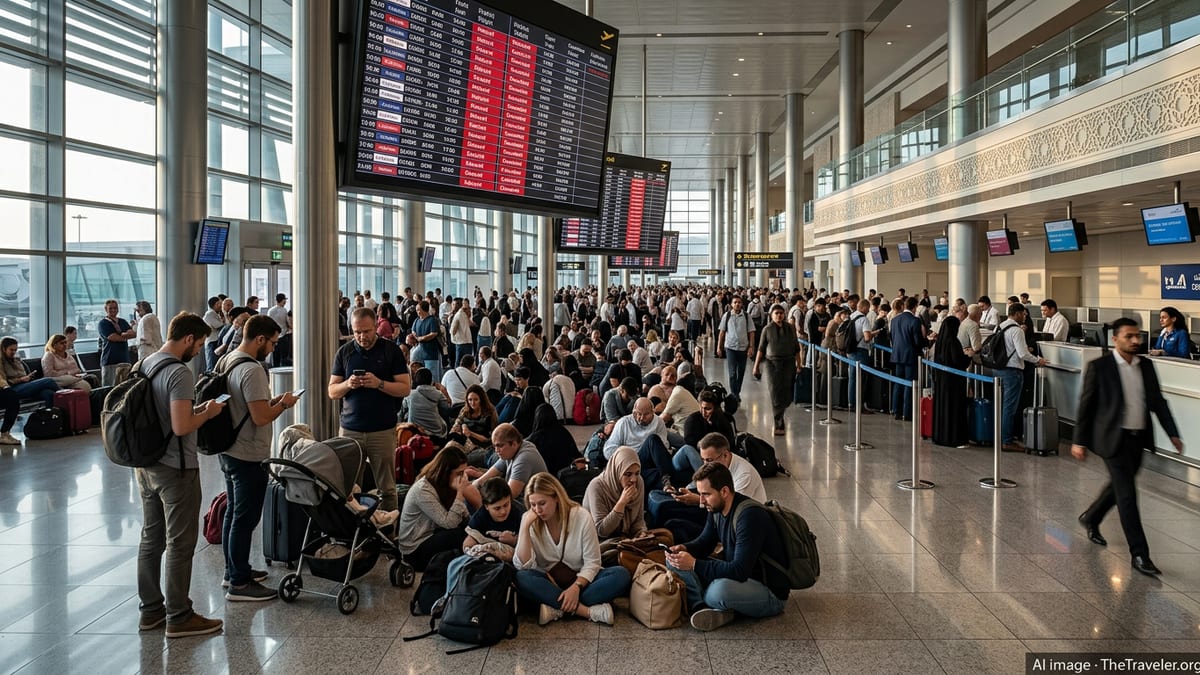
The latest wave of disruption has rippled through some of the world’s busiest transit hubs, with Qatar, the UAE and Bahrain among the worst affected. Airports in Doha and Dubai, which normally pride themselves on clockwork connectivity between Europe, Asia and Africa, have seen departure boards dominated by red status alerts as aircraft are grounded or forced to reroute.
Operational data compiled by regional aviation authorities and tracking platforms indicates that at least 544 flights were delayed and 635 cancelled over a short window as airspace closures, diversions and safety checks cascaded through networks. While precise tallies are still being reconciled, officials say the numbers are likely to climb as knock-on delays accumulate.
In Dubai, where Emirates and flydubai anchor an extensive global network, passengers reported being held on aircraft for hours or shepherded back into crowded terminals as departure slots vanished. In Doha, home base of Qatar Airways, travellers connecting between long-haul services faced missed onward flights and unplanned overnight stays as schedules unravelled.
Bahrain’s Manama airport and other Gulf gateways have also seen widespread disruption. Limited runway capacity, crew duty-time limits and congested alternate routings over safer corridors have made it difficult for airlines to quickly restore normal operations, even when local weather and visibility remained favourable.
Emirates, Flydubai, Gulf Air and Others Scramble
Among the carriers hardest hit are Dubai-based Emirates and flydubai, Bahrain’s Gulf Air, and several other regional and international airlines that rely heavily on Gulf airspace as a bridge between continents. With aircraft and crews out of position, carriers have had to make rapid decisions on whether to delay, divert or cancel flights outright.
Emirates has focused on consolidating services, prioritising wide-body aircraft on trunk routes in an effort to move as many stranded passengers as possible once slots become available. The airline has urged customers to check their flight status frequently and to avoid travelling to the airport unless their flight is confirmed as operating.
Flydubai, which serves a dense network of secondary cities across the Middle East, South Asia and Eastern Europe, has been particularly exposed to sudden airspace and operational constraints on shorter regional sectors. Travellers have reported multiple rolling delay announcements before flights were eventually cancelled, leaving them to compete for scarce rebooking options during peak travel periods.
Gulf Air and other national carriers across the region have likewise been forced into a patchwork of schedule changes and ad hoc recovery flights. Industry analysts note that because many airlines share common routings over the same corridors, any closure or restriction can quickly compound into system-wide gridlock rather than remaining a localized problem.
Passengers Face Crowded Terminals and Uncertain Timelines
For travellers on the ground, the figures translate into long queues at transfer desks, full airport hotels and anxious waits for information. At Dubai International Airport, passengers described snaking lines at customer service counters stretching far into concourses, with some families attempting to sleep on the floor near their gates as they awaited updates.
In Doha, travellers caught between long-haul sectors have struggled to secure seats on the next available services, as capacity on many routes is already tight. Those who arrived without confirmed onward connections have reported being offered itineraries that involve circuitous detours via Europe or South Asia, adding many hours and extra stops to journeys that would normally involve a single short layover.
Manama and other smaller Gulf airports, which are not designed to accommodate significant numbers of stranded transit passengers, have come under pressure to provide basic amenities and clear communication. Local authorities have coordinated with airlines to distribute meal vouchers and arrange temporary accommodation in select cases, but many passengers remain in limbo as carriers triage the most urgent situations first.
Travel agents and online booking platforms have also been inundated with change and refund requests. With airline call centres overwhelmed, some passengers have turned to social media and airport help desks for guidance, while others have opted to purchase entirely new tickets on unaffected routes, hoping to recoup costs later through insurance or compensation claims where applicable.
Knock-On Effects Across Global Routes
The concentration of delays and cancellations in the Gulf has had an outsized impact on global connectivity, given the region’s role as a crossroads for long-haul travel. Flights linking Europe with Asia, Africa and Australasia commonly route through Doha, Dubai and other Middle Eastern hubs, meaning a disruption in one region can unsettle schedules on multiple continents.
Carriers based outside the region that operate into Gulf airports have also been forced to adjust. European and Asian airlines serving Dubai, Doha, Abu Dhabi and Manama have reported aircraft and crews being held out of position, triggering further delays on return legs and impacting rotations on entirely different routes.
Air cargo has not been spared. With many passenger aircraft also carrying belly-hold freight, cancellations have left shipments of time-sensitive goods waiting on the tarmac. Logistics providers have scrambled to reroute consignments via alternative hubs, sometimes at higher cost and with longer transit times, affecting everything from e-commerce deliveries to critical spare parts and perishables.
Aviation experts warn that the process of fully realigning aircraft, crews and schedules could take several days even once airspace conditions stabilise. Because airlines typically operate tight rotations with minimal slack, absorbing such a sharp spike in operational disruption without lingering effects is extremely challenging.
What Travellers Should Do If Affected
With conditions evolving by the hour, travel advisers are urging passengers flying to, from or through the Gulf region to treat their bookings as fluid rather than fixed. Experts recommend monitoring airline apps and official channels closely, as flight status screens in airports may lag behind schedule changes being pushed directly to customers’ devices.
Travellers who are yet to begin their journeys are being encouraged to consider flexible tickets, allow for longer connection times and avoid tight same-day onward plans from Gulf hubs when possible. Those already en route should keep boarding passes, receipts and documentation organised, as this can help when seeking assistance, reimbursement or insurance claims later.
Where airlines are offering free rebooking or alternative routings, passengers may need to accept unconventional itineraries or overnight layovers to secure a confirmed seat. In some cases, it may be faster to reroute via secondary hubs in Europe or Asia rather than waiting for direct services from the Gulf to resume at full capacity.
Travel industry observers note that while the current wave of delays and cancellations is severe, regional carriers have significant experience in ramping up recovery operations after major disruptions. For now, however, thousands of travellers in Doha, Dubai, Manama and beyond remain stranded, watching departure boards and hoping that the next status change on their flight is an overdue call to board.