

More news on this day
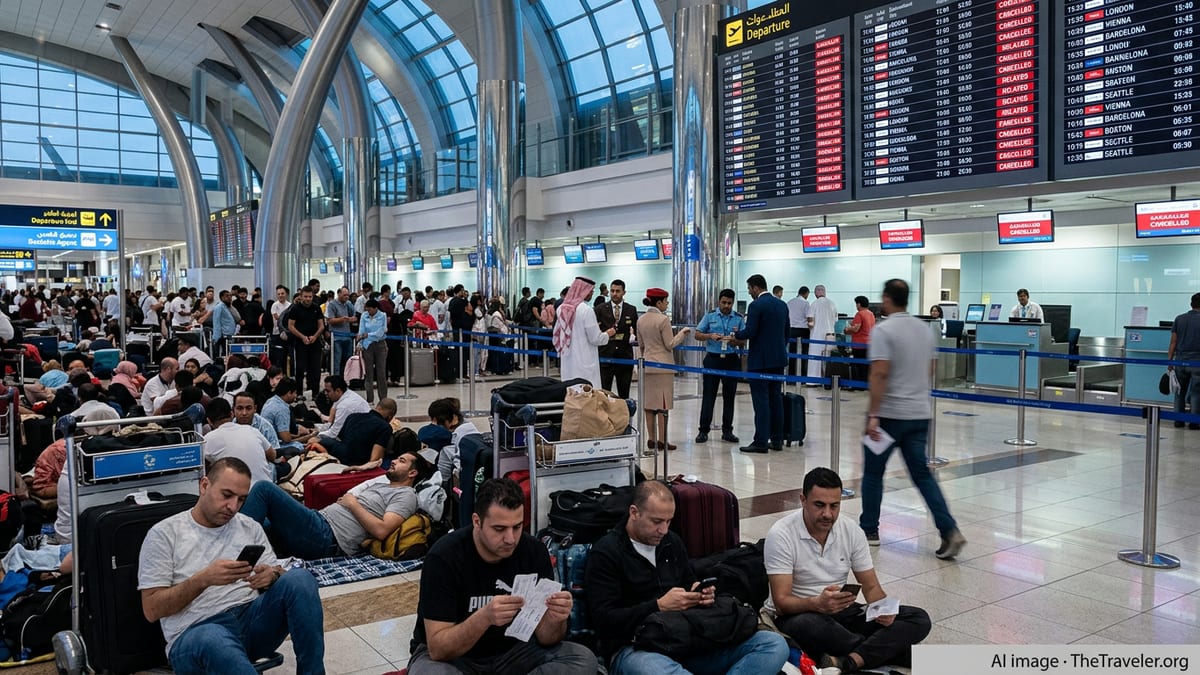
Thousands of travellers across the Middle East are facing days of disruption as airlines in the United Arab Emirates, Qatar, Saudi Arabia, Turkey, Bahrain and neighbouring states cancel 328 flights and delay more than 1,100 services, snarling operations at major hubs including Dubai, Istanbul, Cairo, Abu Dhabi and Muscat.
Get the latest news straight to your inbox!
Regional Tensions Trigger Fresh Wave of Disruptions
Published travel advisories and aviation data indicate that the latest wave of cancellations and delays is closely linked to ongoing regional security tensions and partial airspace closures affecting multiple Gulf and Levant states. Airspace over parts of the United Arab Emirates, Qatar, Bahrain and Iraq has been subject to rolling restrictions in recent weeks, with operators periodically suspending services or rerouting traffic around perceived risk zones.
Industry briefings circulated to corporate clients describe a pattern of operational instability that began in late February 2026 and has continued through March, with initial blanket suspensions gradually giving way to a patchwork of limited resumptions, repatriation services and heavily delayed commercial flights. While some airports remain technically open, fluctuating restrictions on overflight corridors have forced carriers to cancel or delay services at short notice, compounding the impact on passengers already in transit.
The tally of 328 cancellations and 1,155 delays across the region reflects only a snapshot of a moving situation, as schedules are being revised repeatedly during the day. Aviation tracking platforms show extended ground times, aircraft repositioning flights without passengers and a growing number of long-haul services diverting to alternative hubs in Europe and South Asia to avoid congested or restricted airspace.
Major Hubs from Dubai to Istanbul Under Strain
Dubai International and Abu Dhabi’s main airport remain among the most heavily affected hubs, with publicly available airline notices pointing to widespread suspensions and curtailed departure banks. Emirates, flydubai and Etihad have been operating a reduced pattern of flights centred on repatriation and selected trunk routes, with many regular frequencies still removed from timetables or operating at irregular intervals.
In Qatar, operations at Doha’s Hamad International have also been hit by regional turbulence, with Qatar Airways cancelling a significant number of services in recent weeks. Travellers have reported last minute notifications of cancellations, with onward journeys to Europe, the Americas and Asia disrupted when feeder sectors between Gulf hubs are removed from the schedule.
Farther north, Istanbul’s main airports are experiencing knock-on congestion as Turkish Airlines and other carriers attempt to reroute services that would normally overfly affected Gulf and Iranian corridors. Reports indicate some flights are now taking longer routes across the eastern Mediterranean or Central Asia, increasing block times and contributing to a growing backlog of delayed departures and arrivals.
Cairo and Muscat, while less directly impacted by airspace closures, are seeing higher volumes of diverted and rebooked passengers. Egypt Air and Oman Air have both trimmed or temporarily suspended certain Middle East routes, while continuing to operate many services to Europe and Africa. This has turned their hubs into pressure valves for travellers seeking a way out of the region when direct Gulf connections are unavailable.
Emirates, Egypt Air, Saudia, Gulf Air and Others Cut and Reroute
Network carriers across the Middle East have responded by cancelling or consolidating flights, shifting capacity between cities and launching ad hoc repatriation services. Emirates has prioritised selected long-haul destinations and high-demand regional links from Dubai, while continuing to cancel other rotations where routings remain operationally or commercially unviable under current restrictions.
Egypt Air has announced multiple suspensions between Cairo and key Gulf destinations, including Dubai, Abu Dhabi, Doha and Bahrain, in response to evolving airspace and security assessments. Public schedules show a reduced pattern of operations on remaining routes, with some flights operating at non-standard times to secure available overflight slots.
Saudi Arabia’s Saudia and Bahrain’s Gulf Air have also been reshaping their networks. Saudia has limited certain departures from Riyadh and Jeddah towards the Gulf, while maintaining many domestic and alternative international connections. Gulf Air has reported cancellations and delays on select services from Manama, as the airline adjusts routings and timings to account for congestion and restrictions in neighbouring airspace.
Other regional operators, including low cost carriers and smaller national airlines, are facing similar choices. Some have concentrated on domestic and short regional sectors that can avoid restricted zones, while offering flexible rebooking and refund options for passengers on affected international routes.
Passengers Face Long Queues, Rising Costs and Complex Rebookings
For travellers on the ground, the operational changes translate into lengthy queues at ticket counters, crowded transfer areas and a scramble for remaining seats on alternative flights. Accounts shared on social platforms describe passengers sleeping in terminals, repeated rebooking attempts and challenges securing accommodation as disruptions continue beyond the initial 24 to 48 hour window many had anticipated.
As capacity tightens, available fares on unaffected routes have risen sharply, with some travellers reporting significantly higher prices for one way tickets out of Dubai, Doha or Riyadh compared with pre-crisis levels. In markets where competition has been temporarily reduced, travellers are finding that only premium cabins or indirect routings through distant hubs remain available within their travel dates.
The disruption is also affecting connecting itineraries beyond the Middle East. Cancellations of short Gulf feeder sectors are breaking long haul journeys between Europe, the Americas, Asia and Africa, leaving passengers to reconstruct their trips via secondary hubs such as Istanbul, Cairo, Muscat or even farther afield. Travel agencies and corporate travel managers are dedicating additional resources to itinerary changes, while advising clients to build in longer minimum connection times or postpone non essential trips.
Many airlines have introduced flexible policies, allowing one time free date or routing changes and, in some cases, refunds for passengers unwilling to travel amid the uncertainty. However, the volume of affected bookings and limited call centre capacity mean that response times remain slow, and some travellers are reporting delays of several days to receive confirmation of new arrangements.
Outlook: Gradual Recovery but Continued Volatility
Aviation analysts following the region suggest that while the current count of 328 cancellations and 1,155 delays may ease as airlines stabilise their operations, the broader environment for air travel in the Middle East is likely to remain volatile in the short term. The combination of shifting airspace restrictions, ongoing security concerns and the need to reposition aircraft and crews makes a rapid return to normal schedules unlikely.
Published travel and security advisories recommend that passengers due to transit major hubs such as Dubai, Abu Dhabi, Doha, Istanbul, Cairo and Muscat monitor their bookings closely and check the operating status of flights shortly before departure. Travellers are being encouraged to allow extra time for connections, consider routing through alternative hubs where practical and remain prepared for last minute changes.
Industry observers note that past crises in the region have been followed by a strong recovery in air traffic once conditions normalise, particularly at major Gulf hubs that serve as vital connectors between continents. For now, however, airlines and airports across the Middle East are focused on managing the immediate disruption, assisting stranded passengers and gradually rebuilding schedules in one of the world’s most strategically important aviation corridors.