

More news on this day
Thousands of travelers across the Middle East and on key long-haul routes between Europe, Asia and the Americas remain stranded after airlines scrubbed hundreds of flights and delayed scores more, as airspace closures linked to the widening conflict involving Iran, Israel and Western powers ripple through the global aviation network.
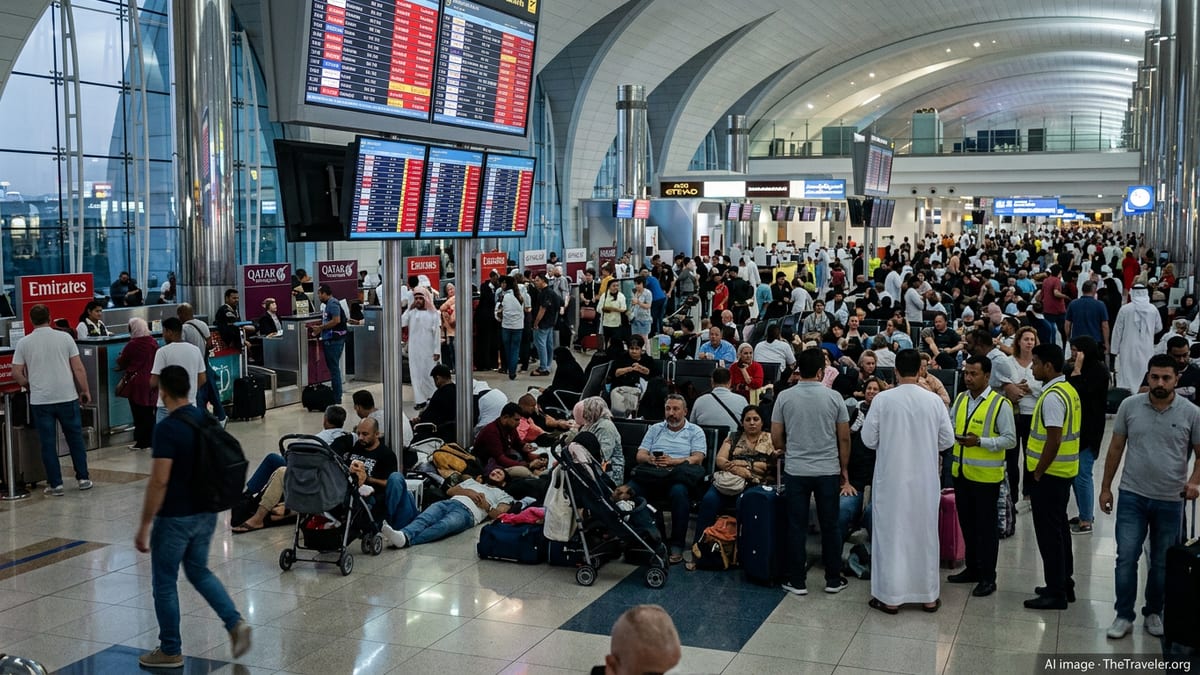
Conflict-Driven Airspace Closures Ripple Across Global Hubs
The latest wave of disruption was triggered when Iran and Israel were hit by opposing strikes, prompting authorities in Iran, Iraq, Israel, Qatar, Bahrain and the United Arab Emirates to close or heavily restrict their airspace to civilian traffic. The resulting shutdown of core Gulf corridors has severed some of the world’s busiest links between Europe, Asia, Africa and Australia, forcing airlines into mass cancellations and long diversion routings.
Key transit hubs in Dubai, Doha and Abu Dhabi have operated at only a fraction of normal capacity for nearly a week, with flight-tracking and aviation data firms counting tens of thousands of cancellations since the first closures. On Thursday and early Friday alone, operational data showed at least 855 flights cancelled and 298 delayed across affected routes, as major carriers scrambled to reposition aircraft and crew or suspend operations entirely on some city pairs.
The knock-on effects have cascaded far beyond the Middle East. Long-haul services into London Heathrow, Frankfurt, Madrid, Vienna, Amsterdam and other European hubs have been thinned out or rerouted, while Asian gateways such as Manila, Delhi and Mumbai report heavily disrupted schedules as aircraft that would usually cross Gulf airspace are diverted or grounded.
In many cases, airlines have opted to cancel services outright rather than operate significantly longer routes around closed skies, citing crew duty limits, fuel constraints and uncertainty over the duration of the restrictions. That has left aircraft and passengers stranded at both origin and destination airports, deepening the operational gridlock.
Major Airlines Slash Schedules as Crisis Deepens
Among Gulf-based carriers, Emirates, Qatar Airways and Etihad remain the most severely affected. Emirates has pared its normally dense network out of Dubai to a skeleton of special repatriation flights, prioritizing routes to major European and Asian cities including London, Frankfurt, Madrid, Vienna, Istanbul and Manila. These flights are largely reserved for citizens and residents being evacuated or for travelers who were previously stranded by cancellations.
Qatar Airways has kept its regular schedule to and from Doha largely suspended, with only limited services operating under special permissions where airspace access allows. Etihad, based in Abu Dhabi, is operating a reduced program of evacuation-style services to destinations such as London, Frankfurt and New York while maintaining some regional connectivity to Jeddah, Cairo and Riyadh via alternative routings that avoid prohibited skies.
European and North American carriers have also sharply cut their Middle East operations. British Airways has cancelled or re-routed a series of flights from London to Dubai, Doha, Abu Dhabi and other Gulf destinations, offering passengers free rebooking or refunds on affected itineraries. Iberia and its low-cost arm Iberia Express have suspended services on certain Middle Eastern routes, while KLM has stopped flying through Iranian, Iraqi and Israeli airspace altogether and cancelled flights to Dubai, Riyadh, Dammam and Tel Aviv.
United Airlines, along with other major US carriers, has focused on suspending or adjusting flights that rely on Gulf overflight corridors, particularly those linking North America with the Indian subcontinent, Southeast Asia and Africa. Many of these services have either been cancelled or rerouted over Central Asia or the Arabian Sea, adding hours to journey times and stretching aircraft and crew rosters to their limits.
Airports from Dubai to London Struggle with Passenger Backlogs
At the front line of the disruption are airports that serve as global super-connectors. Dubai International, typically the world’s busiest hub for international traffic, has been transformed into a holding zone for stranded travelers as regular departures remain largely suspended. Passengers have reported sleeping in terminal corridors and boarding areas, with many stuck for days as they wait for a scarce seat on repatriation services to Jeddah, London, Frankfurt, Madrid, Vienna, Istanbul or Manila.
Jeddah and Riyadh in Saudi Arabia have become critical pressure valves, as their airspace and airports remain comparatively more open than those in the United Arab Emirates and Qatar. Airlines including Saudia, Flynas and selected foreign carriers are using Saudi gateways to stage onward connections to Europe and Asia, though these too have been hit by cancellations and lengthy delays as demand overwhelms available capacity.
In Europe, Heathrow, Frankfurt and Madrid-Barajas have all reported clusters of disrupted flights tied to the Middle East crisis. Passengers arriving from partially open hubs such as Muscat, Cairo or Istanbul often find their connecting flights to or from the Gulf missing from departure boards, replaced instead with long lines at airline service desks as travelers seek rebooking options that may not exist for several days.
Secondary hubs including Vienna, Amsterdam and Seeb in Oman face similar operational strain. Muscat’s Seeb airport has seen a surge in traffic as Oman Air and partner airlines mount extra services to London, Frankfurt, Istanbul and Asian destinations to help clear backlogs created by the closures in Dubai and Doha. While these flights have offered a lifeline to some, they have also introduced new choke points, with terminal facilities operating near capacity.
Stranded Travelers Confront Confusion, Patchy Support and Rising Costs
For individual travelers, the crisis has translated into a confusing patchwork of information, limited options and mounting expenses. Many passengers report receiving notice of cancellations only hours before departure, often after arriving at the airport. With call centers overwhelmed and websites struggling under traffic loads, rebooking can mean queuing in person for hours at understaffed transfer desks.
Families returning from holidays in Southeast Asia to Europe via Dubai have found themselves trapped in the Gulf, forced to pay for additional hotel nights and food as they wait for scarce outbound seats. Migrant workers heading from Manila, Kochi or Dhaka to jobs in the Gulf states have seen their journeys abruptly halted in Istanbul, Delhi or Muscat, with some reporting uncertainty over whether they will be able to reach their employers before work permits or joining deadlines expire.
Religious travelers have also been hit. Pilgrims en route to Saudi Arabia for visits to Mecca and Medina report circuitous reroutes via Cairo, Muscat or Amman, while others have had their trips cancelled outright. Meanwhile, business travelers and conference delegates connecting through London, Frankfurt or Madrid from North America and Asia face missed events and complex claims processes with insurers that may treat conflict-related disruptions differently from standard operational delays.
Consumer rights experts note that passenger protections vary widely by route and airline. Flights departing from the European Union or the United Kingdom on EU or UK carriers generally trigger stronger obligations for care, meals and accommodation, while services starting elsewhere, or operated by non-European airlines, fall under a patchwork of local rules and contract terms. With many cancellations explicitly linked to security and conflict, some standard compensation provisions may not apply.
Airlines and Governments Mount Limited Repatriation Efforts
In response to escalating criticism, governments and airlines have begun organizing structured repatriation programs. The United States, United Kingdom, France, Ireland and several other countries have coordinated with Gulf and regional carriers to prioritize evacuation flights for stranded citizens and residents, particularly from Dubai and Abu Dhabi, where the concentration of grounded passengers remains highest.
Emirates has published rolling lists of special flights from Dubai to destinations including Jeddah, London, Frankfurt, Madrid, Vienna, Istanbul and Manila, while Etihad and Qatar Airways operate their own limited evacuation services from Abu Dhabi and, where possible, from alternative staging points. Seats on these flights are tightly controlled and often allocated via consular channels, leaving many travelers who booked ordinary commercial tickets unsure when they will be able to depart.
Meanwhile, regional alternatives have emerged as crucial lifelines. Oman’s Muscat hub and airports in Saudi Arabia and Egypt have attracted additional services from carriers seeking to bypass closed airspace while still offering connections to Europe and Asia. Turkish Airlines and others are funnelling passengers through Istanbul, though they too have cancelled large numbers of flights across the conflict zone and Gulf region.
Industry analysts warn that even if some airspace begins to reopen in the coming days, the backlog of displaced passengers and aircraft will take much longer to clear. With many airlines still operating conservative schedules and avoiding sensitive corridors, travelers bound for the Middle East or connecting across the region are being urged to expect last-minute changes, build in significant buffers to itineraries and remain in close contact with their carrier before heading to the airport.