

More news on this day
Thousands of travelers have been left stranded or facing marathon reroutings across the Middle East as airlines including FlyDubai, Kenya Airways, Air France, EgyptAir and Etihad Airways suspend or curtail services through major hubs in Dubai, Abu Dhabi and Amman amid ongoing regional airspace closures.
Get the latest news straight to your inbox!
Airspace Closures Trigger New Wave of Cancellations
Published coverage over recent days shows that war-related airspace restrictions across parts of the Middle East have sharply reduced flight options on key Asia–Europe and Africa–Europe corridors, with Dubai, Abu Dhabi and Amman among the most heavily affected gateways. Network data compiled by aviation analysts indicates that dozens of international airlines have either halted operations entirely in the region or shifted to heavily reduced schedules through at least late May.
Industry tracking reports note that Emirates, Qatar Airways and Etihad Airways have all cut capacity at their home hubs, with Dubai and Abu Dhabi particularly constrained by rerouting requirements around conflict zones. One recent analysis estimated that Middle East airspace closures have removed roughly 1.7 million weekly seats from the market, while replacement capacity via alternative hubs in Turkey, India and Southeast Asia covers only a fraction of that loss.
For passengers, the impact is immediate and tangible. Long haul itineraries that once relied on swift overnight connections through Dubai or Abu Dhabi are now subject to last minute cancellations, rolling delays and extended diversions via secondary airports. In Amman, which functions as both an origin and transit point for regional traffic, periodic airspace restrictions and schedule changes have added a further layer of uncertainty.
Publicly available timetables show that many suspended routes are unlikely to resume quickly. Several European carriers have extended their pause on services to major Middle Eastern cities into the late spring and, in some cases, into the autumn, reinforcing expectations of a prolonged period of disruption for international travelers.
FlyDubai, Etihad and Regional Carriers Cut Deep Into Schedules
Low cost and full service Gulf carriers have been forced into repeated schedule overhauls as airspace conditions shift. FlyDubai, which relies heavily on dense short and medium haul operations from Dubai, has been operating at significantly reduced capacity compared with pre-conflict levels, with various short notice cancellations affecting services to Jordan, Egypt and parts of the wider Middle East and North Africa.
Etihad Airways in Abu Dhabi has also adopted a limited network strategy, focusing on a narrower list of destinations while wider regional closures remain in effect. Travel advisories and flight status pages show that the airline has periodically suspended Abu Dhabi services to several key cities, including Amman and selected points in Europe and North Asia, while maintaining restricted operations to India, Pakistan, Saudi Arabia and Egypt.
Other regional players have made similar cuts. Air Arabia and various smaller Middle Eastern airlines have trimmed frequencies or temporarily dropped cities that require overflight of restricted airspace, compounding the shock to the region’s connectivity. For travelers trying to reach or transit the Gulf from South Asia or East Africa, this has translated into longer itineraries, multi stop routings and tighter competition for remaining seats.
Even where airlines are still operating, contingency buffers and indirect routings are adding hours to flight times. Industry commentary highlights that reconfigured paths avoiding conflict zones are increasing fuel burn and operating costs, further limiting the scope for airlines to add back capacity quickly.
Global Airlines Suspend Dubai, Abu Dhabi and Amman Services
Flag carriers from Europe and Africa have also pulled back sharply from the Middle East’s traditional megahubs. According to recent airline updates and travel alerts, Air France has extended the suspension of its Dubai and Abu Dhabi flights, while also holding services to other regional cities such as Riyadh and Beirut. The changes have disrupted one stop links between Europe and destinations in Asia, Australasia and East Africa that previously relied on Gulf connections.
Kenya Airways, which connects Nairobi to the Gulf for onward traffic to Europe and Asia, has scaled back its operations to the United Arab Emirates and surrounding markets amid the same airspace and security concerns. Travelers originating in East Africa and seeking connections through Dubai or Abu Dhabi now face a patchwork of reduced options and may be forced to reroute via alternative hubs in Addis Ababa, Istanbul or Doha, subject to those airlines’ own restrictions.
EgyptAir has likewise adjusted its schedules, suspending or reducing some flights that traverse contested airspace while maintaining core services from Cairo to destinations judged operationally viable. Separate reports on European network planning show that several major groups have frozen their Amman operations for the coming weeks, removing another key link in the region’s air travel chain.
These combined moves have stranded travelers not just in the Gulf but across a wide arc from North Africa to Central Asia. Passengers holding tickets that once offered seamless journeys via Dubai or Abu Dhabi are instead receiving notifications of suspended sectors, fragmented rebookings or full refunds without guaranteed alternative travel on nearby dates.
Ripple Effects Across Asia, Africa and Europe
The closure or partial closure of Middle Eastern airspace has created a domino effect for airlines far beyond the immediate conflict zone. Schedules from Asia to Europe and North America previously depended heavily on the Gulf as a central hub, and the sudden loss of those corridors has forced carriers to redesign networks in real time. Capacity statistics released this week indicate cuts of 40 to more than 60 percent at several major Middle Eastern hubs, leaving a significant gap in global seat supply.
Airports in Turkey, India and Southeast Asia have absorbed some of the diverted demand as airlines reroute flights to avoid the most sensitive areas. However, analysts point out that these alternative hubs cannot fully replace the scale of Dubai or Abu Dhabi, especially for wide body, long haul operations. Travelers are therefore seeing higher fares on remaining routes, longer layovers and increased competition for premium cabin seats as airlines prioritize high yield traffic.
The disruption is also feeding into irregular operations in secondary markets. Aviation data for the end of March highlights hundreds of cancellations and thousands of delays across major Asian and Middle Eastern airports in a single day, with knock on effects for domestic and regional feeders. As aircraft and crews end up out of position, schedule reliability on otherwise unaffected routes has also deteriorated.
Travel management companies and consumer advocates caution that the situation remains fluid, with further timetable changes likely as airlines refine their strategies for the April and May peak travel periods. Business travelers in particular are being urged, through public guidance, to build in additional buffer time and to consider routing through multiple non Gulf hubs where possible.
Stranded Passengers Face Long Rebookings and Limited Support
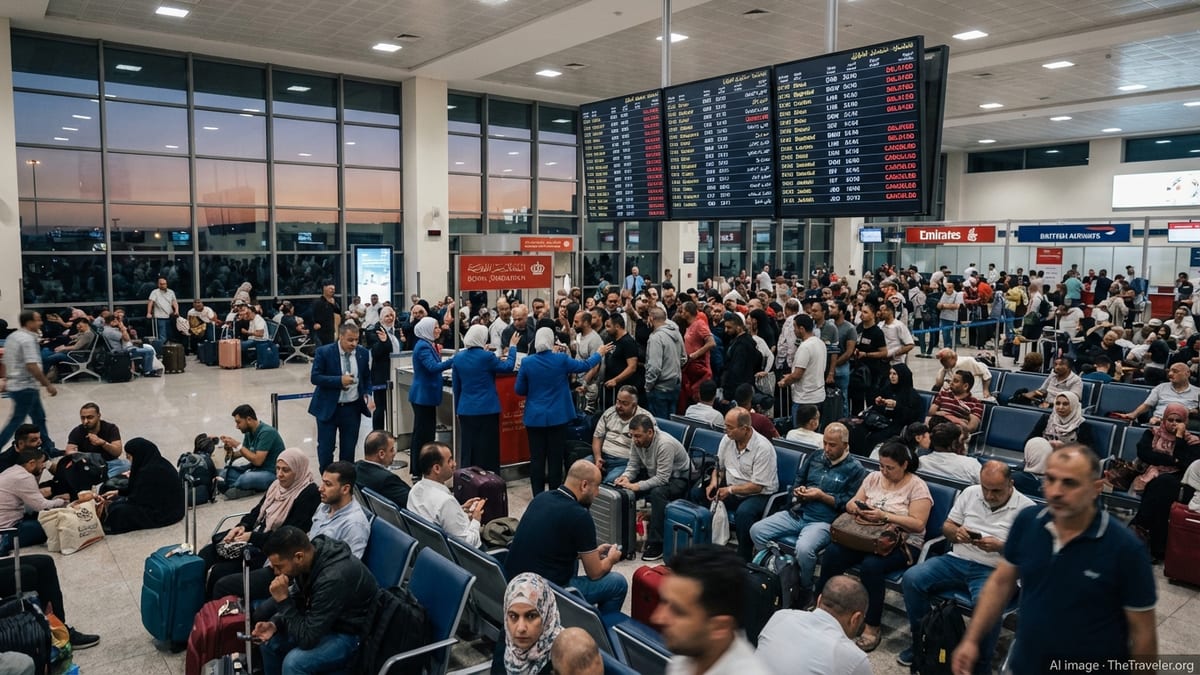
For individual travelers caught in the middle of this upheaval, the practical challenge is securing a way home or onward to their destination. Publicly available accounts from airports in Dubai and Abu Dhabi describe long queues at service desks, with passengers seeking rebookings on the few remaining flights or requesting refunds so they can attempt to construct their own itineraries via alternative hubs.
Consumer rights organizations note that rebooking options differ widely between airlines. Some Gulf carriers are prioritizing passengers whose flights were canceled earlier in the crisis, while others are issuing travel vouchers and encouraging customers to book new trips once more capacity becomes available. International carriers whose services to the region have been fully suspended are, in many cases, offering refunds rather than arranging complex interline reroutings.
Reports from travel advisories emphasize the importance of checking flight status tools and mobile apps frequently, as departure times and operating days continue to shift in response to evolving airspace conditions. Passengers are being encouraged to avoid traveling to airports until their flights are reconfirmed and to keep their contact details updated in airline booking systems so they can receive alerts about last minute schedule changes.
With no immediate resolution in sight, travel specialists widely expect further waves of disruption in the weeks ahead. The combination of suspended routes, reduced frequencies and longer flight paths suggests that the Middle East will remain a challenging region for air travel planning, and that travelers transiting Dubai, Abu Dhabi or Amman may need to prepare for extended journeys, unexpected overnight stays and rapidly changing itineraries.