

More news on this day
Flight cancellations and diversions have surged across the Middle East and beyond as missiles, drones and abrupt airspace closures force Emirates, Qatar Airways, Etihad and Air France to rip up schedules, leaving hotels, tour operators and destinations suddenly cut off from their core markets.
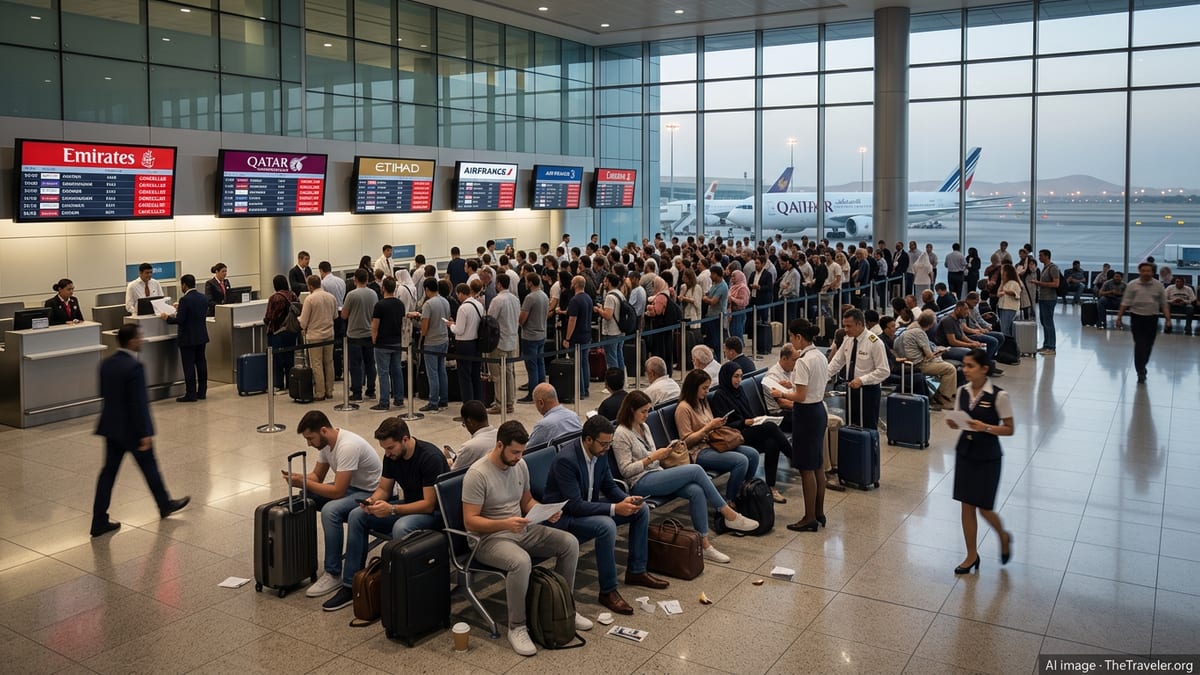
Missiles, Drones and Closed Skies Push Airlines to the Brink
The latest escalation in the U.S.-Israel conflict with Iran has turned one of the world’s busiest aviation corridors into a patchwork of no-go zones almost overnight, triggering what analysts describe as the industry’s most acute crisis since the pandemic. Airspace over Iran, Iraq, Israel, Jordan, Qatar, Bahrain, Kuwait and large parts of the Gulf has been fully or partially closed following waves of missile and drone attacks, forcing carriers to cancel or reroute thousands of flights.
Gulf super-connectors Emirates, Qatar Airways and Etihad have been hit at the heart of their hub-and-spoke model. Operations from Dubai, Abu Dhabi and Doha were largely halted after Iranian missile salvos targeted infrastructure around key airports and prompted sweeping safety restrictions. Flight tracking data and aviation advisories show more than 20,000 flights to and through the Gulf axed or diverted in just over a week, stranding hundreds of thousands of travelers on both sides of the world.
Regulators in Europe have compounded the disruption. The European Union Aviation Safety Agency has advised carriers to avoid a wide swath of Middle Eastern airspace because of the risk that long-range missiles or interceptors could threaten civil aircraft even at cruising altitude. That effectively severs the most direct routes between Europe and much of Asia, undermining a decade of growth built on fast one-stop connections via Dubai, Doha and Abu Dhabi.
Aviation experts warn that even limited resumptions are precarious. Emirates and Etihad have begun operating a skeleton network using lengthy detours over the Caucasus or the southern Red Sea, adding four to six hours to some long-haul journeys and sharply increasing fuel burn and crew costs. Qatar Airways, whose Doha hub was directly affected by Iranian strikes and interception activity, has remained largely grounded on passenger routes while authorities assess ongoing security risks.
Air France and European Carriers Scramble to Rebuild Networks
The repercussions are being felt far beyond the Gulf. Air France, which relies on Middle Eastern routing for services to parts of Asia and Africa, has extended suspensions of flights to Tel Aviv, Beirut, Dubai and Riyadh as it reassesses security and navigational options. The airline had only recently resumed some services after an earlier pause, but the latest missile barrages and new airspace closures forced a fresh wave of cancellations.
Other European and Asian carriers have followed suit, cutting links to the region or imposing lengthy diversions that undermine the economics of certain routes. The closure or restriction of skies over Iran and adjoining countries comes on top of existing bans on Russian overflights for many Western airlines, leaving planners with a shrinking set of viable corridors. Some Europe–Asia routes are now funneled through narrow northern passages over Turkey and the Caucasus, while others swing far south around Egypt, Saudi Arabia and the Arabian Sea.
For passengers, the impact is immediate and visible. Travelers bound for popular winter-sun and business hubs such as Dubai, Doha and Riyadh have found themselves stuck in European transit hotels or sent back to their origin airports after long-haul flights made U-turns midair. Airlines have offered refunds and rebookings, but replacement itineraries often involve multi-stop journeys and uncertain connection times, with many customers reluctant to transit anywhere near an active conflict zone.
Industry groups say the shock has rattled confidence among corporate travel managers and high-spend leisure clients, who are crucial to premium cabins that underwrite many long-haul routes. Several multinational firms have frozen non-essential trips to the broader Middle East, while foreign ministries in North America, Europe and Asia have urged their citizens to leave the region or delay planned visits, further choking demand.
Hotels Pivot From Overbooked to Half-Empty in Days
Nowhere is the shock more dramatic than on the ground in Gulf tourism capitals that built their economies around seamless global connectivity. In Dubai, where hotels were reporting high occupancies at the start of the year, managers describe an extraordinary swing from overbooked to half-empty inventories in the space of a few days as inbound flights were cancelled and outbound visitors rushed to leave.
With Emirates and other carriers slashing schedules, group bookings for conferences, exhibitions and incentive trips have evaporated. Event organizers report postponements into late 2026 or 2027 as businesses wait for clarity on airspace safety and insurance coverage. Leisure-focused properties on beach fronts and resort islands are contending with mass cancellations from European tour operators, many of which cannot reroute charters or guarantee timely arrivals under current restrictions.
In Doha and Abu Dhabi, where airports themselves have been at the center of security concerns, hotels are juggling a different mix of guests. Some properties are accommodating stranded transit passengers on airline-paid vouchers, while others are filling rooms with diplomats, security contractors and journalists drawn by the unfolding crisis. Average daily rates in these markets are volatile, with sharp drops in tourist-oriented segments offset partially by last-minute government and corporate demand.
Elsewhere in the region, from Jordan’s Petra gateway town of Wadi Musa to coastal resorts in Oman and Egypt’s Red Sea, the shock is rippling out in the form of no-shows and slashed forward bookings. Travel agents report that even destinations technically far from missile strikes are being swept up in a generalized perception of regional risk, echoing patterns seen during previous conflicts and terror incidents.
Global Tourism Faces New Uncertainty as Bookings Collapse
The disruption is not confined to Middle Eastern hotels. Because Emirates, Qatar Airways and Etihad serve as critical connectors between Europe, Africa, Asia and Australasia, their partial shutdown sends shockwaves through global tourism flows. Many African safari lodges, Indian Ocean resorts and Southeast Asian destinations rely on customers who transit through Gulf hubs; when those links break, so do high-end itineraries booked months in advance.
Early projections from tourism economists suggest that the Middle East alone could lose tens of billions of dollars in visitor spending this year, with regional arrivals potentially dropping by double-digit percentages compared with previous forecasts. Secondary effects will be felt in feeder markets across Europe and Asia, where travel agencies, destination management companies and cruise operators must reconfigure products previously sold on the promise of fast, one-stop connections via the Gulf.
At the same time, some destinations outside the conflict zone are seeing a surge in interest. Mediterranean countries, parts of southern Europe and Indian Ocean islands accessible via alternative routings are being marketed as safer stand-ins for Gulf city breaks and stopover holidays. Yet capacity constraints, higher airfares and lingering economic uncertainty may limit how much displaced demand can be captured elsewhere.
For travelers, the new reality is one of heightened complexity and risk. Insurers are tightening terms around war and airspace-closure disruptions, often leaving non-refundable hotel stays and tours uncovered even when flights are canceled for safety reasons. Advisers recommend that would-be visitors pay close attention to travel advisories, book flexible rates where possible and prepare contingency plans in case routes are abruptly withdrawn.
Long-Term Questions for Hub Airlines and Destination Brands
While airlines and hotels scramble to manage the immediate fallout, the crisis raises deeper questions about the long-term viability of hyper-centralized hub strategies in an era of recurring geopolitical shocks. Gulf carriers have previously weathered regional tensions by rerouting around isolated hotspots, but the current blanket of missile risks and drone activity across multiple countries leaves far less room to maneuver.
Industry strategists say that if airspace closures persist for months, airlines like Emirates, Qatar Airways, Etihad and their European partners will be forced to rethink network design, perhaps relying more heavily on secondary hubs in safer regions and investing in aircraft capable of longer nonstop sectors that bypass traditional choke points. Any such pivot would have profound implications for hotel development and tourism marketing in cities that have grown around the promise of being the world’s crossroads.
Destination brands, particularly in the Gulf, now face the challenge of sustaining their appeal without the guarantee of easy access. Mega-resorts and shopping districts built for continual waves of connecting passengers may need to shift focus toward regional and domestic markets, as well as longer-stay visitors willing to commit despite the headlines. Some tourism boards are already retooling campaigns to emphasize safety protocols, crisis preparedness and flexible booking policies.
For now, the unanswered question is duration. If missile and drone threats subside and airspace reopens within weeks, the current wave of cancellations may be remembered as a sharp but temporary shock. If, however, the conflict drags on or settles into a new normal of intermittent closures, the world’s reliance on a handful of high-risk skies for global travel could be permanently reassessed, with hotels and tourism economies from Dubai to Paris forced to adapt to a less predictable age of mobility.