

More news on this day
Major Gulf carriers Qatar Airways, Emirates and FlyDubai have canceled 1,358 flights and postponed at least 60 more as escalating tensions and airspace closures across the Middle East leave thousands of passengers stranded in key hubs such as Dubai, Doha and Bahrain.
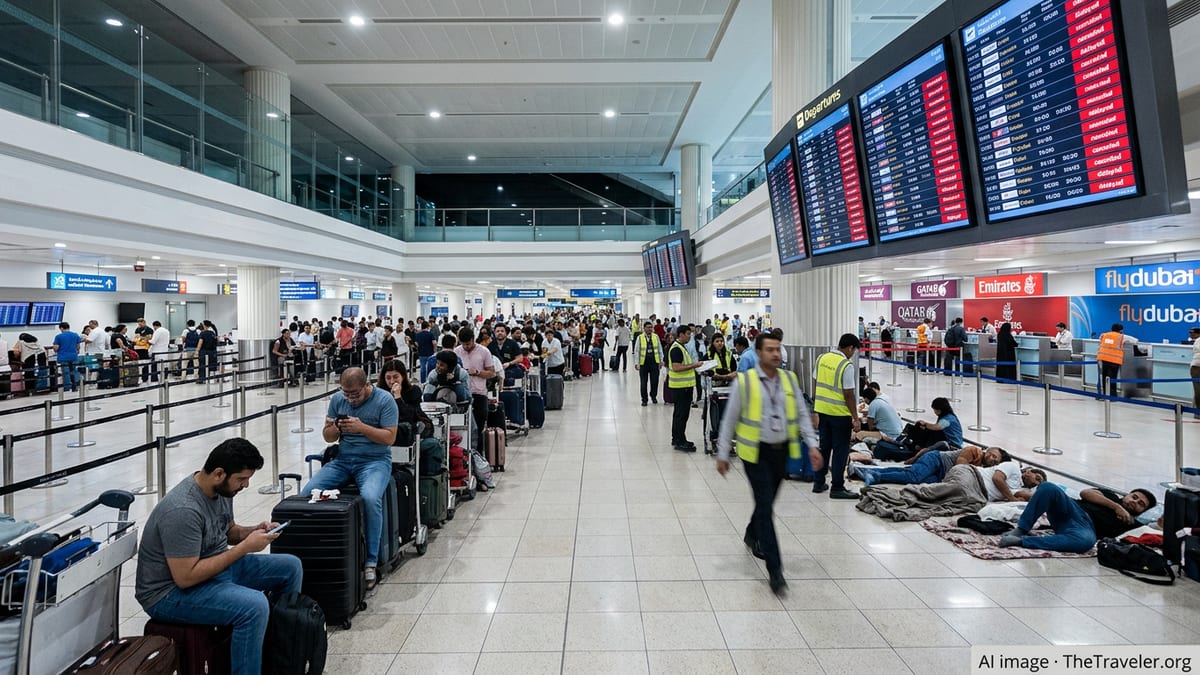
Conflict-Linked Airspace Closures Paralyze Key Gulf Hubs
The latest wave of cancellations follows sweeping airspace restrictions introduced from 28 February across Iran, Iraq, Kuwait, Bahrain, Qatar and the United Arab Emirates, as regional tensions escalated and missile and drone attacks targeted strategic infrastructure. Authorities closed or sharply curtailed access to large sections of the region’s skies, forcing airlines either to ground aircraft or operate limited emergency services.
Dubai International Airport and Dubai World Central temporarily halted regular commercial operations during the initial phase of the crisis, while Doha’s Hamad International Airport and Bahrain International Airport also saw routine traffic suspended or heavily curtailed. These hubs normally function as some of the world’s busiest transit gateways, funnelling tens of thousands of passengers daily between Europe, Africa, Asia and the Americas.
Data from aviation analytics firms and regional regulators indicate that, within just a few days, thousands of flights were disrupted across the wider Middle East, with the heaviest concentration of cancellations clustered around the Gulf super hubs used by Qatar Airways, Emirates and FlyDubai. The figure of 1,358 cancellations and 60 postponements attributed to these three carriers reflects only a portion of the total regional impact.
While limited operations have slowly resumed through tightly controlled emergency corridors, authorities in the Gulf stress that safety remains the overriding priority. Airlines have been instructed to avoid specific risk zones and to coordinate closely with national aviation authorities before operating any movements through contested airspace.
Which Airlines, Routes and Airports Are Hit the Hardest
Qatar Airways, Emirates and FlyDubai have borne the brunt of the current disruption due to their reliance on hub-and-spoke networks centered on Doha and Dubai. Qatar Airways has kept most scheduled passenger services suspended as Qatari airspace remains severely restricted, with the airline signaling it will only fully resume once the Qatar Civil Aviation Authority confirms that routes are safe.
Emirates, based at Dubai International, has progressively restarted a small number of services after initially grounding all flights to and from Dubai for several days. Early resumptions have largely focused on high-demand regional and South Asian destinations, including sectors to India, while long haul connections to Europe, North America and Australasia remain greatly reduced or rerouted along longer paths to avoid closed skies.
FlyDubai, the Dubai low cost carrier that typically operates dense networks across the Middle East, South Asia and Eastern Europe, has resumed only a limited schedule from Dubai International’s Terminals 2 and 3. Priority is being given to flights that help clear the backlog of stranded travelers, with capacity reallocated from less critical leisure routes to essential regional and repatriation services.
On a geographic level, flights to and from Dubai, Doha and Bahrain have seen the most pronounced disruption, but knock on effects extend far beyond the Gulf. Services between Europe and Asia that usually transit over Iran or the northern Gulf are being forced onto more southerly or Caucasus routes, adding hours to flight times and sharply increasing fuel burn and crew costs.
What Stranded Passengers in Dubai, Doha and Bahrain Are Experiencing
For travelers caught in the middle of the crisis, the most visible impact has been in crowded terminals and makeshift accommodation facilities around Dubai, Doha and Bahrain. At the height of the disruption, authorities in the United Arab Emirates reported that more than twenty thousand transit passengers were being sheltered after finding themselves unable to continue their journeys when Dubai’s airports temporarily shut down regular flights.
Airlines and airport authorities have been working with local hotels and government agencies to provide cots, food, water and basic medical care to stranded passengers, alongside transport between terminals and temporary shelters. However, capacity is stretched, and many travelers have reported long queues for rebooking desks, limited availability of nearby hotel rooms and difficulties securing up to date information on new departure times.
Passenger experiences vary significantly depending on ticket type and destination. Premium class travelers and those booked on flexible fares have in many cases been re accommodated more quickly on the few available flights, while economy passengers on discounted or point to point itineraries often face longer waits. Families traveling with young children, elderly passengers and those with medical needs are being prioritized where possible, but resources remain under intense pressure.
In Bahrain and Doha, where traffic volumes are lower than Dubai but disruption remains severe, many passengers have been advised to avoid the airport altogether until they receive confirmation that their replacement flight is operating. Local authorities have also urged residents to defer non essential travel out of the region until commercial schedules stabilize.
Airline Policies, Rebooking Options and Likely Timelines
In statements issued over recent days, Qatar Airways, Emirates and FlyDubai have introduced a range of temporary policies aimed at giving customers more flexibility. These include waiving rebooking fees for affected itineraries, extending travel validity windows into later March and, in some cases, offering full refunds for flights that have been canceled outright.
Passengers holding Qatar Airways tickets issued before the latest escalation have generally been permitted to change their travel dates without penalty once services resume, although specific rules differ by route and fare class. Emirates has advised customers whose flights are canceled to either rebook on alternative departures up to a specified date or request a refund through its normal customer service channels or via their travel agent.
FlyDubai is focusing its limited capacity on passengers already disrupted, asking travelers with future bookings and flexible schedules to postpone non urgent trips. Across all three carriers, call centers and online support platforms are experiencing surging demand, and travelers are being strongly encouraged to use airline apps and automated tools rather than visiting airports in person unless their flight is confirmed to operate.
Regional aviation authorities and industry analysts suggest that more regular schedules may only begin to emerge once a clearer security picture develops and airspace restrictions are eased in stages. Even then, the knock on effects of repositioning aircraft and crew, clearing passenger backlogs and recalibrating global networks mean that disruptions on some routes could persist for days or weeks beyond the formal reopening of key corridors.
Practical Advice for Travelers With Upcoming Middle East Journeys
Travelers scheduled to fly into or through Dubai, Doha, Bahrain or other major regional hubs in the coming days are being urged to monitor their bookings closely. Experts recommend checking flight status repeatedly in the 24 hours before departure, as last minute cancellations or schedule changes remain common in such a fluid operational environment.
Where possible, passengers transiting the Gulf on long haul journeys between Europe, Asia and Australasia may wish to investigate alternative routings that avoid the most affected hubs, even if that means traveling with different carriers or accepting longer total travel times. Travel agents and corporate travel departments are playing a key role in rerouting high priority travelers via secondary hubs in Turkey, Saudi Arabia or further afield.
Travel insurance policies should also be reviewed carefully. Some providers treat conflict related airspace closures as extraordinary circumstances, limiting compensation for delays and cancellations, while others offer broader disruption cover that can help offset the cost of additional accommodation, meals and alternative transport. Policyholders are advised to document all expenses and retain receipts to support any subsequent claims.
For passengers already stranded in cities such as Dubai, Doha and Manama, officials emphasize the importance of following instructions from airport staff, staying in designated shelter or waiting areas and keeping contact information for airlines, hotels and embassies readily available. With the situation evolving daily, timely communication and flexibility remain the most valuable tools for anyone navigating the ongoing disruption to Middle Eastern air travel.