

More news on this day
Escalating conflict and airspace restrictions across Saudi Arabia, Qatar, the United Arab Emirates and Bahrain have triggered sweeping flight cancellations, diversions and long delays, disrupting travel itineraries for hundreds of thousands of passengers worldwide.
Get the latest news straight to your inbox!
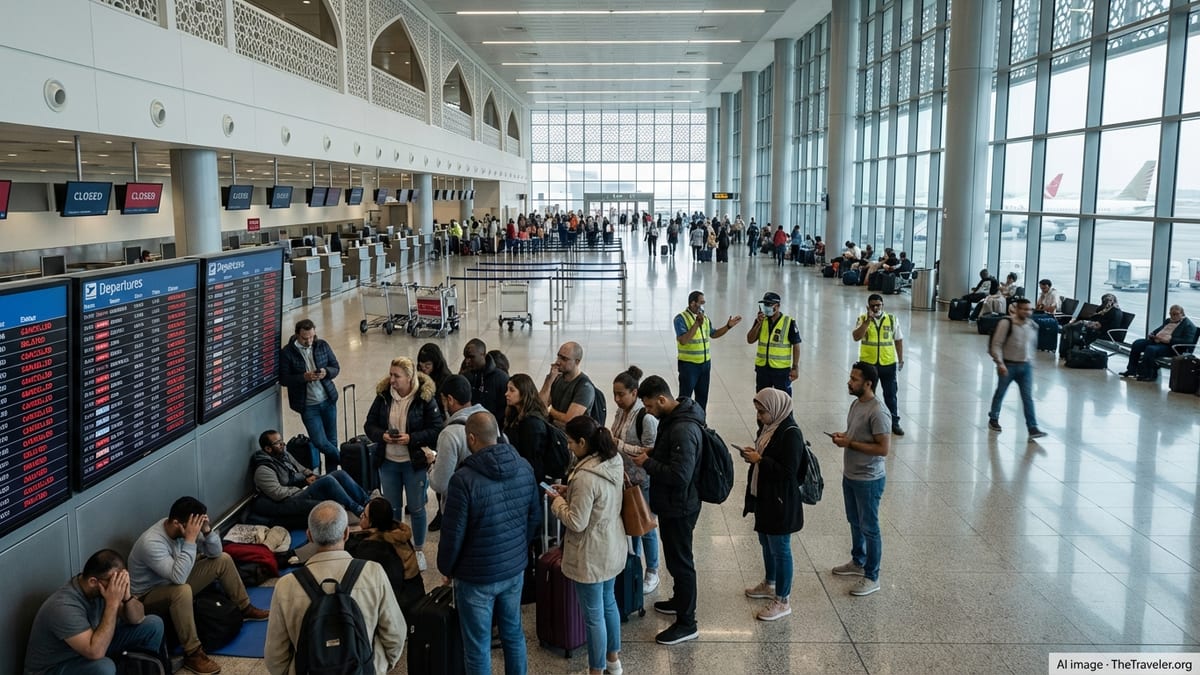
How the Current Disruptions Started and Where They Stand
The latest phase of disruption began in late February 2026, when strikes involving Iran and multiple regional and Western militaries led to rapid closures and restrictions of airspace across much of the Gulf. Publicly available aviation advisories and travel-industry bulletins describe a sharp initial collapse in scheduled flights as carriers temporarily halted services to protect passengers and crews.
By early March, client advisories and risk analyses indicated that airspace over or around the United Arab Emirates, Qatar, Bahrain and parts of Saudi Arabia was subject to significant restrictions, with some corridors effectively closed to commercial traffic. Flight tracking data cited in industry reports showed near-zero movements over several Gulf states during the first days of the crisis, before a slow and uneven resumption of limited operations.
Recent coverage from aviation and business outlets suggests that conditions remain fragile as of March 31, 2026. Major Gulf hubs such as Dubai, Abu Dhabi and Doha are operating at a fraction of normal capacity, while Bahrain’s connectivity is heavily constrained. Saudi airports have recovered more quickly on domestic and selected international routes but still face knock-on delays from congestion in neighboring skies.
Analysts note that the situation is highly dynamic, influenced by the wider conflict environment, evolving missile and drone risks, and ongoing government and airline safety assessments. Travelers planning to transit through the region, or fly to and from Saudi Arabia, Qatar, the UAE or Bahrain, should be prepared for abrupt schedule changes even when flights are advertised as operating.
Impact by Country: Saudi Arabia, Qatar, UAE and Bahrain
In Saudi Arabia, reports from travel advisories and airline updates point to partial recovery on core routes, particularly from Riyadh and Jeddah. National and regional carriers have restored a subset of services, but schedules have been trimmed and some international links, especially to nearby Gulf hubs, remain suspended or reduced. International airlines operating via Saudi airports continue to adjust routings in response to shifting overflight permissions and risk assessments.
Qatar has experienced some of the most severe and sustained disruption. Information from port and travel advisories indicates that Qatari airspace has been subject to intermittent closures, with periods when all regular commercial travel was suspended. Even as some operations have restarted, capacity at Doha’s Hamad International Airport remains far below normal, and several foreign carriers continue to cancel or divert services instead of transiting Qatari airspace.
The UAE, home to major global hubs in Dubai and Abu Dhabi, has seen dramatic fluctuations. Initial airspace restrictions led to widespread cancellations and diversions, with global carriers redirecting long-haul traffic away from the country. More recent market intelligence suggests that Dubai has recovered to roughly half of typical traffic levels, and Abu Dhabi to around two-thirds, but those averages mask significant day-to-day variation. Long-haul operations are often rerouted along more southerly paths, increasing flying times and complicating crew scheduling.
Bahrain’s connectivity has been particularly constrained due to both operational decisions by local carriers and broader airspace risk. Industry bulletins describe Bahrain-linked services as either suspended or operating at very low frequencies. Travelers relying on Bahrain as a regional transfer point have faced multiple cancellations and rebookings, with many rerouted through alternative hubs in Saudi Arabia or further afield.
How Airlines Are Responding on Key Routes
Airlines across Asia, Europe and the Middle East have reshaped their schedules in response to the disruptions. Travel trade reports detail hundreds of cancellations and delays across major carriers serving Saudi Arabia, Qatar, the UAE and Bahrain, including regional operators and long-haul airlines from India and Europe. Many have adopted a rolling approach, publishing short-term schedules a few days at a time rather than full seasonal timetables.
Some carriers have temporarily suspended all flights to certain Gulf hubs while maintaining limited ad hoc or relief services. For example, airline notices show instances where scheduled operations to Doha or Dubai are paused, but isolated non-scheduled flights operate to repatriate passengers or reposition aircraft and crew. Other airlines have shifted capacity toward alternative gateways in the wider region where airspace is more stable, routing passengers through cities such as Muscat or Jeddah instead of Doha or Bahrain.
Where flights are operating, routings are often significantly longer. Market analyses of air-cargo and passenger flows indicate that aircraft are avoiding high-risk airspace corridors, instead detouring across southern Saudi Arabia or further south over the Arabian Sea. These longer trajectories increase fuel burn and block times, which in turn can lead to rolling delays as aircraft and crews fall out of position.
For travelers, this means that even a confirmed, on-time departure remains vulnerable to last-minute adjustments. A flight that appears unaffected on departure boards may ultimately be delayed by an upstream disruption to the aircraft’s previous leg or by late-breaking airspace restrictions announced via NOTAMs and security advisories.
What Travelers Should Do Before Departure
Given the fluid situation, aviation and travel risk specialists emphasize proactive planning. Travelers are encouraged to monitor their booking closely from the moment a trip is scheduled, not just on the day of departure. Airline mobile apps and direct email or SMS alerts tend to reflect operational changes earlier than third-party booking platforms or generic flight trackers.
It is advisable to reconfirm flight status repeatedly in the 48 hours before travel, with a final check shortly before leaving for the airport. Because many carriers are releasing updated schedules on a rolling basis, a flight that appears cancelled several days ahead may be reinstated, and the reverse is also possible. Passengers connecting through Gulf hubs should pay particular attention to minimum connection times and consider whether a longer layover might reduce the risk of misconnection.
Travel insurance with robust disruption coverage can be valuable in the current environment, especially policies that address missed connections, extended delays and enforced stopovers. Policyholders should review exclusions related to war or civil unrest, as these clauses may affect eligibility for reimbursement when disruptions are linked to regional conflict.
Where possible, travelers may wish to build flexibility into their itineraries by selecting fares that allow date or routing changes with limited penalties. Booking directly with airlines, rather than via multiple intermediaries, can simplify rebooking if schedules shift at short notice.
Guidance for Those Already Stranded or En Route
For passengers already in the region, the immediate priority is to stay informed at the airport and through official airline channels. Airport information desks and airline service counters remain the key points for same-day rebooking, although long queues have been widely reported during peak disruption periods. Travelers should be prepared for extended waiting times and limited hotel availability near major hubs when large numbers of flights are cancelled overnight.
Publicly available travel advisories suggest that stranded passengers may benefit from exploring alternative routings that bypass the most affected hubs. This can include flying to a less congested regional airport in Saudi Arabia or elsewhere in the Middle East, then connecting onward to Europe, Asia or Africa on different carriers. In some cases, reaching a nearby country by land or short-haul flight and continuing from there has proved faster than waiting for direct services to resume.
Passengers should keep meticulous records of expenses incurred as a result of disruption, including hotel stays, meals, ground transport and communication costs. These records can support later claims with airlines or travel insurers. It is also important to retain boarding passes, cancellation notifications and any written confirmation of disruption provided at the airport.
Finally, travelers should monitor guidance from their home country’s foreign affairs or state department, which may issue updated recommendations about transiting conflict-affected regions. While most such advisories do not override airline decisions on whether to operate particular flights, they can help travelers assess personal risk tolerance and decide whether to postpone non-essential trips through Saudi Arabia, Qatar, the UAE or Bahrain until conditions stabilize further.