

More news on this day
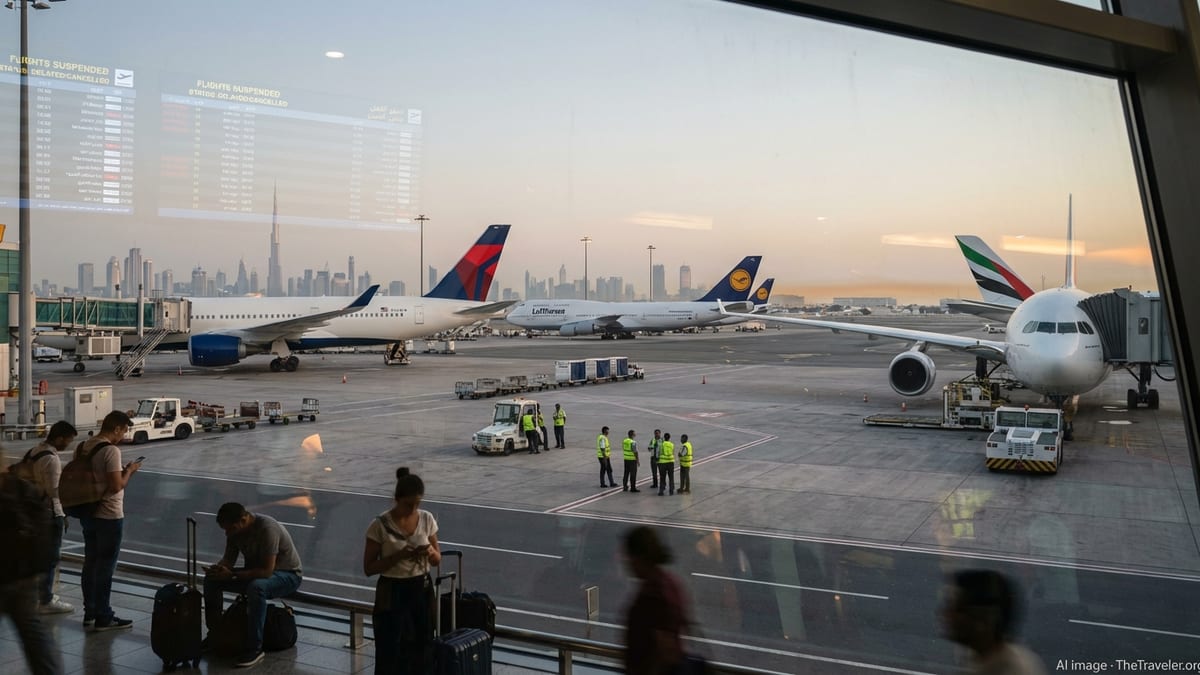
Air travel across the Middle East is again under heavy strain as new data show 32 flights cancelled and 94 delayed on Qatar Airways, Royal Jordanian and FlyDubai, with knock-on disruption affecting major hubs in Doha, Dubai, Amman and Cairo amid ongoing regional airspace restrictions and security tensions.
Get the latest news straight to your inbox!
Latest Wave of Cancellations Across Key Carriers
Published aviation data and regional travel industry reporting indicate that the newest wave of disruption has centered on three major regional operators: Qatar Airways, Royal Jordanian and FlyDubai. Across their networks, at least 32 flights were cancelled and 94 delayed in a short window, concentrating pressure on already fragile schedules at Hamad International Airport in Doha, Dubai International, Queen Alia International in Amman and Cairo International Airport.
The figures sit within a far larger pattern of instability. Industry intelligence providers have documented steep reductions in overall Middle East flight activity since late February, with some reports pointing to cuts of more than half of normal operations as airlines adjust to closed corridors and rerouted traffic. In this context, even a relatively small number of outright cancellations can translate into cascading delays, missed connections and extended passenger backlogs.
Reports from regional travel outlets describe earlier spikes in disruption in recent days, including hundreds of delays and dozens of cancellations spread across Gulf and Levant hubs. This latest cluster linked to Qatar Airways, Royal Jordanian and FlyDubai reflects how the continuing airspace and security situation is now filtering through to specific carriers and routes that connect Europe, Asia and Africa via the Middle East.
For many travelers, the practical effect is that flights which had recently resumed or been added back into schedules after earlier cuts are once again being removed, pushed back or rerouted, often at short notice and with limited alternative options available.
Airspace Closures and Security Tensions Behind the Turmoil
Aviation analysis published in recent days traces the current disruption to a series of airspace closures and military-related restrictions across parts of the Gulf and surrounding region since late February. Flight tracking and advisory data show that key transit corridors have been periodically shut or heavily constrained, forcing airlines to cancel services outright or send aircraft on longer detours that reduce daily utilization and complicate crew planning.
Independent coverage has highlighted how major Gulf and Levant airports have repeatedly paused or slowed operations during missile and drone alerts, with documented incidents involving infrastructure close to aviation facilities. Each interruption, even when brief, can lead to ground holds, diversions and rolling delays that take many hours or longer to unwind once the immediate security concern passes.
According to aviation advisory firms, the impact on network carriers such as Qatar Airways has been particularly acute, given their reliance on dense transfer traffic through a single hub. Publicly available data on schedule adjustments for April show numerous routes still temporarily suspended or operating at reduced frequencies, a sign that capacity is being recalibrated to reflect constrained airspace and heightened operating risk.
In parallel, FlyDubai and Royal Jordanian have continued to grapple with disruption on short- and medium-haul routes that link Gulf hubs with cities across the Levant, North Africa and beyond. The combination of limited routings, shifting safety assessments and uneven demand has made it difficult to restore stable timetables, leaving passengers vulnerable to last-minute changes.
How Doha, Dubai, Amman and Cairo Are Being Affected
Doha’s Hamad International, home base for Qatar Airways, remains one of the most exposed hubs. Industry reports show that the carrier has already trimmed a significant portion of its normal schedule in recent weeks, and the latest cancelled and delayed flights are adding pressure to remaining services, with tighter seat availability and more constrained rebooking options for disrupted travelers.
Dubai International, a critical node for both FlyDubai and other Gulf carriers, has seen repeated waves of delays as arrivals and departures are bunched by airspace restrictions and occasional operational pauses. Airport movement data and regional business coverage describe banks of FlyDubai arrivals from key regional cities reaching Dubai later than planned, pushing back onward departures and straining turnaround times.
In Amman, Royal Jordanian’s home hub at Queen Alia International has been facing its own set of challenges. Previous episodes of regional airspace disruption have already resulted in irregular operations there, and the carrier’s share of the 32 cancellations and 94 delays has further complicated connections between Jordan, the Gulf and major destinations in Europe and North Africa.
Cairo, one of Africa’s busiest gateways, is also feeling the effects. While Egypt’s flag carrier and other airlines continue to operate, the cancellations and delays tied to Qatar Airways and Royal Jordanian are adding to an environment where schedules are fluid and on-the-day changes are increasingly common, especially for flights that rely on Middle East transit points or overflight permissions.
What Passengers Need to Know and Do Now
For affected passengers, the key message from the latest disruption is that even confirmed itineraries through Doha, Dubai, Amman and Cairo remain vulnerable to change. Published airline advisories and independent travel guidance continue to stress the importance of monitoring flight status frequently before departure, using both airline apps and airport information boards where available.
Many carriers in the region, including Qatar Airways, Royal Jordanian and FlyDubai, have introduced or extended flexible rebooking and refund policies during this period, particularly for tickets covering travel between late February and mid-April. However, the exact options can vary substantially depending on fare type, point of purchase and whether the journey involves multiple airlines on a single ticket.
Travel industry commentary recommends that passengers whose flights fall within the group of 32 cancellations seek written confirmation of cancellation from the airline or booking platform and review the applicable conditions for rerouting, vouchers or cash refunds. Those on the 94 delayed services are generally being reprotected on later flights, but should document any out-of-pocket expenses such as hotels or meals in case partial reimbursement is possible under local consumer rules or travel insurance policies.
Travelers are also being advised to allow significantly longer connection times when planning new itineraries through the region, avoid tight layovers, and be prepared for schedule changes in the days leading up to departure. For journeys that are not time-critical, some travel experts suggest considering routings that bypass the most affected hubs until conditions stabilize, especially for travelers with limited flexibility or complex multi-stop trips.
Outlook for Recovery in the Coming Weeks
While there are tentative signs that some Gulf airspace is reopening and that operations at major hubs are slowly improving, aviation intelligence suggests that a full normalization of schedules is unlikely in the immediate term. Airlines are expected to continue making rolling adjustments to April and May timetables as security assessments evolve and as they work through aircraft and crew imbalances caused by weeks of disruption.
Reports from industry analysts indicate that carriers like Qatar Airways are prioritizing core long-haul and high-yield routes as they rebuild, while regional operators such as FlyDubai and Royal Jordanian are focusing on restoring reliable frequencies on key short-haul corridors. In practice, this means that some secondary destinations may remain suspended or lightly served even as headline capacity figures begin to climb.
For passengers, the near-term experience is likely to remain uneven. Some flights will operate close to schedule, while others may see late-notice changes as air traffic control measures shift and airlines attempt to optimize limited resources. Travel planners note that flexibility, real-time information and robust travel insurance are increasingly important tools for anyone passing through Doha, Dubai, Amman or Cairo in the weeks ahead.
As the situation develops, the performance of airlines and airports across the Middle East will continue to serve as a barometer of broader regional stability. For now, the 32 cancelled and 94 delayed flights recorded at Qatar Airways, Royal Jordanian and FlyDubai are another reminder that the region’s role as a global aviation crossroads is being tested by forces well beyond the control of travelers and airlines alike.