

More news on this day
Air travel across the Middle East remains under strain as Kuwait, Abu Dhabi, and Cairo airports report fresh disruption, with at least 98 delays and 24 cancellations affecting regional and long-haul services from Gulf Air, EgyptAir, Qatar Airways, Etihad Airways, Emirates, Kuwait Airways, and other carriers.
Get the latest news straight to your inbox!
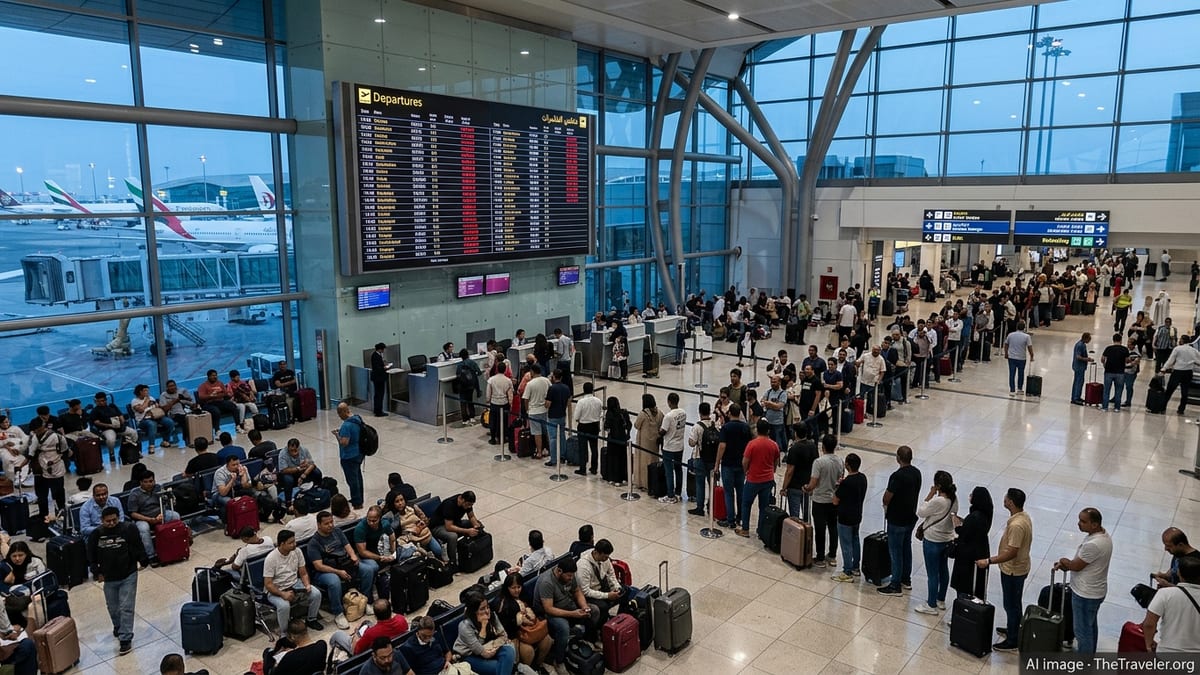
Renewed Disruptions at Strategic Gulf Gateways
Recent operational data and industry bulletins indicate that Kuwait International Airport and Abu Dhabi International Airport continue to experience heavy disruption, with schedules repeatedly adjusted as airlines navigate volatile airspace conditions and shifting security assessments. While outright shutdowns seen earlier in March have eased, capacity remains heavily constrained, translating into clusters of delays and targeted cancellations across the day.
In Kuwait, publicly available advisories describe operations as limited, with aircraft movements throttled and airlines concentrating on essential links and recovery flights. Gulf Air and Kuwait Airways, along with other regional carriers, have been rotating aircraft and crews to clear backlogs where possible, but tight turnaround windows and rerouted flight paths have left little slack in the system.
Abu Dhabi, a critical connecting hub for Etihad Airways and partner airlines, has been similarly affected. Published reports point to a pattern of staggered resumptions, with some Etihad services prioritized while others remain suspended or heavily retimed. This patchwork recovery has helped evacuate stranded passengers and restart core long-haul corridors, yet it has also produced rolling knock-on delays as connecting banks fail to align.
According to operational trackers, the latest wave of 98 delays and 24 cancellations across Kuwait, Abu Dhabi, and Cairo highlights the uneven nature of the recovery. Many affected flights involve Gulf carriers feeding traffic between Asia, Europe, and North America, amplifying the wider global impact.
Conflict, Airspace Closures, and Complex Rerouting
The disruption is rooted in a broader regional crisis that has reshaped flight planning across the Middle East since late February. Publicly accessible aviation overviews for 2026 describe extensive airport damage and intermittent closures in parts of the Gulf following missile and drone attacks, as well as precautionary suspensions driven by changing risk assessments. Key air corridors over Iran, Iraq, Israel, and sections of the Gulf have faced tight restrictions, forcing carriers to design longer, more southerly routes.
These airspace closures have a direct operational cost. Extended routings increase flight times, fuel burn, and crew duty hours, leaving airlines more vulnerable to cascading delays once a single rotation slips. Industry advisories circulated to corporate travel managers in early March note that, even where airports are technically open, reduced slot availability and congested alternate routings can degrade on-time performance for days.
Qatar Airways and Emirates, both highly dependent on complex hub-and-spoke networks, have been particularly exposed to these constraints. While both airlines have restarted select services through Doha and Dubai, public information shows that many routes are still operating at reduced frequencies, and some remain temporarily suspended. As traffic is re-routed through Kuwait, Abu Dhabi, and Cairo, bottlenecks have emerged, compounding pressure on those airports’ ground handling and air traffic flows.
Analysts following global aviation trends in 2026 note that this Middle East disruption comes on top of pre-existing challenges such as aircraft delivery delays, engine maintenance bottlenecks, and crew shortages. The result is a region where any additional shock quickly translates into large numbers of delayed or cancelled flights across multiple carriers.
Cairo’s Role as a Reliever Hub
With several Gulf hubs operating below normal capacity, Cairo International Airport has taken on greater importance as a reliever node for both regional and intercontinental services. Supply chain and logistics updates published in mid-March describe Egypt’s major airports as operational but subject to intermittent delays and cancellations linked to congestion and airspace rerouting.
EgyptAir has been working to maintain its core schedules between Cairo and key African, European, and Middle Eastern cities, even as some flights depart late or arrive outside their usual connection banks. Publicly available data shows that foreign carriers using Cairo as an alternative connecting point have added to the traffic surge, stretching airport infrastructure and lengthening turnaround times at peak hours.
The inclusion of Cairo in the latest count of 98 delays and 24 cancellations underscores how the knock-on effects of Gulf disruptions are now radiating across the wider region. Flights that previously routed via Doha, Dubai, or Abu Dhabi are in some cases being rebooked over Cairo, Jeddah, or Riyadh, redistributing congestion rather than eliminating it.
Travel risk consultancies tracking the situation warn that, while Cairo remains a comparatively stable option, passengers should anticipate schedule changes and allow more generous connection buffers than usual. Egypt’s geographical position, bridging Africa, the Middle East, and Europe, makes it a natural fallback hub but also a potential pressure point when regional skies are in flux.
Passenger Experience: Longer Journeys, Thinner Margins
For passengers, the immediate impact of the ongoing disruption has been longer and less predictable journeys. Regional travel forums and social media posts from early and mid-March describe travellers experiencing extended layovers in Abu Dhabi and Kuwait, with some reporting last-minute gate changes and overnight delays as airlines reshuffled aircraft and crew.
Etihad Airways, Emirates, Qatar Airways, Gulf Air, Kuwait Airways, and EgyptAir have all issued schedule updates and waiver policies at various points this month, according to publicly available statements and travel advisories. These measures have typically included options to rebook without penalties, defer travel, or request refunds on affected itineraries within specified date ranges. However, high demand for limited alternative seats has sometimes left passengers with few immediate options, especially on long-haul segments.
Industry observers note that hub carriers are using a mix of strategies to cope: consolidating lightly booked flights, upgauging aircraft where possible, and operating selective relief services to clear stranded customers. Yet with airspace still constrained and airports operating under heightened security protocols, there is little scope to quickly restore full pre-crisis capacity.
Travel insurance providers and corporate travel managers have responded by updating their own guidance. Many now recommend that travellers bound for or transiting through the Gulf and Egypt build in additional time, monitor flight status frequently on the day of departure, and remain flexible about routing changes that may occur even after check-in.
What Travellers Should Expect in the Coming Days
Looking ahead, publicly available industry commentary suggests that Middle East aviation is entering a protracted period of managed disruption rather than a swift return to normal operations. As of late March 2026, several major regional airports, including those in the United Arab Emirates and Kuwait, are described as partially operational, with capacity ramps tied closely to evolving security and diplomatic developments.
Carriers such as Qatar Airways, Emirates, Etihad Airways, Gulf Air, Kuwait Airways, and EgyptAir are expected to continue revising schedules day by day, balancing demand against restricted routings and airport constraints. Additional clusters of delays and cancellations, similar in scale to the current 98 delays and 24 cancellations at Kuwait, Abu Dhabi, and Cairo, remain likely whenever new airspace notices or operational issues arise.
Travel analysts point out that the global impact extends beyond the region, as aircraft and crew rotations ripple into Europe, Asia, and North America. Passengers starting their journeys far from the Middle East may feel the effects through missed connections, aircraft swaps, or altered departure times, even if their own flights do not touch the region directly.
For now, the consensus across public advisories and aviation briefings is that flexibility is essential. Travellers planning routes that involve Kuwait, Abu Dhabi, Cairo, or other regional hubs are being urged to check their flight status repeatedly in the 24 hours before departure, register contact details with airlines for real-time notifications, and be prepared for last-minute adjustments as Middle East air travel continues to operate under unusually tight margins.