

More news on this day
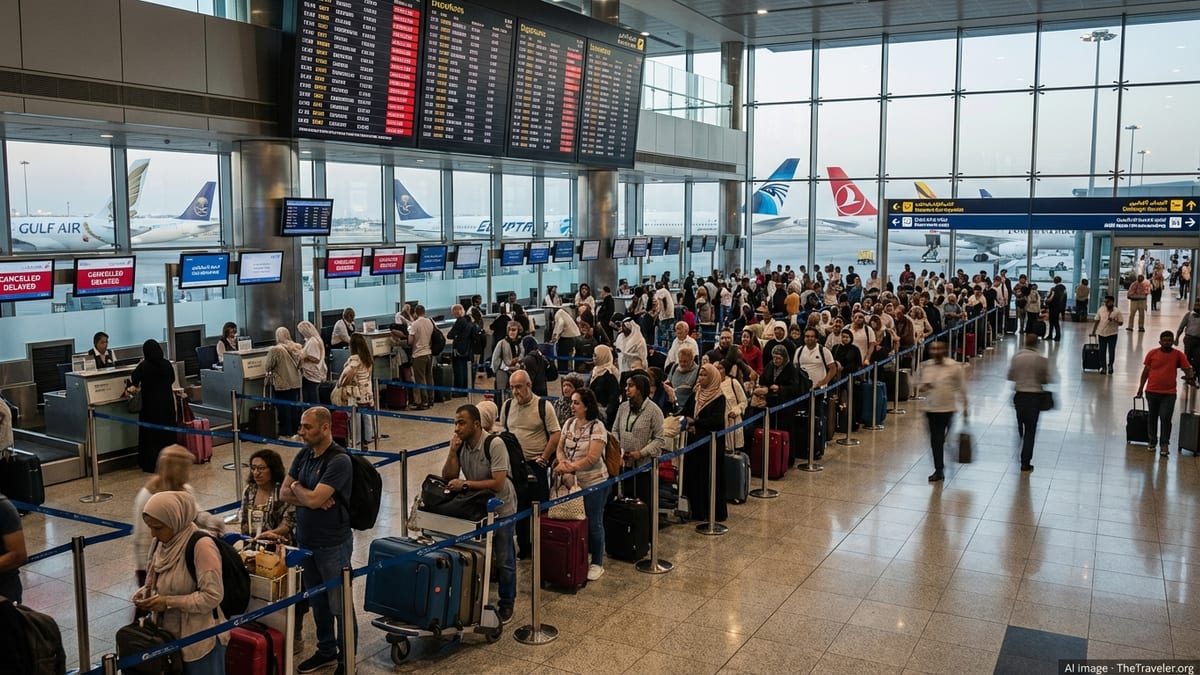
Air travel across the Middle East has been thrown into fresh turmoil as at least 295 flights were cancelled and 262 delayed across Saudi Arabia, Bahrain, the United Arab Emirates and Egypt, with carriers including Gulf Air, Saudia, Pegasus Airlines and EgyptAir struggling to absorb the shock of sudden airspace restrictions and damage at key hub airports.
Airspace Closures Ripple Across Gulf and North Africa
The latest wave of disruption began after coordinated military strikes in the region prompted several Middle Eastern states to restrict or close sections of their airspace, forcing airlines to cancel and reroute flights at short notice. Aviation analytics firms report that almost a quarter of scheduled services to key Middle Eastern destinations were cancelled in a single day, with knock-on disruption now spilling into early March.
Saudi Arabia, Bahrain and the UAE have emerged as critical pressure points, as carriers that normally rely on overflight permissions and dense hub operations suddenly face tight routing constraints. Egypt, which functions both as a regional hub and a gateway between Africa, Europe and the Gulf, has also been drawn into the crisis as its flag carrier suspends multiple routes.
While the headline figures of 295 cancellations and 262 delays capture only a slice of the wider crisis, they underline how quickly a complex aviation network can seize up when a handful of corridors close. Airports in Riyadh, Jeddah, Dammam, Manama, Dubai, Abu Dhabi and Cairo are reporting heavy congestion as aircraft, crew and passengers end up out of position.
Analysts say the scale and speed of the disruption are comparable to previous conflict-related shutdowns in the region, but with a wider geographic footprint because multiple Gulf states have simultaneously tightened their skies. With international long-haul traffic so reliant on Gulf and Egyptian hubs, the impact is being felt well beyond the Middle East itself.
Gulf Air and Saudia Confront Mounting Operational Strain
Among regional carriers, Bahrain-based Gulf Air and Saudi Arabia’s Saudia are facing particularly acute challenges. Data from industry trackers shows Gulf Air cancelling a significant share of its scheduled services as Bahrain’s position between the Gulf and wider Middle East leaves it exposed to airspace bottlenecks. The loss or limitation of key routes has quickly translated into stranded aircraft and disrupted rotations.
In Saudi Arabia, Saudia and low-cost operators such as Flynas have also been forced into selective cancellations and rolling delays, especially on cross-border routes that transit airspace now deemed high risk. Even when domestic services inside the kingdom can operate, crews and aircraft that should be arriving from abroad are frequently delayed or diverted, forcing last-minute timetable changes.
Saudi airports that traditionally act as overflow or diversion points for the wider region are under heavy pressure. As airlines from Europe, Asia and Africa attempt to route around closed corridors, Saudi air traffic controllers are handling increased volumes of overflights and diversions, a pattern that complicates scheduling for Saudia’s own network.
For passengers, this has meant long queues at transfer desks in Riyadh and Jeddah, rebookings spread over several days, and difficulty securing seats during peak travel periods. Travel agents across the Gulf report that some Saudi-bound itineraries now involve circuitous routings and extended layovers, even where flights are technically still operating.
Pegasus and Regional Carriers Cut Routes Into the Gulf
The disruption is not confined to Gulf-based airlines. Turkish low-cost carrier Pegasus has cancelled or suspended multiple services into the region as it responds to the evolving patchwork of airspace restrictions. The airline has publicly confirmed that flights to destinations including the UAE, Qatar, Kuwait and Bahrain have been pulled from schedules for at least several days, while flights to Iraq, Iran, Jordan and Lebanon are suspended into early March.
For Pegasus, which relies on high aircraft utilization and tight turnarounds at its Istanbul hub, the loss of these routes carries both operational and financial consequences. Aircraft that would normally cycle through Gulf and Levant destinations must be reassigned or grounded, while crews are repositioned and hotel stays extended for those already en route when cancellations were triggered.
Other regional carriers, including Turkish Airlines and smaller Gulf-based operators, are implementing similar measures, dramatically thinning the usual web of short- and medium-haul connections that feed long-haul routes. Industry observers say the combined effect has been to fragment what is typically one of the world’s most densely served air corridors.
As airlines in Türkiye, India and Europe suspend or curtail Middle East operations, passengers who booked itineraries using Pegasus and other value carriers to connect via the Gulf are among the hardest hit. Many now face the prospect of rebooking at short notice on legacy airlines at higher fares, with limited clarity on when their original routes will return.
EgyptAir Suspends 13 Routes as Cairo Becomes a Crisis Hub
EgyptAir has moved aggressively to protect safety and manage uncertainty by suspending flights from Cairo to 13 cities across the Gulf and wider region, including Kuwait, Dubai, Doha, Bahrain, Abu Dhabi, Sharjah, Qassim, Dammam, Erbil, Baghdad, Amman, Beirut and Muscat. The decision effectively severs several of Cairo’s key regional links, though domestic operations and some long-haul services continue.
The airline’s crisis cell at Cairo International Airport is now coordinating closely with aviation and security authorities to track the situation hour by hour. Terminal scenes in Cairo mirror those at other regional hubs: passengers crowding customer-service counters, rolling departure-board updates, and growing backlogs of rebookings as aircraft and crews fail to arrive on schedule.
Egypt’s geographic position means the country is both a beneficiary and a victim of regional rerouting. Some long-haul flights from Europe and Africa that once transited deeper into the Gulf are now using Egyptian airspace as an alternative path where safe and permitted. At the same time, the loss of direct services from Cairo to Gulf capitals is undermining EgyptAir’s role as a connector for business, labor and family travel flows.
For travelers in Egypt and the wider North Africa region, the current pattern of cancellations and delays has sharply reduced options for reaching Gulf employment hubs and onward destinations in Asia. Industry sources warn that if the airspace closures persist, demand could shift toward alternative carriers and routings via Europe or the eastern Mediterranean, at least temporarily.
What Affected Passengers Need to Know Right Now
With thousands of passengers stranded or facing major disruptions across Saudi Arabia, Bahrain, the UAE and Egypt, airlines and regulators are urging travelers to monitor their flight status continuously and to expect last-minute changes. Same-day cancellations are common as security assessments evolve, and many flights that do depart are operating with extended flying times and unplanned fuel stops due to detours around restricted airspace.
Most affected airlines, including Gulf Air, Saudia, Pegasus and EgyptAir, are offering some combination of free rebooking, travel vouchers or refunds on cancelled flights. However, policies differ by carrier and route, and processing times are slowed by the volume of requests. Travelers are being advised to work through official airline channels or accredited travel agents, and to avoid heading to the airport without a confirmed new itinerary.
Experts also recommend that passengers build extra buffer time into any essential journeys that still involve transiting the region, and that they consider alternative routings, such as connections via Europe or South Asia, where feasible. For those already stuck at airports, keeping all boarding passes and receipts will be important if compensation or reimbursement claims become available later under local consumer-protection rules.
While aviation authorities stress that safety remains the paramount concern, industry analysts caution that the operational and financial aftershocks of the current wave of cancellations and delays could linger even after airspace begins to reopen. Clearing backlogs, repositioning aircraft and restoring normal schedules across Saudi Arabia, Bahrain, the UAE and Egypt is likely to take days, if not weeks, once the skies are fully declared safe again.