

More news on this day
Dozens of flights linking Tbilisi with key Middle Eastern hubs in Doha, Dubai and Tel Aviv were abruptly canceled or delayed on Monday, as cascading airspace closures and intensifying regional conflict triggered fresh travel chaos across Qatar, the United Arab Emirates and Israel.
Wave of Cancellations Leaves Tbilisi Passengers Stranded
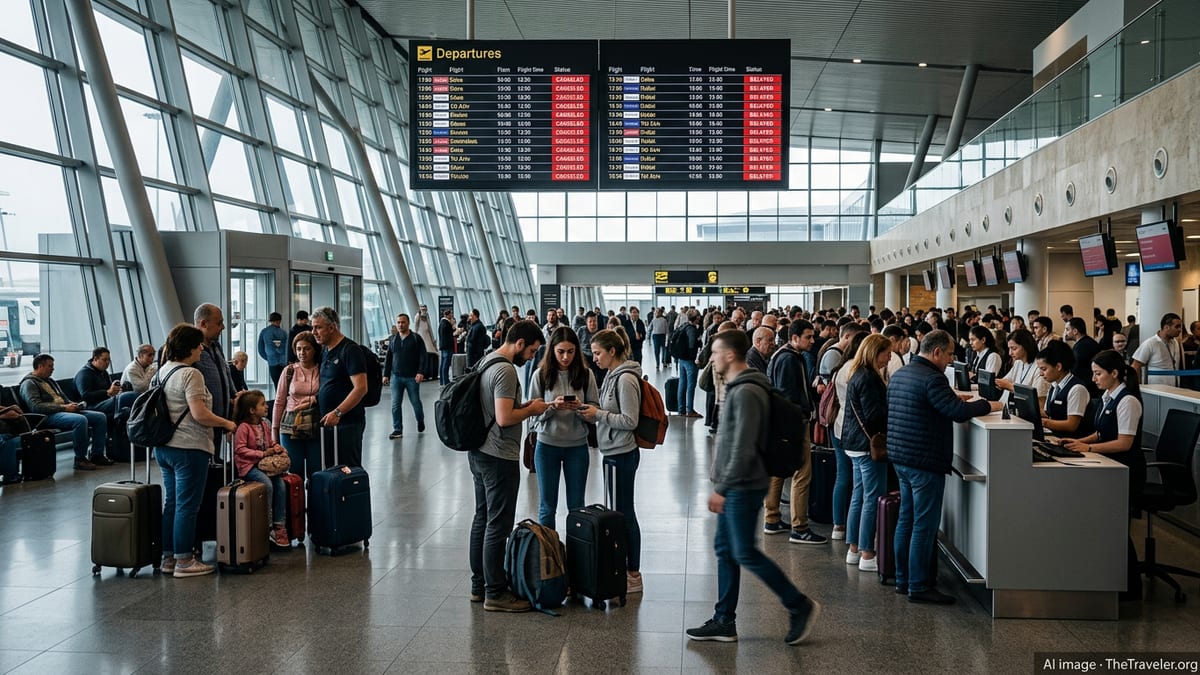
Operations at Tbilisi International Airport were severely disrupted after airport officials confirmed that around 40 flights had been canceled and at least four more delayed, many of them serving major Middle Eastern hubs. The sudden schedule collapse affected both departures and arrivals, hitting passengers trying to reach or transit through Doha in Qatar, Dubai in the United Arab Emirates and Tel Aviv in Israel.
The disruption comes as airlines continue to navigate a volatile security environment across the region, following repeated missile strikes, rapid airspace closures and evolving government advisories. Flights that would normally distribute Georgian travelers and international transit passengers onward from Tbilisi to destinations in Europe, Asia and North America via Middle Eastern hubs have been suspended or significantly reduced.
Staff at Tbilisi reported long queues at airline desks, with many travelers seeking rerouting options via Istanbul, European hubs or alternative Gulf airports where services remain limited but operational. Airport authorities urged passengers not to travel to the airport without a confirmed rebooking, citing the risk of further last minute cancellations as airlines reassess security and airspace conditions hour by hour.
Carriers serving Tbilisi are advising customers to monitor their booking platforms and mobile apps closely, as automated notifications often arrive before flight information displays update at the terminal. Travelers holding tickets through Doha, Dubai or Tel Aviv in the coming days are being warned that even flights still showing as operating remain subject to abrupt change.
Doha and Dubai Struggle to Reopen Amid Continuing Airspace Turmoil
In Doha, Qatar’s Hamad International Airport remains one of the hardest hit by the unfolding crisis. Authorities have repeatedly closed and partially reopened Qatari airspace in recent days following Iranian missile attacks and heightened military activity, forcing Qatar Airways and other carriers to cancel large swathes of their schedules and operate only limited repatriation services on specially approved corridors.
Dubai, typically one of the world’s busiest and most resilient hubs, has also seen unprecedented disruption. Airlines including Emirates, flydubai and a host of international carriers have canceled or suspended services on routes across the region, as well as some long haul flights that would normally use Iranian, Iraqi or Gulf airspace. Airport operators in Dubai have acknowledged thousands of cancellations since late February, with departure halls crowded by stranded transit passengers waiting for scarce rebookings.
The turmoil in both Doha and Dubai has sharply reduced onward options for passengers originating in Tbilisi. Many itineraries that once relied on Middle Eastern connections to reach South and Southeast Asia, Africa or Australia have been invalidated overnight. With Qatar Airways still operating on a skeletal basis and Gulf carriers trimming schedules, seats on alternative routings via Istanbul, major European gateways or Central Asian hubs have become scarce and more expensive.
Regional aviation analysts note that the dual shock of airspace closures and security concerns has exposed just how dependent Caucasus and Eastern European travelers are on Gulf super-connectors. Even as some airlines cautiously restart selective services from the United Arab Emirates and Qatar, they warn that full restoration of pre-crisis frequencies will likely take weeks, if not longer.
Tel Aviv Routes Remain Frozen as Airlines Extend Suspensions
Services between Tbilisi and Tel Aviv have been particularly hard hit, reflecting Israel’s central role in the current conflict and the concentration of military activity in and around its airspace. Multiple international airlines had already suspended Tel Aviv flights following earlier escalations; in recent days, several have announced fresh extensions, pushing their return dates well into late March or beyond.
Carriers from Europe and North America have cited both operational risk and weak demand as reasons for prolonging suspensions to Tel Aviv. Some are operating occasional special services intended to support evacuation and repatriation efforts, but these flights are typically reserved for citizens and permanent residents and rarely available through regular sales channels. For ordinary leisure and business passengers, options remain extremely limited and subject to sudden change.
For travelers in Georgia, the freeze on Tel Aviv routes has severed a previously busy corridor connecting family networks, religious tourism and business ties between the two countries. Travel agents in Tbilisi report that many trips planned around religious holidays and spring events have been abandoned, with customers opting to delay travel indefinitely rather than attempt complex and uncertain routings through third countries.
Airlines maintaining codeshare or seasonal operations between Georgia and Israel have issued broad waivers, allowing passengers to rebook onto later dates without penalty or request refunds where services are fully canceled. However, with no clear timeline for a stable reopening of Israeli airspace, many affected travelers are choosing to keep vouchers or open tickets rather than commit to new dates that may again be disrupted.
What Affected Travelers Need to Know Right Now
For passengers scheduled to fly from Tbilisi to Doha, Dubai or Tel Aviv in the coming days, the most important step is to treat all bookings as provisional. Aviation authorities across the Middle East are updating restrictions frequently, and airlines are adjusting schedules at short notice as they respond to government directives and changing risk assessments. Even confirmed flights can be canceled or retimed within hours of departure.
Travel experts recommend that passengers with imminent departures avoid heading to the airport until they have received explicit confirmation that their flight is operating as planned. Printed itineraries issued days earlier are no guarantee of service in the current environment. Instead, travelers should rely on real time information through airline apps, text alerts and direct communication with carriers or booking agents.
Those whose flights have already been canceled from Tbilisi should explore alternative routings, but be prepared for limited availability and longer travel times. Istanbul and certain European hubs currently offer the widest range of replacement connections for long haul journeys that would normally transit the Gulf, though seats in premium cabins are especially constrained. Flexible date ranges and openness to indirect routes significantly increase the chances of securing a new itinerary.
Passengers with nonessential trips are being urged to consider postponement, particularly where journeys involve multiple connections across the Middle East. Many airlines are offering expanded change fee waivers and refund options due to the conflict, and in some cases travelers can convert tickets into vouchers valid for later in the year. For those who must travel, comprehensive travel insurance that covers war-related disruptions and prolonged delays is strongly advised.
Outlook for Recovery and Key Questions for the Days Ahead
Aviation officials caution that forecasting a precise timeline for recovery remains difficult while military operations and diplomatic negotiations are ongoing. Each incremental decision to reopen or reclose segments of airspace has a knock-on effect across airline networks, influencing whether carriers can safely restore links between Tbilisi and Middle Eastern hubs or must maintain widespread cancellations.
In the short term, gradual increases in limited repatriation and relief flights are likely to continue, particularly from Doha and Dubai, as airlines prioritize citizens and long delayed passengers. However, a full return of high frequency commercial schedules on routes to and from Tel Aviv appears distant, and services via the Gulf hubs will probably remain patchy, with frequent last minute revisions.
For Tbilisi International Airport and the Georgian travel industry, the crisis highlights the need to diversify long haul connectivity beyond a small number of Middle Eastern hubs. Industry observers suggest that expanded links to European, Turkish and Central Asian gateways could provide greater resilience against future regional shocks, although such adjustments take time and significant investment to materialize.
Until a more stable security environment emerges across Qatar, the United Arab Emirates and Israel, travelers from Georgia and beyond can expect continued uncertainty. Monitoring official advisories, staying in close contact with airlines and allowing generous buffers for any essential journeys remain the only reliable tools for navigating an unprecedented period of disruption in one of the world’s most important aviation corridors.