

More news on this day
Escalating conflict involving Iran, Israel and the United States is reshaping aviation across the Middle East in real time, with key hub airports operating on sharply reduced schedules and global carriers rewriting their route maps around newly volatile skies.
Get the latest news straight to your inbox!
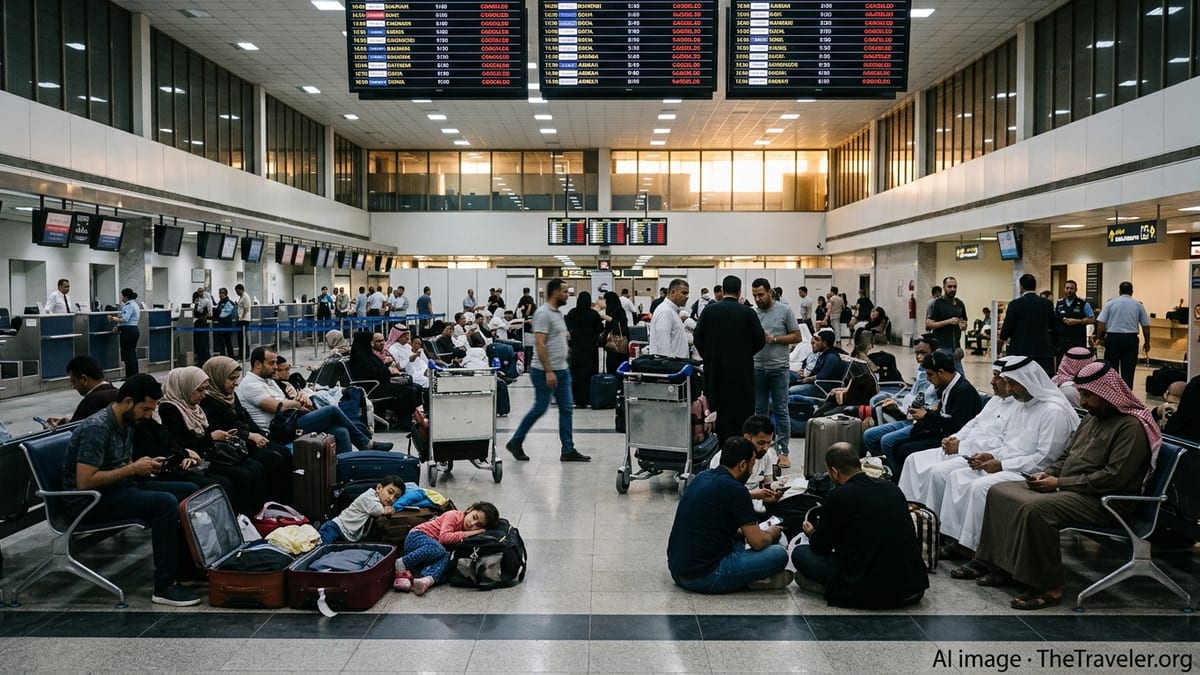
Hub Airports Shift From Global Gateways to Managed Bottlenecks
In a region where a handful of mega-hubs normally funnel long haul traffic between Europe, Asia, Africa and the Americas, current hostilities have turned Middle East airports into managed bottlenecks. Dubai International, Hamad International in Doha and Abu Dhabi International have all faced rolling suspensions, reduced movements and temporary closures of surrounding airspace as authorities respond to missile and drone threats and debris hazards.
Reports indicate that Dubai International, which briefly halted operations during a wave of Iranian missile and drone activity, has since reopened with limited flights and tightened operating windows. Publicly available information describes hundreds of cancellations and delays across the United Arab Emirates in early March and early April, with ground holds and diversions rippling through connecting banks normally timed to support six-continent networks.
In Doha, Hamad International has moved from a full shutdown of regular commercial traffic to a cautious reopening for selected evacuation and cargo flights. Statements and local coverage in early March described only a narrow number of departures allowed, focused on clearing stranded passengers and maintaining limited freight links while broader commercial schedules remain suspended or highly constrained.
Elsewhere in the region, hub airports that are not direct targets are still absorbing spillover. Cairo, Riyadh and Jeddah have seen elevated delays as rerouted traffic and disrupted crew rotations push schedule banks beyond normal capacity. Operational snapshots compiled by industry trackers in early April highlight hundreds of delayed departures at these gateways in a single day, illustrating how a conflict centered in the Gulf now affects hubs across the wider Middle East and Eastern Mediterranean.
Gulf Super-Connectors Cut Capacity and Rebuild Networks
The Gulf’s so called super-connector airlines are experiencing some of their sharpest network shocks since the onset of the COVID 19 pandemic. Public updates from Qatar Airways in early March confirmed a temporary suspension of regular passenger operations due to Qatari airspace closure, followed by the introduction of limited repatriation flights under a special corridor authorization. This has effectively transformed Doha from a round the clock connecting hub into a tightly managed evacuation and cargo node.
Emirates and flydubai, based at Dubai International and Al Maktoum, have also moved through several phases of disruption. Travel trade coverage and airline alerts describe extensive cancellations and rolling rebooking policies, with passengers urged not to go to the airport without confirmed alternate itineraries. As interceptions of drones and missiles continue over the UAE, carriers have been forced to consolidate frequencies, shift departure waves and deploy smaller aircraft on routes where demand and operating conditions are more predictable.
Etihad Airways in Abu Dhabi and regional competitors such as Oman Air and Gulf Air have similarly trimmed schedules, suspended select regional routes and adjusted flight paths to avoid higher risk airspace. Advisory notes from aviation risk consultancies portray a central corridor of Middle East airspace that remains largely blocked, forcing airlines to rely on more southerly or northerly tracks that add hours of flight time and constrain aircraft utilization.
At the same time, foreign carriers that rely on the Gulf hubs as their primary access points into the region and onward to South Asia and Africa are cutting back. Airlines from Southeast Asia, including Philippine carriers, have cancelled multiple services into Doha and Dubai through at least late April, with waivers and flexible rebooking policies signaling that disruptions are expected to extend well beyond the initial flare up of hostilities.
Airspace Closures, Reroutes and Rising Operational Risk
Airspace closures are at the heart of the current disruption. A patchwork of restrictions spanning Iran, Iraq, parts of the Gulf and segments of the Eastern Mediterranean has left the traditional East West trunk lanes through the Middle East effectively severed at times. Security advisories published through March and into April describe intermittent closures, sudden restrictions at all altitudes and a high risk of interception activity that can prompt last minute diversions.
Specialist aviation bulletins characterize the central corridor over Iran and neighboring states as highly constrained, pushing carriers to detour via Saudi Arabia, Egypt, Turkey or longer oceanic routes. These changes typically add between 1.5 and 5 hours to long haul sectors linking Europe and Southeast Asia, driving up fuel burn and complicating crew scheduling. For hub carriers that depend on precise banked connections, even modest extensions can break carefully planned minimum connection times and force wholesale timetable revisions.
Missile and drone attacks have also had direct effects on infrastructure. Reporting on Iranian strikes across the Gulf region describes attempted hits on or near major airports and confirmed damage to data center facilities in Bahrain and Dubai that support critical aviation and logistics systems. While core runway and terminal infrastructure at leading hubs remain largely intact, the perceived risk environment has intensified, underpinning cautious capacity decisions by airlines and nervousness among travelers.
Electronic warfare and navigation interference present a further complication. Aviation alerts in recent weeks reference GPS jamming and spoofing incidents across West Asia, which can affect both en route navigation and approach procedures. Airlines are responding with more conservative dispatch criteria, higher fuel reserves and greater use of alternate airports, all of which add cost and limit the number of flights that can be safely operated in a given day.
Knock-On Effects for Global Connectivity and Cargo
The Middle East’s role as a bridge between continents means that impacts at its hubs quickly extend far beyond the region. For passengers in Europe, Asia and Africa, reduced connectivity through Dubai, Doha and Abu Dhabi has translated into longer itineraries, fewer daily frequencies and tighter availability on remaining services. Industry data compiled for early April show dozens of long haul cancellations tied directly to Middle East disruptions, with knock on delays affecting onward legs to destinations as far afield as North America and Oceania.
In some markets, airlines and regulators are advising travelers to avoid routings via the Gulf altogether in the short term. Civil aviation notices in South Asia and travel waivers from North American and European carriers encourage rebooking over alternative hubs in Europe, Central Asia or Africa, even where this requires an extra stop or higher fares. This shift is providing a temporary traffic boost to airports such as Istanbul, Athens and select North African gateways, but also straining their capacity to handle displaced passengers and last minute charter operations.
Cargo flows are under similar pressure. Logistics bulletins issued in March highlight significant delays for time sensitive freight that would normally transit via Middle East hubs, particularly pharma, electronics and automotive components. With some freighter operators diverting to secondary gateways or suspending routes entirely, shippers are weighing more costly direct options or rerouting via Asia Europe land corridors and African coastal ports already congested by earlier Red Sea and Gulf shipping disruptions.
The cascading impact on supply chains is especially visible in sectors that built just in time inventories around predictable overnight links through the region. Forwarders warn of longer lead times, higher surcharges and a growing reliance on multimodal solutions that combine limited air capacity with rail and sea legs. For global manufacturers, the Middle East aviation shock is becoming another variable in an already complex network of logistical risks.
Uncertain Path to Normalization
Despite intermittent signs of stabilizing operations at select hubs, available evidence suggests that a rapid return to pre crisis norms is unlikely. Security advisories issued through late March and early April continue to flag a high likelihood of sudden airspace closures, further strikes and additional infrastructure damage. While some airports, notably in Saudi Arabia and Oman, report more consistent operations, their ability to fully substitute for Dubai, Doha or Abu Dhabi as transfer points remains limited by terminal capacity and airline network structures.
Middle East carriers are responding with a mix of tactical and strategic adjustments. In the near term, they are prioritizing core trunk routes, maintaining links to key governmental and corporate markets, and using flexible rebooking windows to retain customer loyalty under difficult conditions. Over a longer horizon, analysts writing in regional and international outlets suggest that airline planners may re evaluate their exposure to single corridor choke points by diversifying routings and deepening partnerships with carriers based in Europe, Central Asia and Africa.
For travelers and businesses, the practical message is that volatility in Middle East aviation is likely to persist at least through the coming months. Flight schedules remain fluid, with last minute changes common even on routes that have technically resumed, and war risk, fuel and insurance costs continue to rise. Until a sustained reduction in missile and drone activity is matched by a clear easing of airspace restrictions, the region’s hubs will operate below their designed capacity, and their airlines will continue to navigate one of the most complex operating environments in modern commercial aviation.