

More news on this day
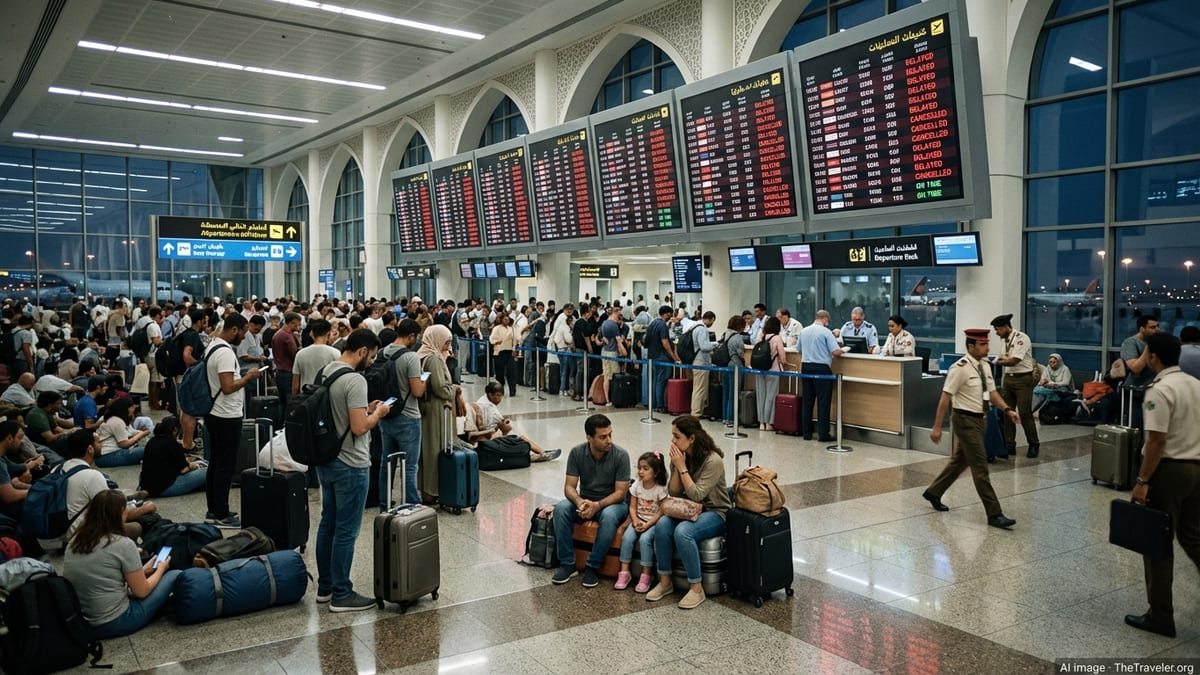
Thousands of passengers across Abu Dhabi, Dubai, Doha and other Gulf hubs were left staring at departure boards in disbelief this weekend as a fresh wave of delays and cancellations at key US airports compounded an already historic airspace shutdown across the Middle East.
US Airport Gridlock Deepens a Global Aviation Crisis
While Gulf travellers have spent the past 48 hours grappling with one of the worst regional aviation disruptions in years, a separate bout of severe schedule chaos at major US hubs has added a new layer of complexity. At Newark Liberty, Orlando, Los Angeles International and New York’s John F Kennedy International Airport, a combined 231 flights were delayed and 160 services cancelled over a 24 hour period, according to preliminary operational data shared by industry analysts on Sunday.
The figures, though modest compared with the thousands of flights cancelled across the Middle East since Saturday, are disproportionately affecting passengers whose journeys start or end in the Gulf. With Dubai, Abu Dhabi and Doha still operating on sharply reduced schedules, any missed connection in the United States can mean days of uncertainty as airlines struggle to find seats on already oversubscribed alternative routings.
Carriers operating the busy transatlantic and transpacific links between US gateway cities and Gulf megahubs report that crews and aircraft are increasingly out of position. This has triggered rolling knock-on delays on both sides of the Atlantic, with some US passengers bound for Abu Dhabi or Doha only learning of cancellations at the gate, and others discovering that long-booked return flights no longer appear in live schedules.
In several cases, long-haul flights from the Gulf that did manage to depart have arrived in the US with no guaranteed onward connections, leaving travellers stranded landside at Newark or JFK as ground handlers attempt to rebook them across fragmented networks.
Airspace Closures Leave Gulf Hubs Struggling to Recover
The trouble in the United States comes as Gulf aviation systems are already stretched to breaking point. Since Saturday, airspace closures across parts of the Middle East, triggered by escalating military strikes and retaliatory attacks, have forced governments including the United Arab Emirates and Qatar to restrict or temporarily halt commercial traffic over key corridors.
Dubai International, Abu Dhabi’s Zayed International and Doha’s Hamad International – three of the world’s most important connecting hubs – have all seen swathes of their schedules wiped out. Regional and international airlines have suspended or curtailed operations, leaving aircraft parked on aprons and crews waiting for clearance to resume flying. Analysts say that more than a fifth of all planned services into affected Middle Eastern countries were cancelled in a single day, with subsequent days showing only marginal improvement as carriers grapple with new safety advisories.
For Gulf-based travellers with tickets to US cities such as New York, Los Angeles and Orlando, this has created a double bind. Even when their originating flight is permitted to depart from Dubai or Doha, onward connectivity into the US domestic network is limited by congestion and crew-duty constraints at American hubs. Travellers are being warned that the usual precision-timed bank of connections which made one-stop itineraries via the Gulf so attractive has temporarily dissolved.
Airport officials in the region describe terminals filled with passengers trying to rebook complex multi-sector journeys that thread through now congested US airports. Many have been offered hotel accommodation or meal vouchers, but with some carriers keeping schedules under rolling review, today’s rebooked itinerary can quickly become tomorrow’s latest cancellation.
Stranded Passengers Face Long Queues and Limited Answers
Across Abu Dhabi, Dubai and Doha on Sunday, the human cost of the disruption was increasingly visible. Check in halls that would typically empty between departure waves remained crowded well into the night as travellers queued for customer service desks, often with little clear information about when airspace restrictions would ease or when US hubs might stabilise their operations.
Some families reported being rebooked multiple times, only to have new flights delayed repeatedly or scrapped outright as conditions evolved. Others found themselves split across different routings, with parents and children or travelling companions assigned to separate flights days apart in a bid to clear backlogs. Premium lounges, usually quiet sanctuaries for long-haul passengers, were overflowing as airlines invited economy travellers facing overnight delays to wait in more comfortable surroundings.
In online forums and at airport information counters, a common refrain emerged: confusion over whose responsibility it is to rebook and compensate passengers when their problems straddle multiple jurisdictions. With an initial disruption caused by regional airspace closures and a secondary shock coming from US hub congestion, many travellers reported being passed between airline, codeshare partner and booking platform, each citing different policies and limitations.
Airlines insist that safety remains the overriding priority, pointing to the need to comply with fast-changing security advisories and to ensure that crews are properly rested before operating ultra-long-haul sectors between the Gulf and North America. But for those already stranded for 24 hours or more, patience is wearing thin.
Airlines Reroute, Trim Schedules and Warn of Prolonged Impact
Facing a volatile security backdrop and mounting operational bottlenecks, carriers on both sides of the Atlantic have embarked on emergency schedule surgery. Gulf airlines have extended temporary suspensions from UAE airports into Monday, sharply limiting departures while they reassess risk and await more stable airspace conditions. In parallel, US and European partners that feed traffic into Gulf-bound services from Newark, Orlando, Los Angeles and JFK are trimming frequencies and swapping in smaller aircraft where demand has softened or connections have become unreliable.
Network planners say that while some long-haul routes can be preserved through creative rerouting that skirts closed airspace, this commonly adds flying time and fuel burn, reducing the number of rotations each aircraft can perform in a day. Over time, that compounds pressure on already tight fleets. The result is that even routes not directly overflying the Middle East, including some transatlantic links into US hubs, are exposed to cancellations as airlines free up aircraft to maintain core corridors.
Industry experts caution that once the immediate security crisis begins to ease, a second phase of disruption is likely as airlines grapple with dislocated aircraft and crew rosters. Getting long-haul networks back into their normal rhythm can take days, and in some cases more than a week, particularly when disruptions coincide across multiple regions as they have this weekend.
Passengers holding tickets for travel between the Gulf and the United States in the coming days are being urged to monitor their bookings closely, sign up for airline alerts and consider building in longer connection windows if travel is unavoidable. Although some flights continue to operate, the environment remains highly fluid, and any fresh airspace restrictions or operational issues at US hubs could quickly trigger another round of cancellations.
What Gulf and US Travelers Should Do Now
Travel agencies across the UAE and Qatar reported a surge in calls on Sunday as customers sought to understand whether they should push ahead with planned trips or postpone. Agents say that for many, the answer depends on flexibility. Those with non-essential travel are being advised to consider deferring departures until at least midweek, by which time airlines hope to have a clearer picture of both regional airspace conditions and US airport performance.
For travellers who must fly, experts recommend keeping itineraries as simple as possible, ideally with a single carrier on a through ticket rather than multiple separate bookings stitched together across alliances. This can make a crucial difference when seeking rebooking or assistance if disruption strikes en route. Passengers are also being reminded to check the fine print on travel insurance policies, as coverage for delays and cancellations triggered by conflict or airspace closures can vary considerably.
At the terminals, airport staff in Abu Dhabi, Dubai, Doha and other regional airports are attempting to direct passengers to updated information screens and dedicated disruption helpdesks. However, with events changing by the hour and call centres overwhelmed, many travellers are turning to airline apps and social media channels for the fastest updates on gate changes and last-minute schedule adjustments.
With Gulf airspace partial closures overlapping with US hub congestion, aviation analysts say the current situation amounts to a “perfect storm” for international travel. Until both regions see a sustained period of operational stability, passengers moving between the Middle East and North America should brace for a travel experience defined by uncertainty, extended journey times and the very real possibility of unexpected overnight stays along the way.