

More news on this day
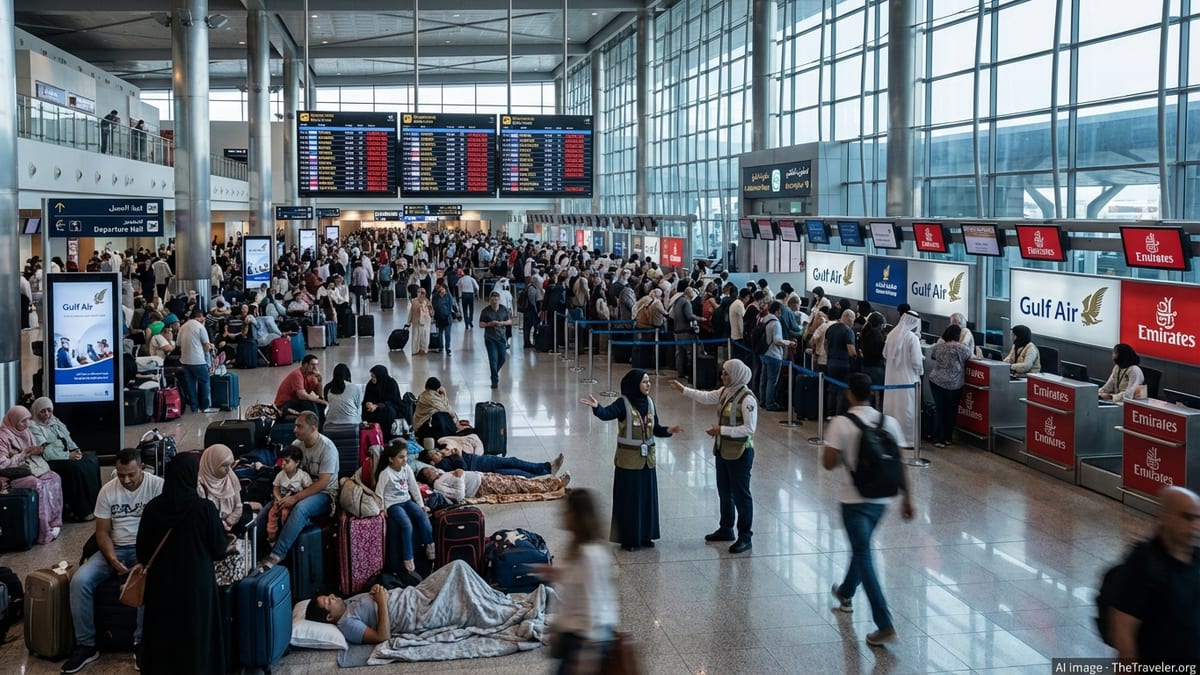
Fresh security tensions linked to the 2026 Iran conflict are sending new shockwaves through Middle East aviation, with Bahrain joining Qatar, the United Arab Emirates, Saudi Arabia, Turkey, Kuwait and Cyprus in reporting dozens of cancellations and hundreds of delays as airlines struggle to keep regional and long-haul networks running.
Get the latest news straight to your inbox!
Security Crisis Deepens Across Regional Airspace
Publicly available aviation data and travel advisories for March 2026 show that airspace restrictions across Bahrain, Qatar, the United Arab Emirates, Saudi Arabia, Iran and Iraq have become a defining feature of the current phase of the Iran war. Authorities in several Gulf states have maintained partial or full closures of their skies at different points since the end of February, citing the risk of missile and drone activity in key flight corridors.
Operational summaries from travel management and risk firms in early March indicate that Bahrain’s airspace has been subject to the same rolling restrictions affecting Qatar and the United Arab Emirates, triggering widespread disruption at hub airports such as Dubai, Abu Dhabi and Doha. The closures have forced large carriers to ground or reroute services, with ripple effects reaching Kuwait, Saudi Arabia and Turkey as aircraft and crews fall out of position.
Airline-focused analyses of the crisis describe a pattern of reactive schedule changes, where carriers cancel blocks of flights during peak alert periods and then reinstate limited operations once military activity eases. This stop-start rhythm is contributing to a growing backlog of displaced passengers and missed connections, particularly on trunk routes linking Europe and North America with Asia via the Gulf.
Recent reporting by international newswires and specialist aviation outlets highlights the scale of the shock. After coordinated US and Israeli strikes on Iran in late February, thousands of flights across the wider Middle East were canceled or diverted, as most regional states moved quickly to shield airspace from potential retaliatory attacks. The latest wave of closures in March has renewed that disruption, even as airlines attempt gradual resumption on selected routes.
Bahrain Joins Regional Hubs Under Pressure
The involvement of Bahrain in the current round of disruption marks a significant expansion of the crisis. Travel alerts issued in early March reference Bahrain alongside Qatar, Kuwait, Saudi Arabia and the United Arab Emirates as locations where airspace controls and heightened security postures are impacting civilian travel, both for point-to-point services and for transfers through hub airports.
Gulf Air, Bahrain’s flag carrier, has faced particular strain as it navigates closures affecting both its home airspace and key partner hubs in the UAE and Saudi Arabia. Industry notices circulating among corporate travel departments in March indicate that the airline has had to curtail or suspend multiple regional rotations, while also absorbing knock-on delays when airspace corridors reopen and traffic surges.
Analysts note that the cumulative impact is especially pronounced on short- and medium-haul routes that feed long-haul connections. A flight cancellation from Bahrain to Dubai or Doha at short notice can break outbound journeys to Europe, Africa or East Asia, leaving travelers needing complex rebooking across several carriers. With many Gulf operators already operating at reduced capacity due to the conflict, spare seats are limited and recovery from each disruption cycle is slower than before.
Financial analysts following listed Gulf airlines suggest that persistent disruption through the spring could dampen what was expected to be a strong rebound year for regional aviation. Higher operating costs from diversions, longer routings around closed airspace and additional fuel burn are already cutting into margins, while compensation and re-accommodation for affected passengers add further pressure.
Cyprus Becomes a Frontline Aviation Bottleneck
Cyprus, lying on the edge of the conflict zone, has emerged as a critical pressure point. A drone strike on the British military base at Akrotiri in early March, alongside a series of security incidents and airspace alerts, has effectively placed the island on the frontline of Europe’s exposure to the Iran war. While Cypriot airspace remains formally open, airports at Larnaca and Paphos have experienced repeated shutdowns, evacuations and large-scale schedule changes.
Local media in Cyprus report that dozens of flights per day have been canceled or delayed at times since the start of March, particularly on services linking the island with Gulf destinations and the broader Middle East. Separate coverage from regional news outlets cites days when more than forty flights were canceled in a 24-hour period at Larnaca and Paphos combined, as airlines suspended operations to and from Middle Eastern cities during peak phases of the crisis.
European consumer-rights platforms that track disruptions across the continent point to Cyprus as one of several airports suffering heavy knock-on effects from Middle East airspace closures. Their data for mid-March show hundreds of cancellations and delays at European airports in a single day attributable to routing changes around the conflict zone, with Cyprus Airways and other carriers forced to adjust timetables as eastbound flights detour via longer, more southerly paths.
Travel blogs and advisory sites oriented toward leisure travelers are urging visitors bound for Cyprus to monitor airport notices closely and to build greater flexibility into itineraries. Some recommend avoiding tightly timed connections through Gulf hubs for the coming weeks, suggesting instead that travelers opt for direct or intra-European routings where possible to reduce exposure to sudden airspace shutdowns.
Unprecedented Wave of Delays and Cancellations
Across the region, publicly available disruption tallies from aviation analytics firms and travel advisory services illustrate the unprecedented scale of the current wave of delays and cancellations. On specific high-impact days in March, compiled figures for major hubs in Qatar, Kuwait and Saudi Arabia point to hundreds of disrupted flights within a 24-hour period, including more than two hundred outright cancellations and well over five hundred delays.
On one such day, a breakdown of operations at key Gulf airports highlighted the intensity of the disruption. A cluster of cancellations and delays across Doha, Riyadh and Dubai alone accounted for more than 500 late departures and arrivals, along with close to 200 cancellations, as airport operators and airlines grappled with temporary closures, security holds and rerouted traffic. When subsequent security alerts extended to Bahrain and the United Arab Emirates, additional cancellations and delays pushed the regional tally higher, edging toward the 29 cancellations and 517 delays recorded across selected hubs during the latest escalation.
These figures sit atop an already elevated baseline created by the initial outbreak of hostilities. International news coverage in late February and early March described how the first waves of strikes led to thousands of flight cancellations across the Middle East and adjacent regions, leaving hundreds of thousands of passengers stranded or facing lengthy diversions. The renewed turbulence in late March has compounded these earlier disruptions rather than replacing them.
For network planners, the challenge lies in the unpredictability of security events. Airlines can schedule conservative timetables and build buffers into turnaround times, but sudden airspace closures or new missile and drone alerts can quickly overwhelm contingency plans. Once a certain threshold of delays is reached on a given day, knock-on congestion at gates, runways and air traffic control sectors makes recovery ever more complex.
How Airlines in Qatar, UAE, Saudi Arabia, Turkey and Kuwait Are Adapting
Carriers based in Qatar, the United Arab Emirates, Saudi Arabia, Turkey and Kuwait are pursuing a mix of tactical and strategic responses as the crisis unfolds. Operational updates compiled by travel advisory firms and airline communications suggest five main levers: targeted suspensions on the most exposed routes, dynamic rerouting around closed airspace, rolling aircraft swaps, crew reassignments to preserve critical long-haul sectors, and increased use of partner networks for rebooking.
Reports on Gulf aviation performance in March show that some of the region’s largest airlines, including those based in Dubai and Doha, have periodically grounded hundreds of flights in a single day as security risks peak. On other days, they have focused on keeping long-haul intercontinental flights operating, even if that requires sacrificing frequencies on shorter regional sectors. Turkish carriers, facing their own overflight constraints, have rerouted a portion of Asia-bound traffic through northern corridors, increasing journey times but maintaining connectivity.
Kuwaiti airlines and Saudi carriers are contending with a dual challenge: protecting domestic networks while also sustaining key international links. Local press coverage notes that airports in Kuwait City and Riyadh have registered waves of delays and cancellations whenever missile and drone activity in the wider region intensifies, followed by bursts of recovery flying when alert levels drop. This pattern has prompted airlines to introduce more flexible ticketing options and fee waivers to manage passenger expectations.
Industry analysts observing the region argue that the current crisis is accelerating longer-term shifts in how airlines price risk and design schedules in volatile theaters. The experience of managing 29 cancellations and 517 delays in a single wave of disruption, across a relatively compact group of hubs, is prompting some carriers to revisit assumptions about hub concentration, fleet utilization and the trade-off between operational resilience and cost efficiency.