

More news on this day
Vast stretches of Middle Eastern airspace have gone dark after coordinated strikes involving Iran, Israel and the United States, abruptly severing some of the world’s busiest flight corridors and leaving hundreds of thousands of travellers stranded from Dubai to London and Sydney.
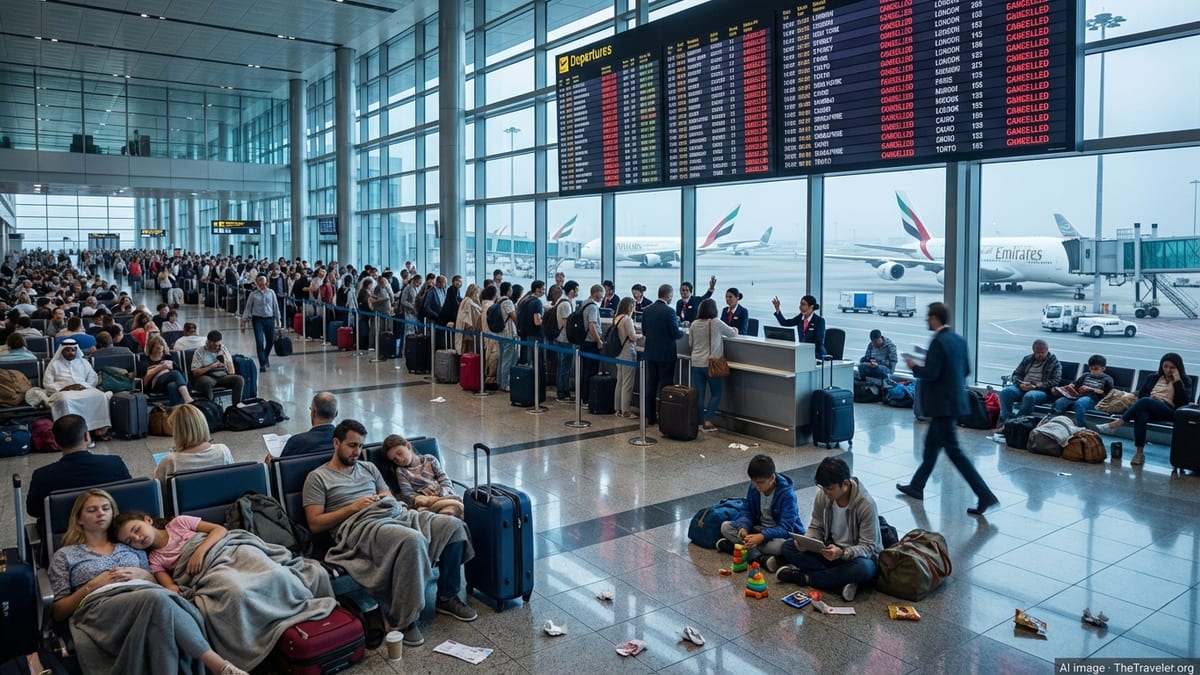
Airspace Lockdown Turns Global Hubs Into Dead Ends
Airspace over Iran, Iraq, Kuwait, Israel, Bahrain, Qatar and the United Arab Emirates remained largely empty on Sunday, according to aviation tracking services, as governments moved to shield civilian aircraft from a fast-escalating conflict. Portions of Syrian and Omani skies have also been restricted, creating an almost continuous no-fly belt that slices through the heart of the global route network.
The sweeping shutdown has hit hardest at the Gulf’s premier hubs. Dubai International, typically the world’s busiest airport for international traffic, has suspended most operations after being struck in the opening wave of Iranian retaliation. Nearby Abu Dhabi and Doha, crucial waypoints linking Europe and Africa with Asia and Australia, have also been effectively shuttered or severely curtailed, turning overnight layovers into open-ended ordeals.
Aviation analytics firms estimate that more than 3,000 flights to and from the broader Middle East were cancelled over the weekend, with many thousands more delayed or forced to divert. Flight boards from Beirut and Riyadh to Athens and Mumbai showed long columns of red “cancelled” notices, underscoring how a regional war has instantaneously become a global transport crisis.
With Russian and Ukrainian airspace already largely off limits to many carriers, the loss of Middle Eastern corridors leaves airlines squeezing into narrow alternative routes over North Africa and the eastern Mediterranean, adding hours of flight time and pushing crews and aircraft beyond their planned operating envelopes.
Travellers Stranded From Transit Hubs to Tropical Beaches
The human cost of the shutdown has been immediate and visible. In Dubai and Abu Dhabi, thousands of passengers have spent the night on terminal floors, wedged between suitcases and sleeping children as they queue for information from overstretched airline desks. Staff for major Gulf carriers have been handing out blankets and meal vouchers as airport hotels rapidly fill to capacity.
The disruption has rippled far beyond the conflict zone. At major European and Asian gateways, long-haul flights that would normally overfly the Middle East have been cancelled outright or forced to turn back mid-route, depositing passengers thousands of kilometres from their intended destinations. In Bali, Bangkok and other holiday hotspots, queues have formed at airline counters as travellers bound for the Gulf or onward to Europe discover that their connections no longer exist.
Some travellers have described a sense of disbelief at how quickly routine journeys unravelled. Passengers reported boarding flights with little sense of the scale of the conflict, only to find themselves diverted to secondary airports or ordered off aircraft after sitting on the tarmac for hours while airlines scrambled to interpret rapidly changing restrictions.
For migrant workers and diaspora communities, the stakes are particularly high. Large numbers of Indian, Filipino, African and European workers who rely on Gulf hubs to reach home are now stuck in limbo, uncertain when pay, visas or family emergencies will allow them to wait out an extended suspension of flights.
Airlines Scramble to Reroute As Networks Fray
Major Middle Eastern carriers, including Emirates, Qatar Airways and Etihad, have suspended most services through their home hubs at least into Monday, with warnings that schedules could remain heavily curtailed for days. Regional airlines in Kuwait, Bahrain and Jordan have also grounded or rerouted services, while carriers in Turkey, India and Europe have cancelled dozens of flights to Gulf and Levant destinations.
Global network airlines are racing to redesign timetables in real time. European flag carriers are sending aircraft on long detours over the Red Sea and North Africa to avoid the closed airspace, while Asian and Australasian airlines are weighing whether such routings are economically viable for already stretched long-haul operations. Aviation analysts warn that with aircraft and crews now out of position across multiple continents, recovery will lag well behind any eventual reopening of skies.
Operational costs are climbing sharply. Longer flight paths mean higher fuel burn at a time when oil markets are already jittery, while crew duty limits are being tested by extended sector times and unexpected diversions. Airlines are also bracing for a wave of compensation and rebooking demands, particularly in jurisdictions where passenger-rights regulations require payments for long delays and cancellations not directly ordered by governments.
Industry experts say that even if some airspace corridors partially reopen in the coming days, lingering security concerns and the risk of further missile or drone attacks will keep many airlines cautious. Several carriers have already announced that they will avoid routing over conflict-affected states for the foreseeable future, even if restrictions are technically lifted.
Safety, Liability and the Politics of Closed Skies
The sudden lockdown has revived questions about how and when governments and airlines choose to close or avoid contested airspace. Regulators in the United States and Europe moved swiftly to prohibit their carriers from flying over sections of the Middle East once the scale of the strikes became clear, citing lessons from past tragedies involving civilian jets downed over war zones.
Airlines, wary of both safety risks and reputational damage, have largely followed the strictest guidance available, in some cases halting flights before official notices were issued. Aviation security consultants note that in a conflict featuring ballistic missiles and long-range drones, the potential reach of weapons exceeds traditional front lines, making risk assessments more complex and fluid than in previous regional flare-ups.
Liability is another concern. Insurers are monitoring events closely as war risk premiums spike, particularly for aircraft transiting near the Gulf. Airlines fear that a miscalculation now could expose them not only to tragic loss of life but also to immense financial and legal consequences. This combination of operational caution and legal exposure helps explain why carriers are opting to cancel and rebook rather than attempt creative routing through narrow corridors that might remain technically open.
Diplomatically, the conflict has put enormous pressure on states that market themselves as secure global crossroads. Gulf governments face the dual challenge of maintaining civil aviation safety while managing their roles as hosts for foreign military bases and participants in complex regional alliances. The balance they strike will influence how quickly confidence returns to Middle Eastern skies once hostilities subside.
Uncertain Timeline Leaves Global Travel in Limbo
For now, there is no clear timetable for a return to normal operations. Analysts draw comparisons to past airspace crises that lasted days or weeks, but warn that the current confrontation is both broader and more unpredictable, involving multiple countries with advanced missile capabilities and deep political grievances.
Travel companies and corporate travel managers are advising clients to avoid non-essential trips that would normally pass through the Middle East, at least in the short term. Tour operators are rerouting itineraries away from Gulf stopovers, while multinational firms activate remote-work protocols for staff based in or transiting through the region.
Passengers with near-term bookings are being urged to stay in close contact with airlines and to expect repeated schedule changes. Many carriers are waiving change fees and allowing free rebooking for travel originally routed through affected airports, but seats on alternative routings are limited and often involve significant detours.
As the second day of conflict draws to a close, concourses from Dubai to Doha remain crowded with people watching departure boards that rarely shift from “cancelled” to “boarding.” Until airspace restrictions ease and military activity subsides, the Middle East’s role as a pivotal bridge in global aviation has been abruptly severed, with ripple effects that are likely to be felt across the travel world for weeks to come.