

More news on this day
Large swathes of Middle Eastern airspace were abruptly shut this weekend after coordinated United States and Israeli strikes on Iran and rapid retaliatory attacks, triggering one of the most severe global aviation crises in decades and leaving millions of travellers stranded or rerouted around the world.
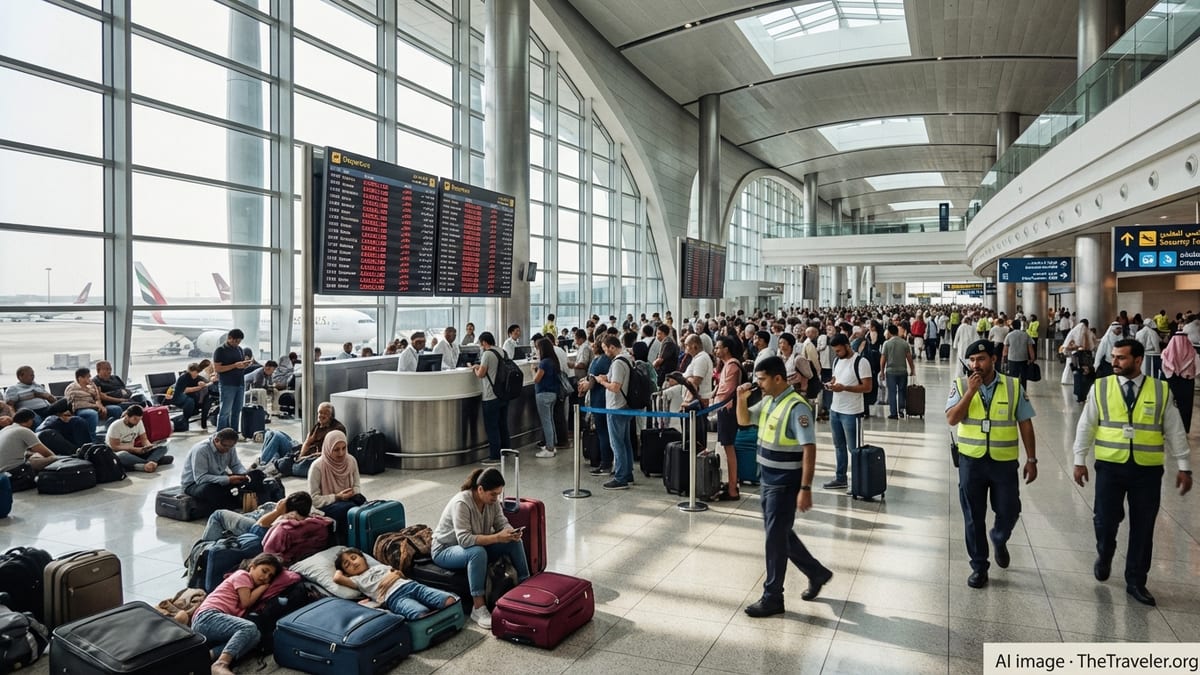
Airspace Lockdowns Turn Key Hubs into Ghost Terminals
From late Saturday into Sunday, aviation authorities in Iran, Israel, Iraq, Jordan, Qatar, Bahrain, Kuwait and the United Arab Emirates announced full or partial closures of their skies to civilian traffic as missiles and drones crisscrossed the region. Airports in Dubai, Abu Dhabi and Doha, normally among the world’s busiest transit hubs, halted regular passenger operations, transforming crowded concourses into holding areas for confused and exhausted travellers.
Flight tracking and aviation analytics firms reported thousands of cancellations and delays rippling far beyond the conflict zone as airlines scrambled to divert aircraft away from the closures. By Sunday morning, more than 3,000 flights to or from the Middle East had been cancelled over the weekend, and well over 19,000 were delayed globally as carriers tried to rethread their networks around a widening no-fly zone.
Officials and industry analysts warned that the closures could persist for days, given the scale of military activity and the risk of further strikes on airports and critical infrastructure. With Russian and Ukrainian skies already largely off-limits to Western carriers, the sudden loss of major Middle Eastern corridors leaves few viable paths between Europe, Africa and Asia, amplifying the shock to international travel.
“For travellers, there is no way to soften this,” one aviation analyst said on Sunday. “People should expect rolling cancellations, diversions and last-minute changes as long as these airspace restrictions remain in force.”
Airlines Freeze Operations as Regional Networks Unravel
Major Gulf carriers were among the first to move from selective rerouting to full suspensions. Emirates halted all flights to and from Dubai through at least Monday afternoon local time, while Etihad extended a shutdown of operations at Abu Dhabi’s Zayed International Airport until early Monday, citing continued airspace disruption and safety concerns for passengers and crew.
Qatar Airways suspended departures and arrivals in Doha after Qatari airspace was closed, and low-cost operator flydubai confirmed widespread disruption to its regional network. Budget airline Wizz Air halted all services to Israel, Dubai, Abu Dhabi and Amman for at least a week, while Turkish Airlines cancelled flights to a broad swathe of destinations across the Gulf, Iran, Iraq, Jordan, Lebanon and the wider region.
Legacy carriers in Europe and North America also moved quickly to insulate staff and passengers from the conflict zone. Lufthansa Group, Air France-KLM, British Airways, Virgin Atlantic, Finnair and others suspended routes to Tel Aviv, Tehran, Beirut and several Gulf cities, while rerouting or cancelling services that would normally overfly the Middle East. U.S. and Canadian airlines, including Delta, American Airlines and Air Canada, halted flights to Israel and key Gulf hubs, in some cases offering fee-free rebooking and refunds for affected customers.
The rapid sequence of decisions underscored the fragility of a global aviation system that had only recently recovered to near pre-pandemic traffic levels. With aircraft and crews stranded out of position and multi-day closures now likely on some routes, schedules are expected to remain unstable even after key airspaces begin to reopen.
Passengers Stranded from Dubai to Delhi and Beyond
Inside terminals from Dubai to London and Mumbai, departure boards on Sunday were lit with cancellations and indefinite delays, while serpentine queues formed at airline service desks. Travellers who had boarded long-haul flights overnight awoke to announcements of diversions and unplanned stopovers as pilots were ordered to avoid closed corridors or turn back entirely.
In India, airports in major cities such as Delhi, Mumbai and Hyderabad reported more than 200 international cancellations in a single day, many of them services to and from Gulf hubs that act as onward gateways to Europe and North America. Passengers connecting through Abu Dhabi and Dubai found themselves stuck in holding areas as authorities restricted access to airside zones and hotels quickly filled with displaced travellers.
Similar scenes played out at European gateways, where passengers arriving for flights to the Middle East were met with shuttered check-in counters and minimal information about when services might resume. Some travellers opted to abandon itineraries altogether, while others tried to piece together complex alternative routings via Africa or Central Asia, often at substantial personal cost.
For residents and migrant workers whose livelihoods depend on regular shuttle flights between Gulf states and their home countries, the sudden halt has raised deeper anxieties. With airspace closures framed as precautionary but open-ended, many fear being stuck far from family or employment, especially if the conflict escalates or sanctions regimes tighten around the belligerents.
Governments Race to Organize Evacuations and Alternatives
The scale of the disruption has triggered urgent responses from governments whose nationals form a large share of the tourist and expatriate population in the Gulf. Authorities in several European countries began planning special flights and potential airlift operations to bring home citizens once limited corridors can be negotiated, prioritizing vulnerable travellers and those transiting through now-closed hubs.
In the United Kingdom, officials have been preparing what could become one of the largest civilian evacuations in recent decades, with tens of thousands of British tourists and residents believed to be in the United Arab Emirates and neighboring states. Diplomatic channels have been activated to secure temporary overflight permissions and humanitarian corridors, though concrete timelines remain uncertain.
South and Southeast Asian governments, whose citizens make up a significant portion of the Gulf workforce, have set up emergency helplines and consular desks in affected airports. Some are exploring the use of alternative hubs in Saudi Arabia and Egypt, where operations are limited but not fully suspended, to mount phased repatriation efforts once risk levels are deemed manageable.
For now, officials are advising travellers to avoid non-essential journeys to the region and to remain in close contact with airlines and consulates for the latest updates. With missile and drone strikes already reported near key airports, security experts caution that it may be days before insurers and carriers are willing to restore regular commercial traffic over some of the busiest air corridors on earth.
Longer Routes, Higher Fares and a New Aviation Shock
Even if a partial reopening of airspace begins in the coming week, the impact on global travel is expected to be felt for months. The Middle East is a crucial bridge between Europe, Africa and Asia, and carriers had already been detouring around Russian and Ukrainian skies since 2022. With large portions of the Gulf and Levant now added to the list of avoided zones, airlines may be forced into significantly longer routings over the Mediterranean, North Africa or the Indian Ocean.
These deviations add hours to flight times and burn substantially more fuel, costs that airlines already grappling with high operating expenses may ultimately pass on to passengers through higher fares and surcharges. Capacity constraints are also likely as aircraft are tied up on elongated rotations, making it harder for carriers to maintain current schedules even once immediate safety concerns ease.
Industry analysts warn that business travellers and tourism-dependent economies alike could feel the aftershocks. Corporate travel planners face renewed uncertainty over access to key markets in the Gulf and beyond, while destinations that rely on Middle Eastern carriers for connectivity worry about a sudden drop in visitor numbers and spending.
For millions of individual travellers, the message is blunt: flexibility will be critical in the weeks ahead. Experts recommend avoiding tight connections, building in contingency days on complex itineraries and closely monitoring airline alerts. With the conflict still evolving and airspace restrictions subject to rapid change, global aviation has entered a new period of volatility just as the world was beginning to believe the era of systemic travel shocks had passed.