

More news on this day
Air Côte d’Ivoire has delayed the launch of its planned Abidjan–Beirut service until June, as renewed Middle East tensions and rolling airspace restrictions complicate airlines’ efforts to add capacity into Lebanon and the wider region.
Get the latest news straight to your inbox!
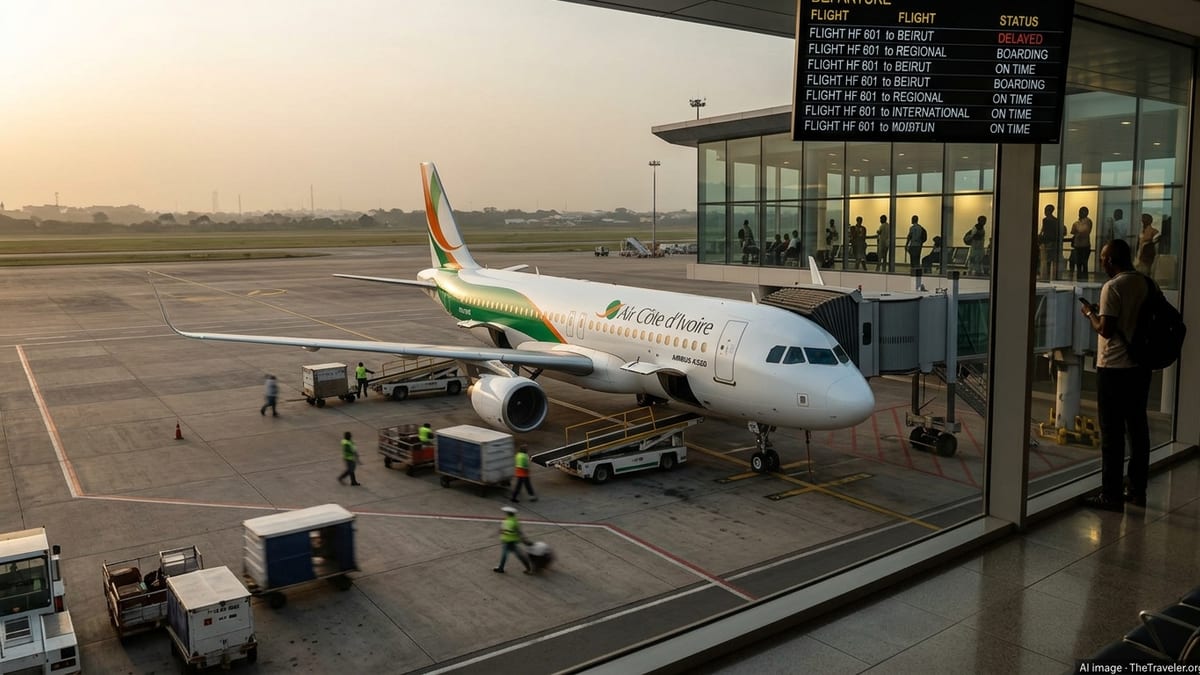
New West Africa–Lebanon Link Pushed Back
The Abidjan based carrier has been preparing to add Beirut to its growing international network as part of a broader strategy to position Côte d’Ivoire’s economic capital as a transfer hub linking West Africa with Europe and the Middle East. Industry bulletins earlier in 2026 highlighted Beirut as the airline’s next major Middle East destination, originally targeted for a spring 2026 launch.
Updated route-planning documents from African airline associations now indicate that the inaugural Abidjan–Beirut flights are scheduled to begin in June, reflecting a several month delay compared with the carrier’s initial ambitions. While the airline has not issued a detailed public statement on the postponement, the adjustment aligns with a wider pattern of carriers recalibrating operations into Lebanon as security conditions remain volatile.
For West African and Lebanese diaspora communities, the new link has been anticipated as a direct bridge between Abidjan’s large Lebanese community and Lebanon, reducing reliance on multi stop itineraries through European or Gulf hubs. The shift to a June start pushes back those expectations and keeps passengers dependent on more complex routings at least through the first half of the year.
According to published coverage on regional aviation, the route is part of a dual expansion that also includes Abidjan–Paris, underscoring Air Côte d’Ivoire’s aspiration to connect West Africa not only with Europe but also with key Middle Eastern gateways through Beirut.
Regional Conflict Keeps Airspace in Flux
The postponement comes against a backdrop of heightened tensions across the Middle East that continue to unsettle airline planning. Since mid 2025, successive rounds of confrontation involving Israel, Iran and armed groups across the region have periodically triggered temporary airspace closures and flight suspensions in several countries.
Publicly available information from flight tracking platforms and airline advisories shows that routes crossing Iran, Iraq, Syria and Jordan have been among the most affected, forcing carriers to cancel services or adopt longer detours around restricted zones. These changes have added complexity and cost for airlines seeking to maintain schedules between Europe, Africa and destinations further east.
Lebanon has found itself at the edge of these disruptions. Rafic Hariri International Airport in Beirut has remained operational for much of this period, but traffic has been repeatedly thinned out as foreign carriers pause or scale back service whenever tensions escalate. The resulting stop start pattern has made it more challenging for new entrants to commit to firm launch dates.
For a mid sized African airline such as Air Côte d’Ivoire, opening a new route directly into an airspace corridor that is subject to rapid regulatory and security shifts carries additional risk. Delaying the Beirut start to June allows more time to assess whether the situation stabilizes sufficiently to support a sustainable operation.
Beirut’s Connectivity Hit by Successive Suspensions
Lebanon’s commercial air links have been especially sensitive to regional shocks. During past flare ups, international media coverage documented how carriers such as Air France, Lufthansa group airlines and various Gulf and European operators suspended or reduced Beirut flights for weeks at a time, even while the airport technically remained open.
More recently, local news outlets and aviation specialists have reported renewed cancellations on services to and from Beirut, particularly on routes connecting to Gulf states and Iraq. The adjustments have often been justified on the basis of broader regional airspace closures rather than specific threats to Beirut itself, but the net effect has been a thinner and less predictable flight schedule.
Lebanon’s flag carrier, Middle East Airlines, has usually maintained a reduced but continuous presence at the airport, adjusting timings and destinations as needed. Foreign airlines, by contrast, have tended to return more cautiously after each episode, sometimes attaching provisional restart dates that are later pushed back if the security outlook worsens again.
It is into this fragile operating environment that Air Côte d’Ivoire plans to introduce its Abidjan–Beirut link. The June target effectively places the launch on the far side of the current wave of restrictions that has affected multiple Middle Eastern airspaces in early 2026.
Strategic Stakes for West Africa–Levant Travel
Beyond the immediate operational concerns, the delayed route carries strategic significance for both West Africa and Lebanon. Abidjan hosts one of the largest Lebanese diaspora communities in Africa, and travel demand between the two markets has traditionally been channelled through third country hubs in Europe or the Gulf.
Travel industry analysis suggests that a nonstop service would shorten journey times and potentially reduce costs for business travelers, visiting friends and relatives traffic, and traders moving between West Africa and the Levant. Tourism bodies in both regions have also viewed the link as an opportunity to diversify visitor flows away from traditional European source markets.
Air Côte d’Ivoire has been working to strengthen its position in a competitive African aviation landscape, where larger rivals from the Gulf and Europe often dominate long haul connections. Establishing Beirut as part of its network would provide an additional option for passengers from neighboring West African countries to connect eastward through Abidjan.
The decision to hold off until June does not appear to alter the underlying rationale for the route. Instead, it reflects an attempt to align commercial ambitions with a more predictable security and regulatory environment across the Middle East.
Outlook: Summer Launch Hinges on Security Trend
With the new start date now circled for June, attention will focus on whether the regional situation allows airlines to rebuild more stable schedules by the start of the Northern Hemisphere summer season. Industry observers note that if airspace restrictions ease and ceasefire understandings hold, carriers that had suspended or scaled back Beirut services may gradually restore capacity.
For prospective passengers in Côte d’Ivoire, Lebanon and the wider West African region, the coming months are likely to involve continued reliance on existing one stop itineraries via Europe or the Gulf. Travel agents report that itinerary planning into Beirut remains subject to last minute changes whenever regional tensions spike, with rerouting and schedule adjustments still a common feature.
Air Côte d’Ivoire’s revised June timeline positions the airline to take advantage of any improvement in conditions while retaining the option to adjust again if instability persists. For now, the route remains a symbol of both the potential and the vulnerability of new air links that seek to bridge regions affected by recurring geopolitical shocks.
As airlines and passengers alike navigate this unsettled landscape, the Abidjan–Beirut service stands as a test case for how smaller African carriers can expand into sensitive markets while managing security, regulatory and commercial risk.