

More news on this day
Escalating conflict across the Middle East is turning one of the world’s busiest crossroads into a zone of uncertainty, with sudden airspace closures, costly rerouting and ripple effects that are reshaping how travelers and goods move across continents.
Get the latest news straight to your inbox!
Airspace Switch-Offs Ripple Across Global Flight Networks
Within hours of joint United States and Israeli strikes on Iran on February 28, 2026, large sections of Middle Eastern skies effectively went dark to civilian aviation. According to recent aviation and travel-industry trackers, Iran, Iraq, Israel, Syria, Qatar, the United Arab Emirates, Kuwait, Bahrain and Jordan all closed or sharply restricted their airspace in the first days of March, triggering what analysts describe as one of the most extensive regional shutdowns in recent memory.
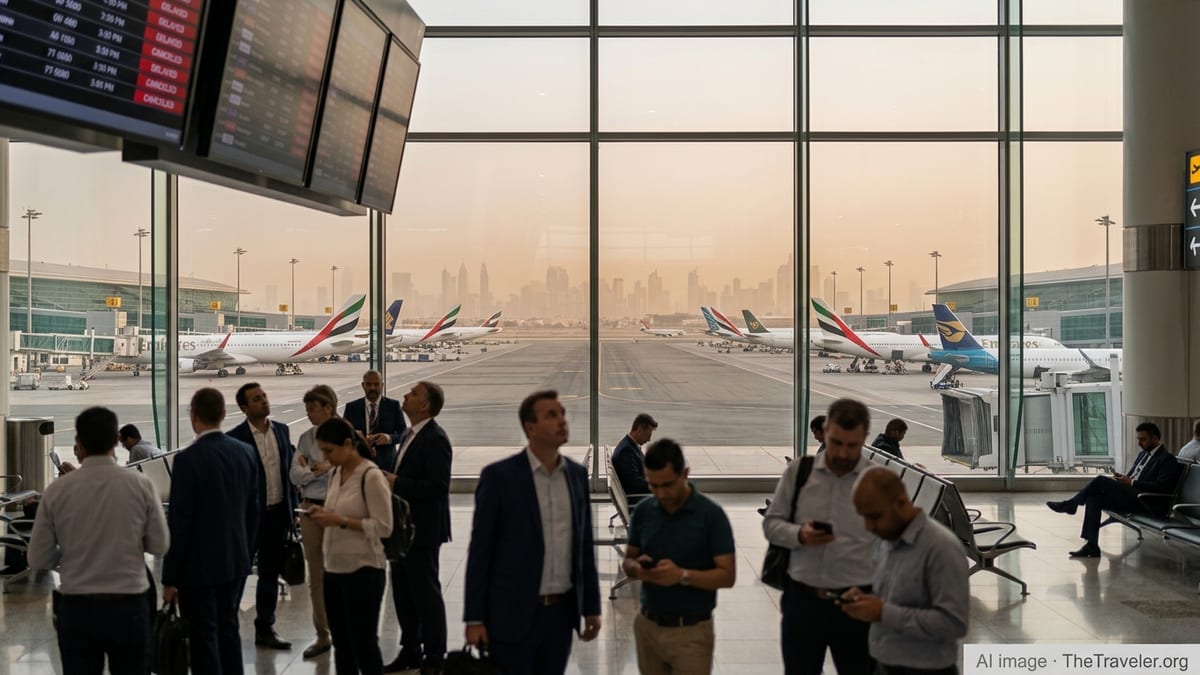
The cascading closures hit at the heart of intercontinental connectivity. Dubai, Abu Dhabi and Doha, among the world’s busiest transfer hubs for traffic between Europe, Africa and Asia, saw hundreds of departures and arrivals halted or diverted in a matter of hours. One industry tally indicates that more than 3,400 flights were canceled on Sunday March 1, followed by at least 1,200 additional cancellations on Monday March 2 as restrictions persisted and airlines attempted to reposition aircraft and crew.
Even where airports remained technically open, a complex patchwork of no-fly zones and military advisories forced carriers to redraw routings in real time. Publicly available air-traffic data shows long-haul flights that once crossed the Middle East in a straight line now arcing north over Turkey and the Caucasus or south over the Arabian Sea and East Africa, adding hundreds of miles and significant flying time to each journey. The result has been a surge in missed connections, rolling delays and overnight strandings from London and Frankfurt to Bangkok and Singapore.
Some regional services have resumed on a limited basis as of mid-March, but travel planners note that many airlines are filing only short-notice schedules, leaving passengers with little visibility beyond a few days. The new reality for anyone transiting the wider region is that a confirmed ticket no longer guarantees that the most direct route will operate as planned.
Jet Fuel, War Risk and the Rising Cost of a Seat
The upheaval in Middle Eastern airspace is converging with an energy shock that is pushing travel costs higher. The war has sharply disrupted traffic through the Strait of Hormuz, a corridor that normally carries around a fifth of global oil exports. Publicly available energy-market data shows that oil and gas prices have climbed as tankers face missile and drone threats and navigate changing security advisories.
That volatility is feeding directly into the price of jet fuel, one of airlines’ largest operating expenses. Industry coverage in recent days indicates jet fuel benchmarks spiking well above pre-war levels, with the steepest pressures felt on long-haul routes that burn the most fuel and now face detours of 30 minutes to more than two hours to avoid conflict zones. For carriers already operating on thin margins, the combination of higher fuel bills and circuitous routings is squeezing profitability.
Travel analysts warn that leisure and business customers are likely to see the impact first in reduced capacity rather than immediate headline fare increases. Some airlines have already trimmed frequencies to destinations that required substantial diversions or overflight permissions judged too unstable. Reports from major U.S. and European carriers suggest that strong demand is, for now, allowing them to absorb part of the cost, but forward-looking commentary points to higher summer fares on select long-haul markets if disruptions persist into the peak travel season.
Travel management companies are advising corporate clients to factor in both direct price increases and hidden costs. Longer flight times mean higher crew expenses, tighter aircraft utilization and more frequent schedule changes, all of which can cascade into last-minute rebookings, additional hotel nights and higher travel insurance premiums for trips touching the wider Middle East corridor.
From Red Sea Shipping Shocks to Airport Gridlock
In parallel with the turmoil in the skies, maritime trade routes around the Arabian Peninsula and Red Sea remain fragile. Houthi attacks and threats against commercial shipping in the Red Sea and Bab el Mandeb Strait since late 2023 led global carriers to divert vessels around the Cape of Good Hope for much of 2024 and 2025. Industry factboxes and shipping advisories note that container traffic through the Suez Canal corridor dropped by as much as 90 percent at the height of the crisis, and even now sits far below pre-conflict norms.
Although some container lines tentatively restarted Red Sea sailings in early 2026 as attack rates dipped, the latest warnings from Yemen-based militants and regional risk bulletins have kept uncertainty high. Recent port and maritime advisories describe a “complex and uncertain” operating environment, with some carriers once again opting for the longer route around southern Africa despite higher fuel consumption and longer transit times.
For travelers, these shipping shifts translate into less visible but still tangible consequences. Higher freight rates and longer delivery times are pushing up the cost of everything from aircraft spare parts to hotel food imports, costs that tourism operators in the Gulf, Egypt and East Africa indicate they are struggling to fully absorb. In popular stopover cities, airport retail and hospitality businesses report facing inventory fluctuations and higher procurement prices, with knock-on effects for the overall travel experience.
The combined strain on air and sea corridors also complicates humanitarian and evacuation logistics. Aid agencies and travel security firms relying on commercial lift to move personnel and supplies now face tightening capacity, fluctuating schedules and stringent risk assessments for any movement through key hubs such as Dubai, Doha, Jeddah and Amman.
Travelers Confront a New Normal of Contingency Planning
For individual travelers, the most immediate impact of these tensions is a loss of predictability. Borderline routings that once felt routine, such as Europe to India or Southeast Asia via the Gulf, can change with little notice as airspace advisories are updated and carriers adjust risk thresholds. Long queues at rebooking desks, sudden gate changes and unplanned overnight stays have become more common features of trips that intersect the wider region.
Publicly available guidance from airlines, travel agencies and security consultancies is increasingly focused on resilience strategies rather than reassurance. Travelers are being urged to build longer layovers into itineraries, favor tickets on a single airline or alliance to ease reprotection, and monitor airline apps closely in the 24 hours before departure. Flexible booking policies that emerged during the pandemic are being extended or reintroduced for certain Middle East routes, allowing date changes or rerouting without penalties when airspace status shifts.
Insurance providers are also reassessing coverage. Policy documents and consumer advisories show more products including specific language on war, civil unrest and airspace closure, with some underwriters narrowing coverage for trips that involve known hotspots while others market premium plans that promise faster assistance when routes collapse. For many travelers and corporate travel managers, understanding these clauses is now as important as scanning visa rules.
The uncertainty is reshaping demand patterns. Experts tracking booking data report a tilt away from itineraries that require Middle Eastern connections when reasonable alternatives exist, even if those alternatives are longer or more expensive. At the same time, strong underlying appetite for international travel means many passengers are accepting the risk, so long as there is some prospect of rerouting if their original path is closed.
How Today’s Crisis May Redraw Tomorrow’s Routes
Industry observers see the current turmoil as part of a broader realignment that began with the pandemic and has accelerated with successive geopolitical shocks. Airlines are reassessing their dependence on any single corridor, including the Middle East overflight routes and hub-and-spoke networks that have dominated long-haul travel for two decades. Some carriers have already announced new or resumed nonstop services that bypass traditional Gulf hubs, linking secondary European and Asian cities directly to reduce exposure to contested skies.
Airports outside the immediate conflict zone are positioning themselves as alternatives. Public statements and route-development announcements highlight efforts by hubs in southern Europe, Central Asia and East Africa to attract transfer traffic that might previously have flowed through Dubai, Doha or Abu Dhabi. These airports are investing in terminal upgrades, security screening and transit visa policies in a bid to capture travelers seeking more stable routings.
In the longer term, aircraft technology could accelerate this shift. New-generation ultra-long-range jets are allowing airlines to connect distant city pairs nonstop, sidestepping choke points such as the Middle East and the Red Sea entirely. At the same time, higher fuel prices and war-risk surcharges may limit how widely such routes can be deployed, keeping pressure on carriers to balance efficiency with resilience.
For now, the only certainty for travelers is continued flux. As tensions in the Middle East evolve, so too will the global map of air corridors and ground connections that knit together the travel industry. The region remains a vital bridge between continents, but it is one that passengers, airlines and ground operators are learning to cross with greater caution and contingency planning than ever before.