

More news on this day
The deepening US–Israel–Iran conflict is inflicting a sudden and severe blow to Middle East tourism, with Qatar now joining the UAE, Saudi Arabia, Bahrain, Turkey, Kuwait, Jordan, Oman and Egypt in a regional collapse that industry bodies say is costing at least 600 million dollars a day in lost visitor spending as airspace closures, flight cancellations and booking freezes spread across the region.
Get the latest news straight to your inbox!
Airspace Closures Turn Global Hubs Into Dead Ends
Within days of the first US and Israeli strikes on Iran on February 28, authorities across the Middle East began shutting or restricting their skies, triggering a cascading shutdown of some of the world’s busiest aviation corridors. Airspace restrictions in Iran, Iraq, Israel, Jordan, Kuwait, Qatar, Bahrain, Syria and the United Arab Emirates have forced airlines to cancel or reroute thousands of flights between Europe, Asia and Africa, cutting through the strategic role Gulf hubs play in global connectivity.
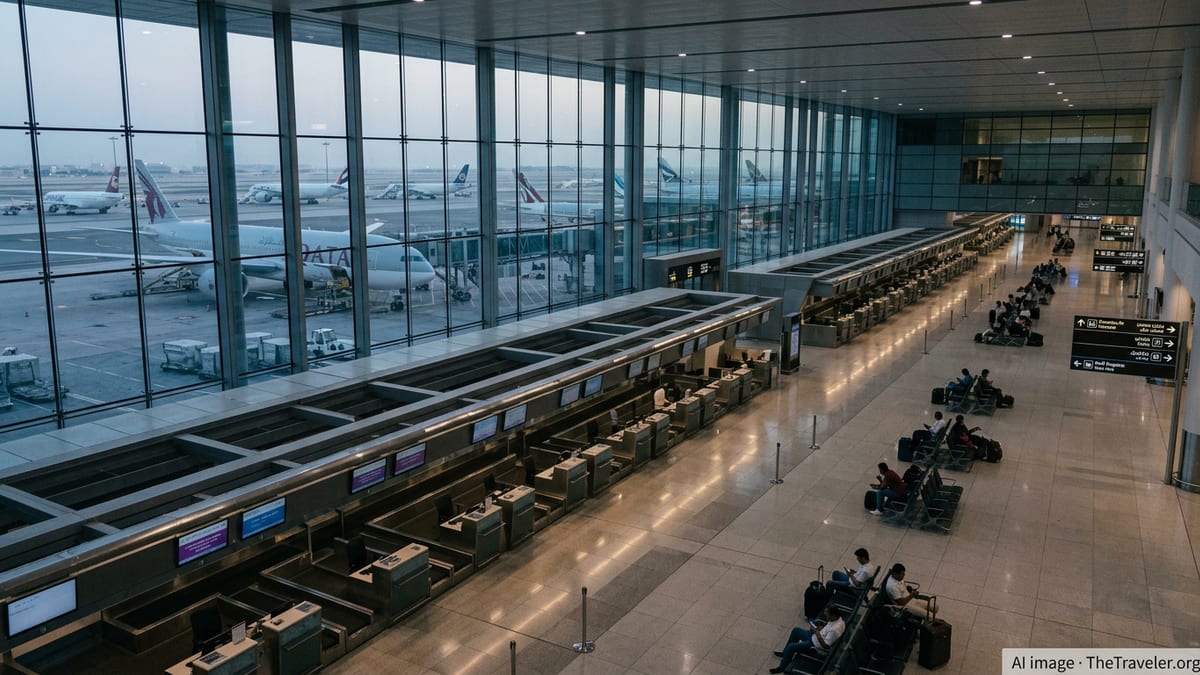
Doha’s Hamad International Airport, Dubai International Airport and Abu Dhabi’s main hub, normally packed with transit passengers, have all reported significant disruption as operators grounded aircraft, delayed departures and reprogrammed schedules around active conflict zones. In Qatar, a temporary airspace closure in late February led to a wave of cancellations and diversions that continues to ripple through March, while similar measures in the UAE and Kuwait have further contracted the region’s capacity.
The impact extends beyond the Gulf. Israel’s airspace was shut for several days after the initial strikes, effectively isolating Ben Gurion Airport from international traffic. Egypt’s aviation authorities have issued repeated security advisories and restrictions on certain routes, pushing carriers to avoid Eastern Mediterranean and Red Sea flight paths. Together, these decisions have transformed the Middle East from a through-route for world travel into a complicated patchwork of no-fly zones and emergency corridors.
International carriers from Europe and Asia have responded by suspending or sharply scaling back services to the region, adding pressure on local airlines and erasing critical feed into tourism destinations from Istanbul and Doha to Sharm el-Sheikh and Muscat. For many travelers, even those not flying directly into conflict states, the complexity and uncertainty around routings has been enough to delay or abandon trips altogether.
WTTC Puts Daily Tourism Hit at 600 Million Dollars
The World Travel & Tourism Council has warned that the current conflict is already costing the Middle East travel sector at least 600 million dollars per day in lost international visitor spending, based on pre-war forecasts for 2026 spending of more than 200 billion dollars across the region. That estimate reflects not only outright cancellations but also the evaporation of future bookings as uncertainty persists.
This daily loss is spread across leading tourism markets that had been banking on a strong year: the UAE with Dubai’s high-end retail and resort mix, Saudi Arabia’s fast-growing leisure and pilgrimage sector, Qatar’s post-World Cup push to cement itself as a premium stopover destination, and the beach, cultural and medical tourism industries of Egypt, Jordan, Oman and Turkey. Each of these markets relies heavily on international arrivals whose travel plans are now on hold.
Before the latest escalation, analysts expected international visitor numbers to push new records, with the region benefiting from expanded hotel pipelines, eased visa rules and aggressive destination marketing. Now, scenario modelling by industry consultancies suggests arrivals could fall by double-digit percentages in 2026 compared with earlier projections, equating to tens of millions fewer travelers and tens of billions of dollars wiped from expected tourism receipts.
Crucially, the 600 million dollar figure is an average, not a ceiling. If airspace closures and safety warnings persist into peak summer and autumn travel seasons, the aggregate loss could far exceed early estimates, particularly for countries like the UAE, Saudi Arabia and Qatar that have made tourism a central pillar of economic diversification plans.
Qatar and Gulf Neighbors See Bookings Collapse
Qatar has been pulled rapidly into the center of the crisis. Following the closure of its airspace at the end of February and missile activity elsewhere in the Gulf, airlines serving Doha have cut frequencies or suspended routes, while travelers have scrambled to rebook via alternative hubs. Package operators report that leisure bookings to Qatar, already sensitive to perceptions of regional security, have dropped sharply as travelers pivot to destinations seen as more insulated from the conflict.
Across the wider Gulf, the picture is just as stark. The UAE’s flagship airports have reported cancellation rates that at points have affected the majority of scheduled flights, while Kuwait and Bahrain have both grappled with interrupted operations after strikes and security alerts. Saudi Arabia, which had invested heavily to position itself as one of the world’s fastest-growing tourism markets, is now seeing a significant share of the region’s daily 600 million dollar tourism loss as group tours, conferences and religious travel are deferred.
Tourism-dependent businesses are feeling the strain almost immediately. Hotels in Doha, Dubai, Riyadh and Manama report occupancy plunging as inbound corporate and leisure guests fail to arrive, with some properties shifting to accommodate stranded transit passengers or repatriation flights at discounted rates. Luxury retailers and restaurant operators that cater to high-spending Gulf and international visitors describe footfall dropping to levels not seen since the early months of the pandemic.
For Qatar and its neighbors, the timing could hardly be worse. Many destinations had expanded capacity on the assumption of uninterrupted growth, opening new resorts, convention centers and entertainment districts. That investment now risks sitting underutilized if travel warnings, insurance exclusions and airline network cuts remain in effect for an extended period.
Egypt, Jordan, Oman and Turkey Grapple With Secondary Shock
While not all frontline states in the conflict, Egypt, Jordan, Oman and Turkey are experiencing a powerful secondary shock as confidence in regional travel erodes. These countries depend heavily on international tourism to support employment and foreign currency earnings, and many have only recently regained momentum after the pandemic-era downturn.
Egypt’s Red Sea resorts and cultural sites along the Nile had been reporting strong forward bookings from Europe and Russia, but tour operators now say new reservations have slowed dramatically as travelers reconsider itineraries that pass through or near Middle Eastern airspace. Jordan, similarly, is seeing weaker demand for iconic sites such as Petra and Wadi Rum as long-haul visitors opt for destinations perceived as safer and more accessible.
In Oman, which has been carefully positioning itself as a quieter, nature-oriented alternative to the glitz of nearby Gulf hubs, the knock-on effect of airspace rerouting and heightened regional risk is evident in rising cancellation rates. Turkey’s major airports and coastal resorts, long reliant on traffic funneled through Middle Eastern carriers and on travelers combining itineraries across the region, also face thinner pipelines of guests as connecting flights disappear.
For these destinations, the danger is less about direct physical damage and more about the psychological association with a conflict zone. Safety advisories from foreign ministries, changing airline schedules and heightened media coverage can be enough to steer undecided tourists elsewhere, even when on-the-ground conditions in cities like Muscat, Amman or Antalya remain calm.
What Travelers and the Industry Should Understand Now
For prospective visitors, the most immediate takeaway is that the Middle East’s aviation and tourism landscape is fluid and can change on very short notice. Airspace closures, temporary airport shutdowns and last-minute schedule changes are likely to persist as long as the conflict continues, meaning that even confirmed itineraries may be disrupted. Travelers considering routes via Qatar, the UAE, Kuwait, Jordan, Oman, Saudi Arabia, Bahrain, Egypt or Turkey should monitor airline advisories closely and be prepared for rebooking or extended layovers.
Travel industry professionals, from tour operators to corporate travel managers, are shifting back into a crisis-management posture familiar from the pandemic period. Many are revisiting contingency plans, diversifying routings away from sensitive corridors, and updating clients on insurance coverage, refund policies and force majeure clauses that govern trips disrupted by war and airspace closures. Flexible booking terms, real-time communication and clear safety protocols are again central selling points.
At the same time, analysts caution against assuming a uniformly long or irreversible downturn. Past regional conflicts have shown that tourism in the Middle East can rebound quickly once hostilities ease and travel advisories are softened, particularly where governments and private operators coordinate on marketing and incentives. The current 600 million dollar daily hit is severe, but it is framed against a sector that, as recently as last year, demonstrated a strong capacity for recovery.
For now, however, Qatar and its regional peers find themselves on the front line of an unprecedented tourism shock tied directly to airspace closures and geopolitical risk. Until skies reopen fully and travelers regain confidence in the safety and reliability of transiting the region, the gulf between projected and actual visitor spending will remain wide, and the daily cost to the Middle East’s tourism economies will continue to climb.