

More news on this day
Middle East tourism, a sector worth hundreds of billions of dollars and central to several Gulf economies, is bracing for losses of up to 56 billion dollars this year as the escalating conflict involving Iran, the United States and Israel shuts airspace, damages flagship hotels and shakes global traveler confidence.
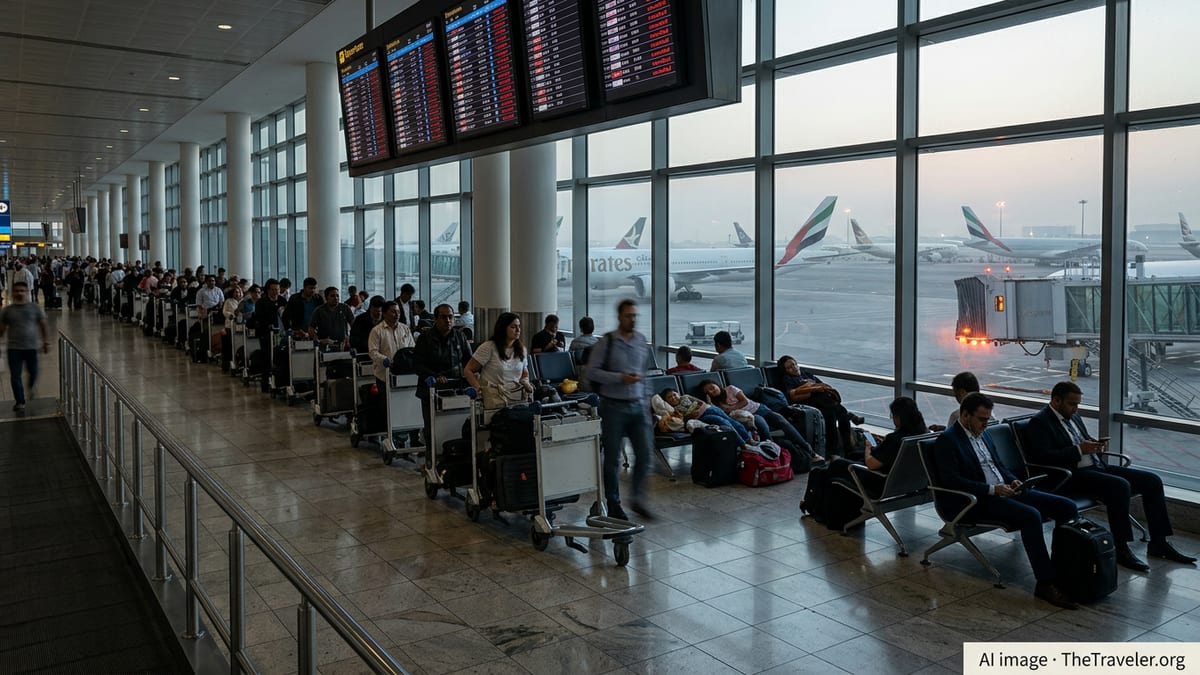
Airspace Closures Ground Thousands of Flights
The latest conflict has rapidly turned the region’s busy skies into one of the world’s most disrupted aviation corridors. Airspace closures across the United Arab Emirates, Qatar, Kuwait, Bahrain and several neighboring states have forced airlines to ground or reroute thousands of flights, stranding passengers from Europe to South Asia. Analysts describe the disruption as the most severe blow to international air travel since the pandemic-era shutdowns.
Major hubs such as Dubai International Airport, Abu Dhabi and Doha, normally among the world’s busiest transit points, have seen schedules slashed after nearby strikes and precautionary shutdowns. Industry data providers report that more than 5,000 flights were canceled in the first two days of the crisis alone, with some estimates putting the number of disrupted services much higher as airlines continue to reconfigure networks.
Carriers based both inside and outside the region are affected. Gulf airlines that built their business on seamless connections between Europe, Africa and Asia are now grappling with displaced aircraft and crews, longer detours around closed airspace and sharply higher fuel costs. International airlines from Europe and Asia have suspended or curtailed services to Middle Eastern destinations, deepening the shock to inbound tourism.
Travel associations say the uncertainty has rippled far beyond the immediate conflict zone. With itineraries shredded and rescue flights operating on a limited basis, many travelers report being unwilling to book future trips that rely on Gulf transit hubs, even if their final destination lies elsewhere.
Hotel Landmarks Damaged As Safety Fears Rise
On the ground, images of debris near some of the region’s most recognizable hotels have further dented the Middle East’s carefully cultivated image as a safe, high-end tourism haven. In Dubai, authorities and hotel groups confirmed that debris from intercepted drones struck areas around the city’s flagship coastal properties, including luxury resorts that have long symbolized the emirate’s tourism boom.
While structural damage has so far been limited compared with the devastation seen in previous regional conflicts, even isolated incidents at such high-profile sites carry outsized reputational risks. Hoteliers report that international guests, already anxious about disrupted flights, are now questioning the safety of staying in landmark properties that feature prominently in global marketing campaigns.
Industry consultants note that the timing is particularly painful. Over the last decade, Gulf states poured tens of billions of dollars into new beachfront resorts, desert retreats and urban entertainment districts to position destinations such as Dubai, Abu Dhabi, Doha, Riyadh and Jeddah as year-round playgrounds for international visitors. That strategy had begun to pay off, with many cities surpassing pre-pandemic arrival and revenue levels by late 2025.
Now, as civil defense sirens and images of damaged hotel facades circulate on social media, tour operators say they are fielding a wave of questions from clients about the proximity of resorts to potential targets and the availability of shelters or evacuation plans. Even where local authorities stress that damage is superficial and security robust, the psychological impact on would-be visitors is significant.
Visitor Confidence Collapses, Bookings Put On Hold
Beyond the immediate operational chaos, the most serious threat to Middle Eastern tourism may be a crisis of confidence that could linger well after airspace reopens. Travel agencies across Europe and Asia report sharp spikes in cancellations and postponements for trips to Gulf destinations, Red Sea resorts and cultural hubs such as Jordan and Oman.
Tourism economists now project that inbound arrivals to the wider Middle East could fall between 11 and 27 percent this year compared with earlier forecasts that assumed strong growth. In visitor spending terms, updated modeling suggests the region could lose between 34 and 56 billion dollars as travelers opt for alternative destinations or delay long-haul vacations altogether.
For Gulf Cooperation Council states, which have invested heavily in tourism as a pillar of economic diversification away from oil, the stakes are especially high. The sector generated an estimated 367 billion dollars in economic activity across the wider Middle East last year, according to industry data, and underpinned hundreds of thousands of jobs in aviation, hospitality, retail and entertainment.
Tour operators say perceptions can change quickly in a social media era where images of grounded aircraft and nervous tourists at terminals circulate in real time. Even travelers whose itineraries do not involve the immediate conflict zone are rethinking routes that transit Gulf hubs, compounding the decline in demand. Some agencies in key source markets say they have effectively paused new Middle East sales until government advisories and insurance conditions become clearer.
Economic Fallout Spreads Across the Region
The anticipated hit to tourism is already feeding into broader economic concerns. In countries such as the United Arab Emirates, Saudi Arabia and Qatar, where tourism and aviation have become central to national development strategies, a prolonged slump in visitor numbers could weigh on growth, public finances and private investment plans.
Hotels, restaurants, attraction operators and transport providers are among the first to feel the squeeze as occupancy rates drop and reservations evaporate. Industry executives warn that if the downturn extends into the key summer and autumn travel seasons, pressure will grow on employers to cut costs, putting service-sector jobs at risk and slowing new project launches.
Ripples are also being felt in neighboring economies that rely on Gulf connectivity to attract visitors. Popular destinations in Turkey, Egypt, Jordan and beyond have built much of their long-haul business around one-stop itineraries via Gulf hubs. With those networks disrupted and travelers wary of flying through the region, local tourism boards fear collateral damage even in places far from the front lines.
Some analysts draw parallels with the first Gulf War and the aftermath of the September 11 attacks, when security fears and airspace restrictions reshaped global travel flows for years. While the scale and duration of the current conflict remain uncertain, there is broad agreement that protracted instability in a region so central to international aviation would have consequences well beyond its borders.
Prospects for Recovery Hinges on Stability and Messaging
Despite the bleak near-term outlook, many in the industry insist that the Middle East’s tourism success story is not permanently derailed. They point to the region’s rapid rebound after the pandemic, when Gulf destinations were among the first globally to regain and surpass pre-crisis visitor levels, as evidence of underlying resilience and strong pent-up demand.
Airport authorities and tourism boards are already working on contingency plans to restore confidence once security conditions improve. These include flexible rebooking policies, coordinated marketing campaigns emphasizing safety and reliability, and potential incentives for airlines and tour operators to resume suspended routes.
Ultimately, however, the speed and strength of any recovery will depend on how quickly the conflict de-escalates and whether there are further high-profile incidents involving civilian infrastructure. For now, industry forecasters are clear that the downside risks dominate. If airspace closures and security concerns persist for weeks or months, the upper-end projection of a 56 billion dollar loss in visitor spending could move from worst-case scenario to baseline expectation.
As stranded travelers wait for flights home and newly built resorts sit partially empty, the region’s tourism leaders face a familiar but sobering challenge: convincing the world that the Middle East is once again a safe and seamless place to visit, in a moment when war has thrust its vulnerabilities into the global spotlight.