

More news on this day
Bahrain is the latest Middle East destination to be swept into a deepening tourism slump, as new US–Israel–Iran hostilities and missile strikes across the Gulf trigger airspace closures, mass flight cancellations, and an emerging double‑digit year‑on‑year decline in international arrivals across key markets including Saudi Arabia, Kuwait, the United Arab Emirates, Qatar, Oman, and Lebanon.
Get the latest news straight to your inbox!
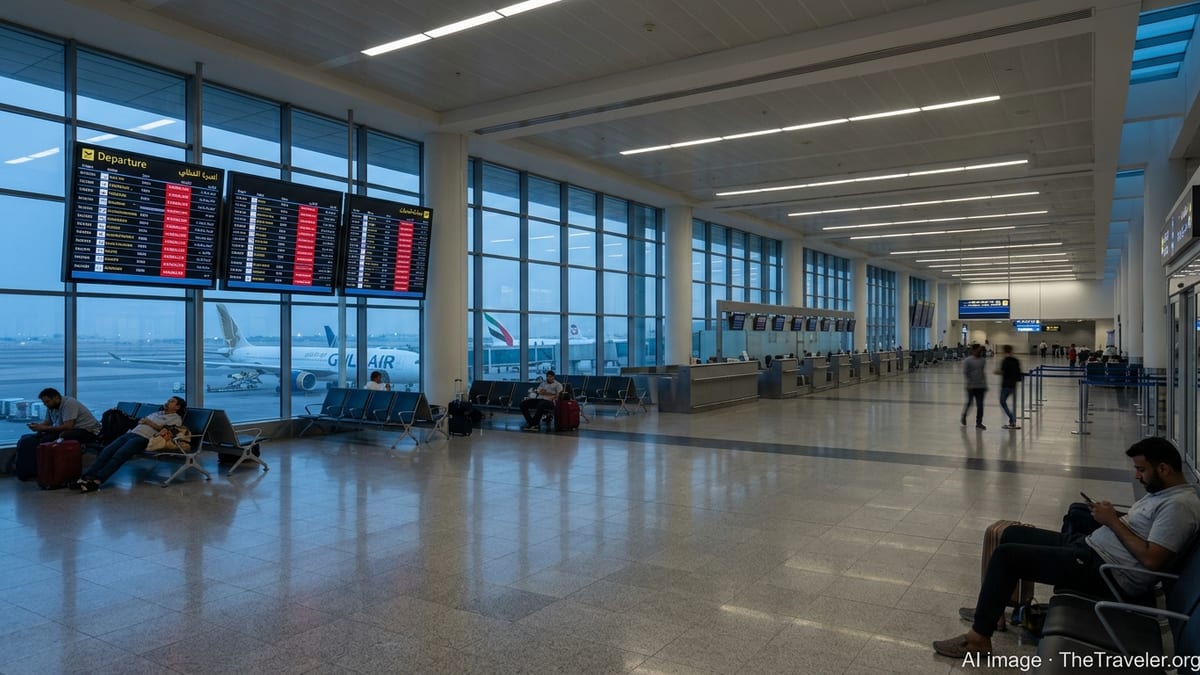
Airspace Closures Leave Airlines With Empty Skies
The latest phase of the regional security crisis escalated on 28 February 2026, when joint United States and Israeli strikes on Iran were followed by retaliatory missile and drone attacks targeting Gulf states and critical military infrastructure. In response, Bahrain, Kuwait, Qatar, Israel, Syria, and the United Arab Emirates temporarily closed their airspace, while other states imposed heavy restrictions, effectively shutting down some of the world’s busiest flight corridors between Europe and Asia.
Publicly available flight‑tracking data and aviation analytics indicate that more than a thousand flights were canceled or diverted within days of the first strikes, stranding passengers from Dubai and Doha to Istanbul and Bangkok. Key hub airports in Dubai, Abu Dhabi, and Doha, which normally handle tens of thousands of long‑haul transit passengers each day, saw commercial operations reduced to a trickle of evacuation and repatriation services.
Coverage from international outlets describes large numbers of wide‑body aircraft parked on remote stands across the Gulf, with airlines operating well below their pre‑conflict capacity. Earlier regional analysis already pointed to airlines in the United Arab Emirates flying at less than half of normal levels during previous peaks in tension, and similar or worse patterns are now re‑emerging as carriers wait for airspace to reopen or reroute aircraft along longer, more expensive paths that bypass the Strait of Hormuz.
For tourism‑dependent economies, these closures translate immediately into lost arrivals. With flying times increased, insurance costs rising, and travelers wary of transiting conflict‑adjacent hubs, both leisure and corporate demand into the Middle East has started to fall sharply compared with expectations only a few months ago.
Double‑Digit Tourism Drop After Earlier Boom
Prior to the latest escalation, the Middle East had been one of global travel’s standout recovery stories. United Nations Tourism data and regional market reports showed the region welcoming around 100 million international visitors in 2025, roughly 39 percent above 2019 levels, on the back of aggressive investment in aviation, visas, and destination marketing in Saudi Arabia, the UAE, Qatar, Oman, and Bahrain.
That upswing has given way to what analysts now describe as a tourism crisis. Recent regional assessments compiled by travel‑industry researchers suggest that international arrivals to the Middle East could fall by at least 11 percent year on year in 2026, with some scenarios pointing to declines of up to 27 percent if conflict persists through the peak summer and autumn seasons. The reversal is particularly abrupt given that forecasters had been expecting another double‑digit increase in arrivals as recently as late 2025.
Gulf Cooperation Council members are at the sharp end of the downturn. Studies monitoring booking patterns and cancellations indicate that destinations such as the UAE and Saudi Arabia, which rely heavily on long‑haul air connectivity and large transit hubs, face some of the steepest losses in absolute visitor numbers. Lebanon, already exposed to spillovers from the Gaza conflict and frequent skirmishes along its southern border, is also seeing renewed pressure on an industry that had only partially recovered from its financial crisis.
While early projections suggest Qatar and Bahrain may see slightly smaller percentage declines than their larger neighbors, regional commentators note that any drop from recent record volumes is significant for small, service‑oriented economies that positioned tourism and aviation as core engines of non‑oil growth.
Bahrain’s Tourism Momentum Abruptly Stalls
Bahrain enters this downturn from a period of rapid expansion. Passenger‑traffic statistics and sector briefings released over the past year highlighted record volumes through Bahrain International Airport, rising hotel room supply, and strong intra‑GCC visitor flows, particularly from Saudi Arabia. National carrier Gulf Air had reported steady growth in passengers from its Manama hub, supported by new routes and fleet modernization.
The escalation of the 2026 Iran war has abruptly changed that trajectory. Iranian retaliatory strikes on Manama on 28 February, including impacts near the district hosting the United States Navy’s Fifth Fleet, have not only heightened security concerns but also undermined Bahrain’s image as a safe, easy weekend and transit destination. Temporary airspace closures and re‑routed traffic have reduced Bahrain’s hub role and cut into short‑break leisure trips from neighboring markets.
Sector watchers now group Bahrain with Saudi Arabia, Kuwait, the UAE, Qatar, Oman, and Lebanon among the countries most exposed to the current tourism shock. With the region as a whole facing an expected 11 percent or greater year‑on‑year contraction in international arrivals, Bahrain’s hospitality and retail sectors are bracing for lower occupancy, weaker spending, and delayed investment decisions on new hotels, entertainment projects, and cruise infrastructure.
The timing is particularly sensitive because Bahrain, like several of its neighbors, has been banking on tourism to diversify away from hydrocarbons. Falling visitor numbers risk widening fiscal gaps, slowing job creation, and complicating efforts to position Manama as a boutique cultural and lifestyle hub competing with larger Gulf cities.
Empty Flights, Shifting Routes, and Traveler Hesitation
Across the wider region, the immediate impact of the conflict is visible in thinner passenger loads, suspended city pairs, and longer alternative routes. Airlines that continue to operate are often flying with reduced cabin factors as nervous travelers postpone or cancel trips, especially for discretionary leisure and conference travel. Analysts point to similarities with earlier phases of the Gaza war, when bookings to several Middle Eastern destinations dropped even before any formal airspace closures were announced.
Global travel demand data collected by booking platforms and industry consultancies indicate that searches and ticket purchases for itineraries touching Gulf and Levant destinations have weakened sharply since late February. Some carriers in Europe and Asia have temporarily suspended services to hubs in the region or cut frequencies, further reducing capacity just as cancellations rise.
Travel insurance advisories, risk‑rating agency assessments, and government travel guidance are reinforcing this trend. Recommendations urging citizens to depart countries such as the UAE, Saudi Arabia, Lebanon, and Oman when commercial options are available have led to outbound demand focused on evacuation rather than tourism. Hotels that had expected a busy spring driven by events, exhibitions, and beach holidays are instead managing rebookings, early check‑outs, and rising no‑show rates.
This combination of empty or near‑empty flights on remaining routes, grounded aircraft in key hubs, and persistent traveler anxiety is feeding into the broader forecast of a double‑digit drop in arrivals across the Middle East in 2026, compared with the strong baseline of 2025.
Destinations Race to Contain Damage and Reassure Visitors
Governments and tourism boards across the Gulf and Levant are moving to contain the fallout, even as the security situation remains fluid. Initial steps include waiving change fees for event organizers, promoting flexible booking policies in partnership with airlines and hotel groups, and launching marketing campaigns that emphasize safety, resilience, and the geographic concentration of military activity away from most tourist districts.
Some hubs are working with airlines to reconfigure networks by shifting capacity toward shorter regional routes that do not require overflying high‑risk airspace, in an effort to sustain at least part of the visitor economy. Industry commentary also points to the importance of domestic and intra‑regional tourism, which may help offset some of the losses from long‑haul markets if conflict does not spread further.
However, sector analysts caution that reputational damage can linger well beyond the end of active hostilities. Previous episodes of conflict in the Eastern Mediterranean and Gulf show that destinations like Lebanon and parts of the Gulf often experience an immediate collapse in tourism demand, followed by a multi‑year recovery period as airlines rebuild schedules and travelers regain confidence.
For Bahrain and its neighbors, the central question now is how long the current airspace restrictions, security alerts, and elevated geopolitical risk will persist. The longer the disruption lasts, the more likely it is that the current 11 percent‑plus projected decline in Middle East tourism for 2026 will deepen, reshaping investment plans and traveler perceptions of the region’s once‑booming destinations.