

More news on this day
Passengers across the Middle East are facing severe disruption as at least 60 flights have been canceled and 44 delayed in recent days, with Gulf Air, FlyDubai, and EgyptAir among the carriers grounding services and leaving travelers stranded in Bahrain, Saudi Arabia, Dubai, Cairo, and Kuwait.
Get the latest news straight to your inbox!
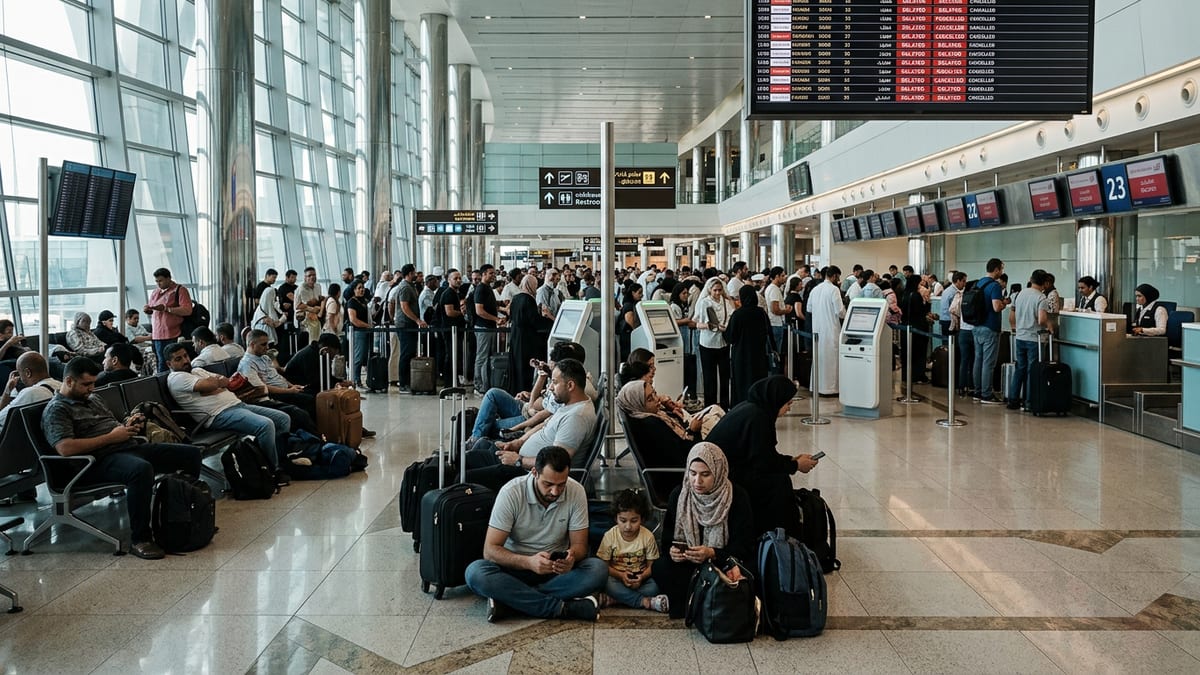
Regional Conflict Triggers Wave of Cancellations
Publicly available information links the latest wave of cancellations and delays to the wider security crisis affecting airspace across the Gulf region. A series of strikes and missile incidents since late February 2026 has prompted temporary airspace closures and operational restrictions in several Middle Eastern states, sharply curtailing normal airline schedules.
Reports indicate that Bahrain, the United Arab Emirates, Kuwait, and parts of Saudi Arabia have all imposed varying levels of airspace controls in recent days. These measures, combined with damage or partial shutdowns at major hubs, have forced regional and international airlines to slash services, re-route flights, or suspend certain routes altogether.
Analysts note that the Middle East is a critical crossroads between Europe, Asia, and Africa. Any disruption to Gulf airspace can quickly cascade into wider global delays and cancellations as aircraft, crews, and passengers are left out of position. The current tally of around 60 cancellations and 44 delays tied to Gulf Air, FlyDubai, and EgyptAir reflects only a slice of the broader regional turmoil.
Available coverage suggests that the picture remains highly fluid. Airlines are adjusting timetables on a rolling basis, meaning that flight statuses for Bahrain, Dubai, Kuwait City, Riyadh, Jeddah, and Cairo can change with little notice as conditions evolve.
Airline Impacts: Gulf Air, FlyDubai, and EgyptAir
Gulf Air, Bahrain’s flag carrier, has been among the most heavily affected airlines. Public data shows that aircraft have been repositioned to neighboring Saudi airports and that many Bahrain-origin services have been canceled outright or rerouted. Travelers who had planned to transit through Bahrain are now facing last-minute changes or extended layovers while the airline reshapes its network.
Low-cost carrier FlyDubai, a key operator out of Dubai International Airport, has also cut back operations. Industry updates describe a shift to limited schedules, with a focus on essential or repatriation-style flights while many regular commercial services remain grounded. This has contributed to a backlog of passengers in Dubai, where hotels and airport facilities are under strain from extended, unplanned stays.
EgyptAir, the Egyptian flag carrier based in Cairo, has reduced or suspended certain regional routes in response to the changing risk environment and airspace restrictions. Some flights linking Cairo to Gulf destinations such as Bahrain, Kuwait, and the United Arab Emirates have been affected, contributing to wider disruption for passengers attempting to connect between Africa, the Middle East, and Europe.
Across these three airlines, the immediate impact has been visible in at least 60 cancellations and 44 delays tied directly to the current disruption. However, knock-on effects are rippling through code-share and interline agreements, meaning travelers booked with other carriers can also find themselves caught up in schedule changes initiated by Gulf Air, FlyDubai, or EgyptAir.
Major Hubs Under Pressure: Bahrain, Dubai, Cairo, Kuwait
Key regional hubs are experiencing some of the most acute pressure. At Bahrain International Airport, reduced arrivals and departures have translated into long waits, rebooking queues, and difficulty securing alternative routings, especially for passengers with non-flexible tickets or tight onward connections.
In Dubai, one of the world’s busiest international airports, operations have shifted from normal high-frequency schedules to a more limited pattern of services. Travel advisories and airport updates emphasize that only a fraction of typical daily flights are currently operating. This has encouraged travelers to treat any confirmed departure time as provisional and to check status repeatedly in the hours leading up to a flight.
Cairo International Airport has become both a pressure point and an alternative gateway. With some Gulf routes curtailed, EgyptAir and other carriers are using Cairo as a staging point for connections to Europe and Africa. While this provides an outlet for some stranded travelers, it has also increased congestion at check-in, security, and transfer desks as airlines juggle disrupted itineraries.
Kuwait’s main airport is experiencing similar strain, with publicly available information pointing to grounded aircraft and an unpredictable departure board. Passengers attempting to transit through Kuwait City are reporting rolling delays and last-minute gate changes as airlines adapt to evolving airspace constraints and operational limits.
What Stranded Travelers Are Experiencing on the Ground
Accounts shared in open forums and media coverage describe a travel environment marked by rapidly changing information, crowded terminals, and limited clarity on when full schedules might resume. Some passengers report being rebooked multiple times, only to have replacement flights canceled again as restrictions shift.
Extended airport stays are common, particularly in Dubai and Bahrain, where hotel availability near the airport is tightening and nightly rates have risen in response to the surge in stranded travelers. Others have opted to move overland between Gulf states, attempting to reach airports with slightly more stable operations, such as Dammam or Jeddah in Saudi Arabia, to secure outbound seats.
Travelers holding tickets with Gulf Air, FlyDubai, or EgyptAir are seeing a mix of options, including rebooking on later dates, changes of routing via alternative hubs, or refunds where flights are canceled outright. However, the volume of affected passengers has lengthened response times at call centers and airport service desks, adding to frustration.
With schedules being adjusted day by day, many travelers are turning to real-time flight tracking tools and airport departure boards to verify that an aircraft is actually operating before heading to the terminal. This behavior reflects a broader shift from planning around timetables to planning around what is visibly flying at any given moment.
Key Guidance for Upcoming Travel in the Region
For those with imminent trips to or through Bahrain, Saudi Arabia, Dubai, Cairo, or Kuwait, travel experts recommend building in significant flexibility. Public guidance emphasizes that passengers should assume that even confirmed flights may be rescheduled, retimed, or canceled on short notice as airlines respond to security developments and airspace decisions.
Travelers are widely advised to monitor their airline’s official channels and airport departure information closely, especially in the 24 hours before departure. Same-day checks are particularly important at hubs like Dubai and Bahrain, where operational plans may be updated multiple times within a single day.
Passengers with non-essential travel are being encouraged in some advisories to consider postponement or rerouting via more stable hubs outside the immediate conflict-affected zone. Those who must travel are urged to prepare for extended layovers, potential overnight stays, and the possibility of re-routing through secondary airports in Saudi Arabia, Egypt, or other neighboring states.
While the exact timeline for normalization remains uncertain, airlines and airports are gradually testing limited services as conditions permit. However, given the scale of the current disruption and the strategic importance of Gulf airspace, industry observers suggest that irregular operations and rolling cancellations could persist for days or weeks, and that travelers should plan accordingly.