

More news on this day
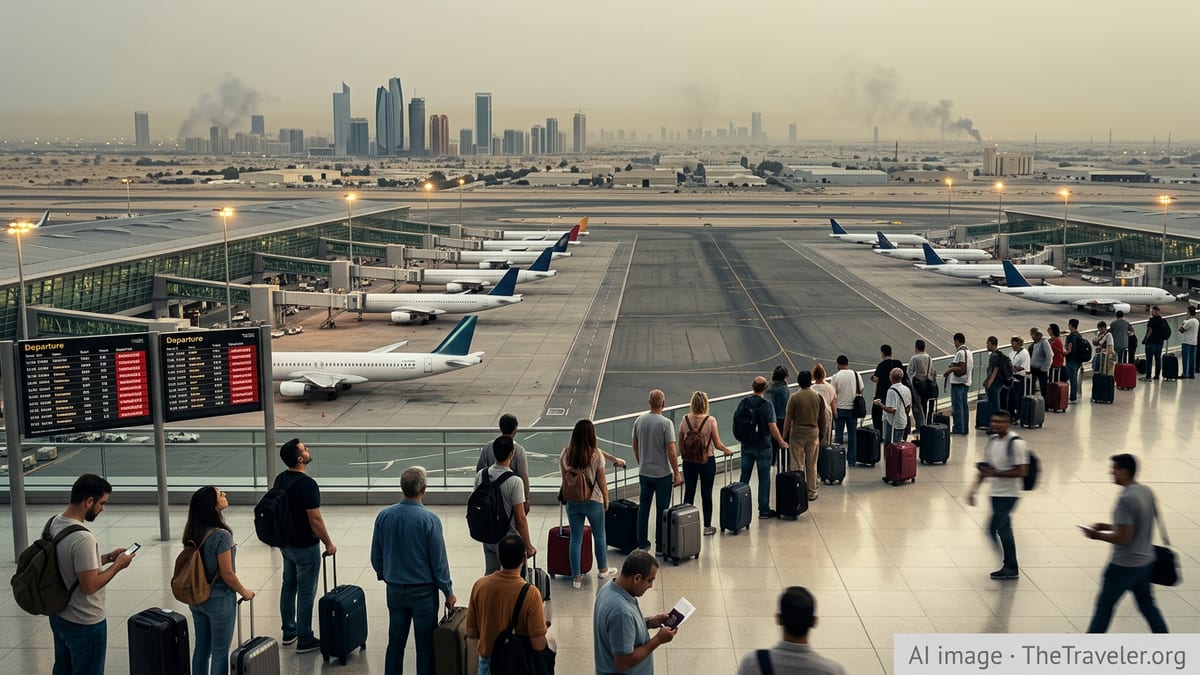
A sudden and dramatic escalation in the US–Israel confrontation with Iran has pushed the Middle East into one of its most volatile moments in decades, triggering sweeping government travel warnings, airspace closures and a scramble by foreign travelers and expatriates to get out while commercial routes remain open.
Joint Strikes and Retaliation Ignite a New Phase of Conflict
The latest crisis erupted after coordinated US and Israeli strikes on Iran beginning on February 28, widely reported to have targeted senior military and security leaders as well as elements of the country’s nuclear infrastructure. The operation, described by Israeli officials as a decisive preemptive campaign, marked a sharp break from years of shadow warfare and proxy clashes, bringing direct confrontation into the open.
Within hours, explosions were reported in Tehran and other major Iranian cities. Air raid sirens and rolling power outages left residents sheltering in basements and metro stations as authorities sealed off parts of the capital. Israel simultaneously entered a nationwide state of emergency, closing schools, suspending most civilian air traffic and mobilizing reservists amid warnings of imminent missile and drone barrages from Iran and its allies.
Iran’s promised retaliation followed swiftly. The Islamic Revolutionary Guard Corps announced waves of ballistic missile and drone launches aimed not only at Israel but also at US military facilities and diplomatic compounds across several Gulf states, dramatically widening the geographic scope of the conflict and raising immediate concerns for civilian air travel and maritime shipping.
Regional tensions deepened further as Hezbollah aligned itself more openly with Tehran. From March 2, cross-border fire between Hezbollah and Israel intensified, with strikes on northern Israeli communities answered by Israeli air raids in and around Beirut, adding Lebanon to the growing list of countries directly affected by the spiraling confrontation.
Embassy Strikes and a New Level of Risk for Travelers
For foreign travelers and expatriates, the conflict crossed a dangerous new threshold when suspected Iranian drones targeted the US embassy in Riyadh, Saudi Arabia, and other diplomatic sites. Footage shared on regional media showed flames and smoke rising from the embassy compound in the Saudi capital after an overnight strike, part of a broader pattern of attacks on US and allied facilities.
Though early official reports suggested limited damage and no mass casualties at the embassies, the symbolism was stark. The attacks underscored that even heavily protected diplomatic zones were no longer off-limits, prompting Washington to draw down staff and restrict operations at missions across the region. Several other Western governments quickly followed suit, announcing partial closures or relocations of consular services.
These developments have made consular support less accessible precisely as travelers need it most. With embassy teams reduced and working under security constraints, basic services such as emergency passport issuance, evacuation coordination and up-to-date local security information have become harder to obtain on the ground. Tourists still in major hubs from Riyadh and Dubai to Muscat and Manama report long waits for answers on evacuation options and mounting pressure from employers and families to return home.
The perception of risk is being reshaped in real time. Once considered comparatively insulated from front-line violence, key Gulf capitals and their high-end business hotels, shopping districts and airport corridors now feel closer to the conflict than ever before, feeding a growing sense of unease among visitors.
Airspace Closures, Canceled Flights and a Choked Strait of Hormuz
Air travel has been thrown into turmoil as governments and airlines reassess the safety of flying over an increasingly militarized region. Israel shut its airspace to most civilian flights as part of its emergency measures, effectively halting routine commercial connections to Tel Aviv and forcing carriers to re-route or suspend services.
Across the Gulf, sporadic missile and drone activity, along with reports of intercepted projectiles near major cities and energy infrastructure, have led to dramatic changes in flight patterns. Aviation trackers show long-haul services between Europe and Asia drawing wide arcs to avoid Iranian and Iraqi airspace, significantly lengthening flight times and driving up costs. Many airlines have temporarily suspended routes into Iran, Iraq and parts of the Levant altogether.
On the maritime side, the crisis has converged around the Strait of Hormuz, the narrow waterway that carries a substantial share of the world’s seaborne oil. Following the initial strikes, Iran’s Revolutionary Guard signaled that vessel traffic through the strait would be severely restricted, and multiple incidents involving damaged tankers and port facilities in Oman and Bahrain have since been reported. Some of the world’s largest shipping companies have paused transits, effectively choking a key artery of global trade.
For travelers, these disruptions have immediate consequences: cruise itineraries in the Gulf have been upended, ferry routes curtailed and contingency plans for overland travel rendered more complicated by the possibility of sudden border closures and shifting security lines. Even those transiting the region without leaving airport terminals face the risk of missed connections and last-minute rerouting as airlines adjust day by day.
Unprecedented US Travel Warnings and Global Advisories
In response to the rapidly deteriorating security picture, the United States has issued some of its starkest guidance in years for citizens in the Middle East. A recent worldwide caution urges Americans to exercise heightened vigilance everywhere, with particular emphasis on the Middle East and North Africa following the launch of combat operations in Iran.
More striking still are region-specific directives advising US nationals to leave a broad swath of countries while commercial options remain available. Advisories for Israel and the West Bank, already elevated after months of unrest, have been reinforced by authorization for nonessential US government personnel and their families to depart. Similar messages have been directed at Americans in Gulf and Levant states vulnerable to spillover from the US–Israel–Iran confrontation.
Other Western governments are issuing parallel warnings. Several European foreign ministries now urge against all but essential travel to Israel, Lebanon, Iran, Iraq and parts of the Gulf, while recommending that citizens already there consider immediate departure. Insurance providers are quietly revising coverage for travel to and through high-risk zones, with some policies excluding war-related disruptions and others suspending coverage entirely in certain destinations.
These overlapping advisories are reshaping how travelers and the industry view the region, effectively redrawing the map of what is considered viable for leisure and even business travel, at least in the short term.
What This Means for Tourists, Expats and Future Travel Plans
The fallout for travelers is being felt on multiple fronts. Tourists who arrived in the region only days ago for winter sun in the Emirates, cultural tours in Jordan or religious pilgrimages in Israel now find themselves weighing evacuation options, often in crowded airports and against a backdrop of sirens and rolling news of fresh strikes.
For expatriates, from oil-sector engineers and shipping crews to teachers and hospitality workers, the dilemma is more complex. Many face contracts, homes and communities ties that make immediate departure difficult, yet they must also navigate closed schools, fuel shortages, security checkpoints and the psychological strain of living under air raid alerts and curfews. Some companies are organizing charter flights for staff and families, but capacity is limited and demand intense.
Looking ahead, tour operators and airlines are bracing for a sustained collapse in demand for itineraries that touch the eastern Mediterranean and Gulf corridors. Booking platforms are already seeing spikes in interest for alternative hubs in Europe, North Africa outside the conflict zone and parts of Asia that can be reached without crossing contested airspace. Industry analysts warn that even if a ceasefire is eventually reached, it could take months or years for traveler confidence in some Middle Eastern destinations to fully recover.
For would-be visitors, the core advice from governments and security experts is consistent: monitor official advisories closely, maintain flexible plans and avoid non-essential travel into areas covered by “do not travel” or “leave now” warnings. In a region suddenly on edge, the margin for miscalculation has narrowed, and the era of assuming business as usual on Middle Eastern routes has, at least for now, decisively ended.