

More news on this day
A sweeping airspace shutdown across much of the Middle East on February 28, 2026 has plunged global aviation into crisis, after coordinated United States and Israeli strikes on Iran triggered Iranian retaliation and prompted airlines worldwide to halt or reroute flights.
Regional Airspace Shuts as Conflict Escalates
Within hours of the first reported explosions over Iranian cities on Saturday, aviation maps showed vast swathes of Middle Eastern skies abruptly empty of civilian aircraft. Iran, Israel, Iraq, Jordan, Qatar, Bahrain, Kuwait and the United Arab Emirates all announced full or partial airspace closures, while Syria restricted corridors along its southern border. Authorities cited mounting security risks as Iran launched missiles and drones in response to the US-Israel operation.
Iran’s Civil Aviation Organisation confirmed that national airspace was closed to most civilian traffic until further notice, effectively severing a major east west corridor that many long haul services rely on. Israel, already on high alert, also shut its skies, halting operations at Tel Aviv’s Ben Gurion International Airport as air raid sirens sounded across the country.
The cascading decisions rippled quickly through neighbouring states. Aviation regulators in the Gulf announced temporary but far reaching restrictions, warning that military activity and potential retaliatory strikes posed a high risk to civil aviation. Europe’s safety regulator issued conflict zone bulletins advising carriers to avoid affected airspace, reinforcing what flight trackers were already showing in real time.
Officials stressed that the closures were precautionary but gave no clear timeline for reopening. With military operations ongoing and the possibility of further strikes or miscalculation, airlines and passengers were told to brace for days, if not longer, of severe disruption.
Dubai and Gulf Hubs at a Standstill
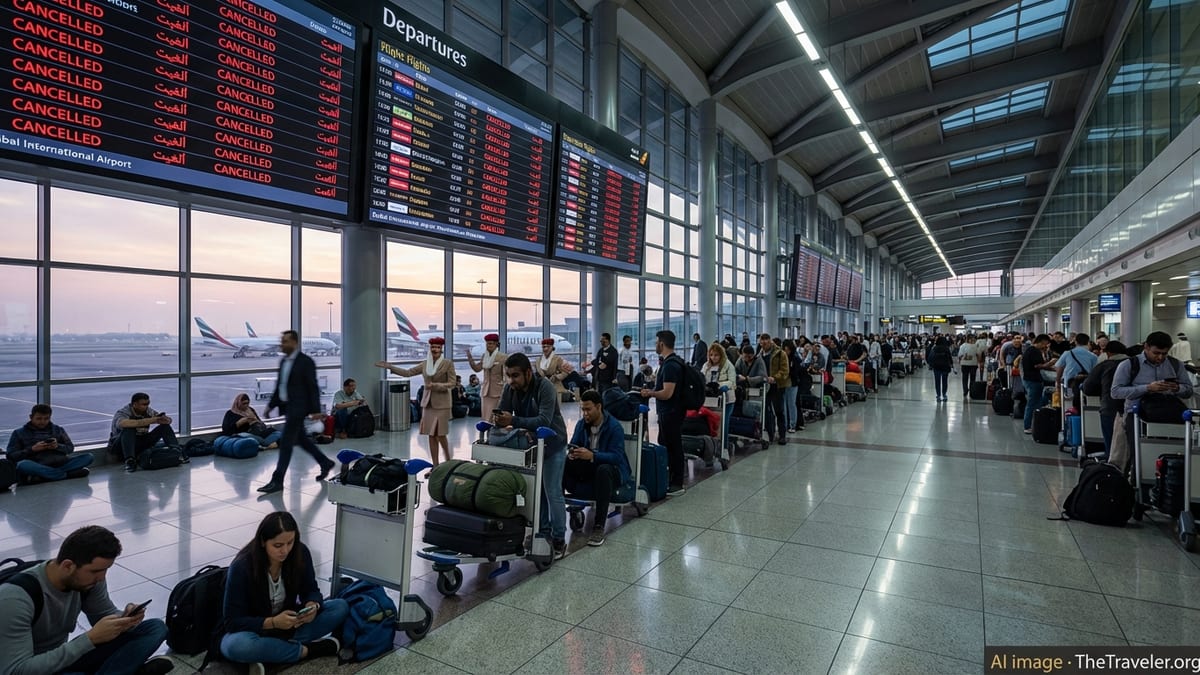
The most immediate shock to global travel was felt in the Gulf, where some of the world’s busiest connecting hubs abruptly fell silent. Dubai International Airport, consistently ranked among the top airports for international passenger traffic, suspended all flights after the United Arab Emirates partially closed its airspace. Operations at Dubai World Central, the emirate’s secondary airport, were also halted.
Home carrier Emirates, along with flydubai and other regional airlines, cancelled or suspended services as they assessed rapidly shifting airspace restrictions. Qatar Airways temporarily halted traffic to and from Doha after Qatar closed its skies, while Bahrain, Kuwait and Oman also moved to restrict flights amid reports of explosions near sensitive military facilities.
Cirium data indicated hundreds of cancellations across the wider region in a matter of hours, with Israel, Jordan and Qatar among the worst affected destinations by percentage of grounded flights. Airlines warned that even routes technically still operating would likely face substantial delays due to diversions, congestion at alternative hubs and crew scheduling challenges.
Aviation analysts said the Gulf’s role as a bridge between Europe, Africa and Asia magnified the impact. With Russia and Ukraine already off limits to many carriers, the sudden loss or restriction of Middle Eastern corridors removes another vital artery of global connectivity, forcing airlines into longer, more expensive routings.
Global Carriers Scramble to Reroute and Cancel
Major international airlines moved quickly to suspend flights into the heart of the crisis zone and replot long haul routes that would normally cross Iranian or Iraqi airspace. Lufthansa, British Airways, Air France, KLM and other European carriers cancelled services to Tel Aviv, Dubai, Beirut, Amman and several Gulf cities, in some cases extending suspensions into early March.
Indian carriers, including Air India and IndiGo, announced temporary halts to certain Middle East routes and signalled they would avoid the region’s conflict-affected skies where possible. Airlines serving Asia Europe markets began preparing for significant additional fuel requirements and possible technical stops as they charted longer paths around closed airspace.
US airlines also took precautionary steps. Carriers operating to Israel and the Gulf either suspended flights outright or advised passengers that services were under review, citing government guidance and internal security assessments. Some airlines opted to overfly alternative corridors further south or north, while maintaining flexibility to adjust routings at short notice.
Industry experts noted that the immediate priority for carriers was safety, followed closely by the complex logistics of repositioning aircraft and crews stranded at outstations. The crisis struck at a time when many airlines were already contending with tight aircraft availability and high demand on long haul routes, amplifying the potential for network wide knock on effects.
Stranded Passengers Face Uncertainty and Long Detours
For travellers across the Middle East and beyond, the sudden wave of cancellations and diversions translated into long queues, overnight airport stays and a scramble for information. Passengers en route to hubs such as Dubai, Doha or Tel Aviv reported flights turning back mid journey or diverting to secondary airports in Europe, North Africa and South Asia.
Airlines urged customers not to travel to airports unless they had confirmed departures and encouraged the use of digital channels to rebook. Many carriers introduced flexible change policies and fee waivers for affected itineraries, but the sheer number of grounded flights left limited immediate alternatives, especially for those needing to cross between Europe and Asia.
Travel agents and corporate travel managers said they were working to reroute essential business travellers along longer, more circuitous paths that sometimes added many hours to journey times. In leisure markets, some holidaymakers were being offered refunds or travel credits, while others chose to postpone trips entirely until there was greater clarity on the security outlook.
In regional tourism hotspots, hotel and tour operators reported a wave of last minute cancellations from visitors unable or unwilling to transit through the affected hubs. Some destinations that remained accessible began positioning themselves as alternative stopover points, although capacity constraints limited how quickly they could absorb displaced demand.
Longer Term Implications for Routes and Risk
Aviation and travel analysts cautioned that the longer the confrontation persists, the more structural its impact on global air networks is likely to be. Airlines have already contended with several years of elevated geopolitical risk, from the war in Ukraine and restrictions on Russian airspace to tensions in the Red Sea shipping lanes affecting cargo and connectivity. The new Middle East crisis adds another layer of complexity to route planning, insurance costs and fleet deployment.
Carriers that rely heavily on Middle Eastern overflight rights may be forced to permanently redesign key routes if airspace closures become prolonged or intermittent. That would mean higher fuel burn and reduced aircraft utilisation, squeezing margins on already thinly profitable long haul services. Some airlines may choose to cut or consolidate frequencies on vulnerable routes, potentially reducing options and raising fares for travellers.
For the tourism industry, the episode underlines how dependent global travel remains on stable corridors through politically sensitive regions. Popular itineraries that connect European cities to Indian Ocean resorts, Southeast Asia or Australasia via Gulf hubs could be reshaped if confidence in the reliability of those hubs is undermined. At the same time, secondary hubs in Southern Europe, North Africa and Central Asia may see opportunities to capture redirected flows, provided they can demonstrate robust safety and operational resilience.
Diplomatic efforts to de escalate the confrontation will be closely watched by aviation stakeholders, who say clear communication and coordinated risk assessments will be crucial to restoring confidence. Until then, travellers planning journeys that cross the wider Middle East are being advised to build in extra time, prepare for sudden changes and stay in close contact with airlines as the situation evolves.