

More news on this day
Air travel across the Middle East was thrown into sudden chaos on Saturday after Iran launched retaliatory missile strikes on United States assets in Gulf states, prompting rapid airspace closures that grounded hundreds of flights and left thousands of panicked travelers stranded from Dubai to Doha.
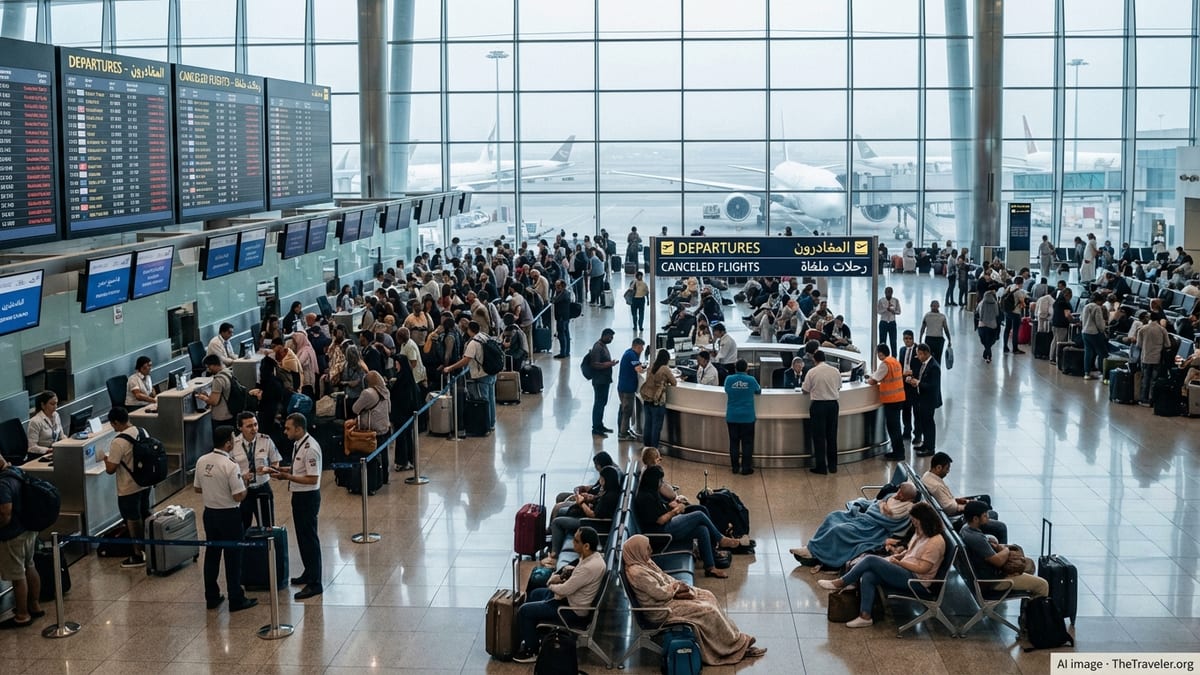
Retaliatory Strikes Ignite Regionwide Aviation Shutdown
The unprecedented disruption followed coordinated US and Israeli airstrikes on targets in Iran on February 28, which Washington described as the start of “major combat operations” against Tehran’s missile and naval capabilities. Within hours, Iran answered with salvos aimed at US and Israeli military facilities across the Gulf, striking in or around Bahrain, Kuwait, Qatar and the United Arab Emirates, all of which host significant American assets.
Explosions and interception booms were reported near Manama, Abu Dhabi and Doha, as air defense systems lit up night skies and civil aviation authorities raced to impose emergency restrictions. Gulf governments framed the moves as precautionary security steps, but the combined effect was to freeze much of the region’s air traffic in a matter of hours.
By mid-afternoon local time, at least eight states across the broader region, including Iran, Israel, Iraq, Jordan, Qatar, Bahrain, Kuwait and the UAE, had announced full or partial airspace closures. Aviation tracking data showed a conspicuous void over key Middle Eastern corridors that normally carry a dense stream of traffic between Europe, Asia and Africa.
Iran’s Revolutionary Guard signaled that more attacks could follow, declaring all US and Israeli military targets in the Middle East to be fair game. That warning injected further uncertainty into airline risk calculations and suggested that disruption to civilian travel could deepen if hostilities escalate or drag on.
Hubs in Dubai and Doha Fall Silent as Airlines Ground Fleets
Some of the heaviest disruption was felt at the region’s two largest transit gateways, Dubai and Doha, where sprawling terminals built to handle tens of millions of passengers a year suddenly fell quiet. The UAE’s General Civil Aviation Authority announced a temporary partial closure of national airspace as a precaution, prompting Dubai-based Emirates and Etihad to halt departures and divert or cancel inbound flights.
In Qatar, the Civil Aviation Authority ordered a full suspension of air traffic after the Defense Ministry said it had intercepted multiple incoming threats. Flag carrier Qatar Airways, which operates one of the world’s busiest long-haul networks, parked a significant portion of its fleet and began a rolling wave of cancellations affecting routes across Europe, Asia and the Americas.
Data from regional and global flight-monitoring services indicated that by midday, hundreds of flights had been canceled, diverted or turned back mid-route as corridors over Iran, Iraq, Kuwait, Bahrain, Qatar and parts of the UAE effectively shut down. Airlines that continued operating in the wider region were forced into long detours over Saudi Arabia and the Red Sea, adding hours to travel times and fuel costs.
Industry analysts warned that the Middle East’s emergence as a vital bridge between continents, especially since many carriers began avoiding Russian and Ukrainian airspace in 2022, has made global aviation acutely vulnerable to shocks in Gulf skies. The current closures have effectively severed some of the most important east–west links, with ripple effects likely to be felt at airports as far away as London, Singapore and Sydney.
Travelers Stranded in Terminals and Transit Hotels
Inside airports from Riyadh to Muscat, travelers awoke to departure boards flashing “canceled” and “indefinitely delayed” across entire banks of flights. In Dubai, passengers on overnight services from Europe and North America were held on tarmacs or returned to gates, while transit passengers found themselves unable to continue onward to Asia or Africa.
Stranded tourists described scenes of confusion in crowded terminals as airport staff struggled to keep up with fast-changing restrictions and incomplete information. Families bound for holiday destinations, expatriate workers connecting to home countries and business travelers heading to conferences all joined growing queues at airline service desks.
With regional carriers unable to offer firm rebooking dates, many travelers were given hotel vouchers or directed to makeshift rest areas in concourses. Others reported being told to shelter in place inside airports amid government advisories warning of potential follow-on attacks and urging residents to stay away from windows.
For passengers whose itineraries crossed multiple closed airspaces, options narrowed to either extended stopovers in unaffected hubs such as Istanbul and Cairo or complete abandonment of travel plans. Some travelers turned to social media in frustration, accusing airlines of poor communication and calling for clearer guidance on refunds and alternative routing.
Global Airlines Scramble to Reroute and Assess Risk
The closures prompted a rapid response from international carriers, many of which had already adjusted schedules in recent weeks amid rising tensions. European airlines including KLM, Air France, Lufthansa and British Airways announced suspensions or diversions of flights to Tel Aviv, Dubai, Doha and other regional destinations, citing security concerns and uncertainty over airspace availability.
Carriers from Asia and North America followed suit. Japan Airlines, Air India, major US airlines and several Gulf-adjacent operators said they would avoid Iranian and Iraqi skies and, in some cases, the wider Gulf region altogether until risk assessments could be updated. Low-cost carriers with thinner margins warned that prolonged detours could make some routes temporarily unviable.
Operationally, airlines are grappling with longer flight paths, higher fuel burn and complex crew-rostering challenges as rest-time rules collide with extended sectors. Aviation experts noted that the situation bears some resemblance to the post–Russia-Ukraine rerouting that reshaped long-haul networks from 2022 onward, but with even fewer viable alternatives given the concentration of conflict zones across West Asia.
Insurers are also reassessing premiums for overflight and landing in the vicinity of active hostilities. Aviation security consultants said underwriters are likely to push airlines to maintain wide buffers around missile engagement zones, further constraining route planners already working around multiple closed flight information regions.
Tourism and Regional Economies Face New Shock
The sudden paralysis of air links threatens a sharp setback for tourism sectors that were only beginning to stabilize after years of volatility tied to the broader Middle Eastern crisis. The UAE, Qatar and Bahrain have invested heavily in positioning their cities as stopover-friendly hubs and major business and leisure destinations, with hotel pipelines and entertainment sectors geared toward ever-growing visitor numbers.
Hospitality operators in Dubai and Doha reported a surge of unexpected check-ins from waylaid passengers, filling rooms that might otherwise have gone to higher-spending tourists. Tour operators across the region scrambled to rearrange itineraries or evacuate clients via remaining open routes, while cruise and desert tour providers braced for cancellations as long-haul guests struggled to reach embarkation points.
Economists warned that should airspace restrictions persist, the impact on retail, events and business travel could be severe. Airlines based in the Gulf, which rely on complex hub-and-spoke networks, are particularly exposed, though global carriers routing through the region will also feel the strain. Oil market volatility and investor unease about the prospect of a wider war add further pressure to economies closely tied to external confidence.
For now, authorities across the Gulf are balancing the imperative of security with mounting calls from the travel industry for clear timelines and coordinated protocols for reopening skies. With Iran insisting that its retaliation will continue until it considers its objectives met, and US and Israeli officials vowing to sustain pressure on Tehran, travelers and tourism operators alike are bracing for a prolonged period of uncertainty above one of the world’s most important crossroads.