

More news on this day
A fresh wave of turbulence across the Middle East has sharply disrupted Gulf aviation, with regional airspace closures prompting Gulf Air, Qatar Airways and Emirates to suspend or hold scores of services and leaving passengers stranded in Riyadh, Dubai, Doha and Bahrain.
Get the latest news straight to your inbox!
Airspace Closures Ripple Across the Gulf
The latest disruptions stem from escalating conflict linked to the 2026 Iran war, which has triggered rolling airspace shutdowns across several Gulf states. Publicly available information shows that Qatar and the United Arab Emirates moved early to restrict or close their skies to civilian traffic, with Bahrain following as security concerns widened along major flight corridors.
Flight-tracking data and regional coverage indicate that the closures quickly cascaded through the tightly interconnected Gulf network, forcing airlines to cancel, suspend or divert services at short notice. Hub airports in Doha, Dubai and Bahrain, normally among the busiest transit points between Europe, Asia and Africa, have seen large portions of their schedules wiped out or placed on indefinite hold.
Within this broader disruption, industry tallies point to at least 125 flights formally suspended and a further 21 held on the ground across Bahrain, Qatar and the UAE over recent days. Many of these flights were operated by Gulf Air, Qatar Airways and Emirates, carriers that depend heavily on seamless regional airspace access to support long-haul connections.
While some neighboring states such as Saudi Arabia and Oman have remained partially open, capacity on alternative routes has been limited. This has created severe bottlenecks for travelers attempting to reroute around the closed corridors, compounding delays and uncertainty.
Major Gulf Carriers Cut and Rework Schedules
Gulf Air, Bahrain’s flag carrier, has been among the most affected, as Bahrain’s airspace has faced some of the tightest restrictions. Airline updates and travel advisories describe a near-total halt to regular operations through its Manama hub, with a series of scheduled flights either formally suspended or reclassified as special services operating via alternative airports such as Dammam in Saudi Arabia.
Qatar Airways has likewise curtailed normal passenger operations through Doha’s Hamad International Airport. According to published coverage, the carrier has focused on limited relief and evacuation-style flights as Qatari airspace reopens only under restricted conditions. Standard commercial connections through Doha, particularly those linking Europe and North America with Asia and Africa, remain heavily reduced compared with pre-crisis levels.
In the United Arab Emirates, Emirates has been forced to trim what is usually one of the world’s most extensive long-haul networks. Reports from passenger forums and regional media describe a temporary suspension of large parts of its Dubai schedule at the height of the airspace closures, followed by a gradual shift to reduced operations prioritizing repatriation and essential travel. Many flights that do operate are subject to lengthy reroutes around conflict zones, extending journey times and tightening aircraft availability.
The combined effect across the three carriers is a patchwork of outright cancellations, suspended routes and last-minute operational holds. Even as some limited services resume, schedules are being revised repeatedly as airspace status changes, making it difficult for travelers and agents to predict which flights will actually depart.
Passengers Stranded in Riyadh, Dubai, Doha and Bahrain
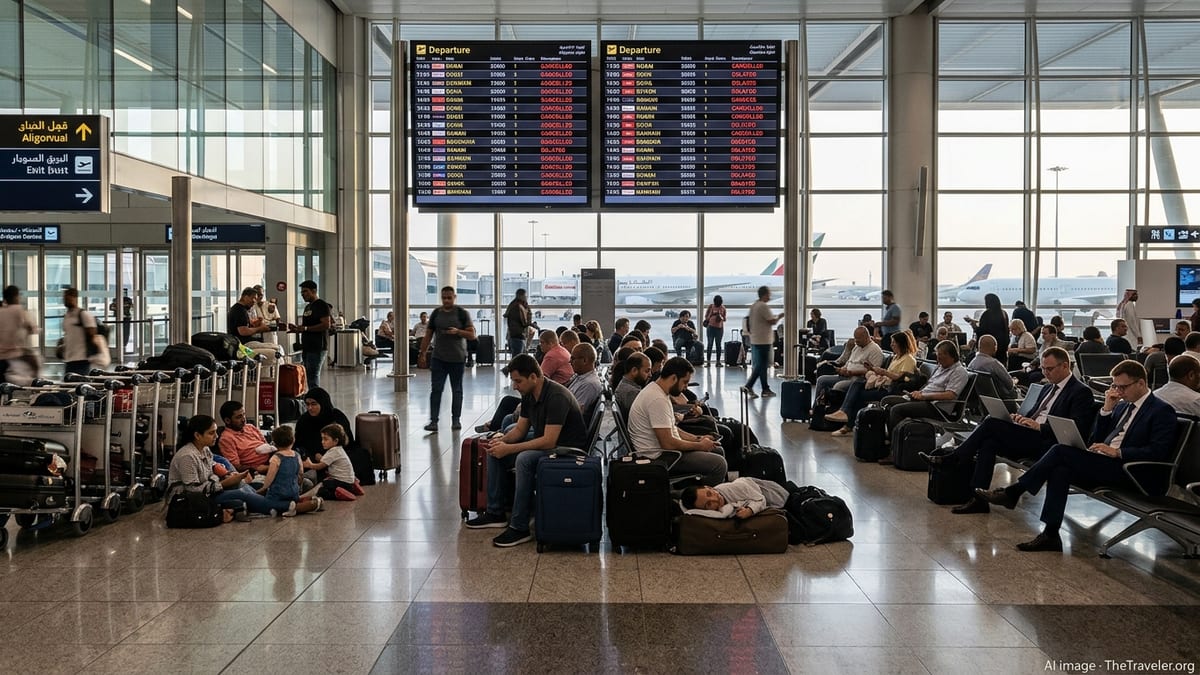
The operational turmoil has translated into tens of thousands of disrupted journeys, with Riyadh, Dubai, Doha and Bahrain emerging as key pinch points. Travelers transiting these hubs have reported being stranded for days as onward flights are cancelled or delayed, often with little advance warning and limited alternatives available.
In Dubai, a city that normally prides itself on efficient passenger flows, terminals have seen unusually high numbers of long-stay travelers waiting for rebooking. Accounts circulating on travel forums describe passengers being advised not to come to the airport unless they have written confirmation that their flight is operating, as departure boards fluctuate with the evolving airspace picture.
Doha has faced similar challenges. With Qatar Airways operating only a fraction of its usual schedule under constrained conditions, many transit passengers have found themselves stuck between itineraries, relying on ad hoc relief flights or overland journeys to reach open airports in neighboring countries.
In Bahrain and Riyadh, where alternative capacity is tighter than in the UAE or Qatar, disruption has been particularly acute for travelers on regional connections or onward long-haul services. Public reports highlight passengers resorting to cross-border road trips to Saudi hubs such as Dammam or to Omani airports like Muscat in search of available seats out of the region.
Which Flights Are Most Affected
Based on patterns emerging from airline statements and timetable data, the bulk of the 125 suspended and 21 held flights fall into three broad categories. First are point-to-point services within the Gulf itself, including short hops between Bahrain, Doha, Dubai and nearby cities, which have been curtailed where either origin or destination airspace is restricted.
Second are high-traffic long-haul corridors that rely heavily on Gulf hubs for connections, especially routes linking Europe with South and Southeast Asia, as well as Australasia. When overflight permissions through key Gulf flight information regions are narrowed or withdrawn, these services are often the first to be suspended or rerouted, as detours can add substantial flight time and fuel costs.
The third category includes so-called relief or evacuation-style flights operated on a limited basis to clear backlogs of stranded passengers. These services, sometimes departing from secondary airports such as Riyadh or Dammam rather than the main Gulf hubs, do not always appear in standard booking systems and are typically prioritized for travelers whose original flights were cancelled during the peak of the shutdowns.
For travelers holding tickets on Gulf Air, Qatar Airways or Emirates, the most heavily affected itineraries are those involving tight connections through Doha, Dubai or Bahrain, as well as journeys scheduled during the core closure windows for Qatari, Emirati or Bahraini airspace. Even flights that remain technically “scheduled” may be subject to short-notice operational holds if security assessments change.
What Travelers Need to Know Right Now
For those due to travel in the coming days, publicly available guidance from airlines and airports across the region emphasizes the importance of monitoring bookings closely. Passengers are being encouraged to check their flight status repeatedly in the 24 hours before departure, as schedules remain fluid and some services may be reinstated or pulled with only a few hours’ notice.
Rebooking options are often constrained by aircraft availability and ongoing route restrictions, so travelers whose flights are among the 125 suspended or 21 held should prepare for extended layovers or alternative routings. Many carriers are offering flexible change policies, but seat capacity on remaining services is tight, especially on popular Europe–Gulf–Asia corridors.
Travelers already stranded in Riyadh, Dubai, Doha or Bahrain are advised, through local advisories and airline updates, to coordinate directly with their carrier via official apps, websites or customer service channels, rather than heading to the airport without confirmation of a seat. In some cases, passengers may be reprotected onto different airlines or routed through secondary regional hubs where airspace remains open.
With the regional security situation still volatile, aviation analysts caution that further adjustments are likely in the short term. While limited services by Gulf Air, Qatar Airways and Emirates are expected to expand as airspace gradually reopens, the experience of recent days illustrates how quickly the Gulf’s tightly integrated aviation network can be disrupted when conflict intrudes on critical flight corridors.