

More news on this day
Switzerland has been swept into a fast‑moving global economic shock as Middle East conflict disrupts vital energy and transport corridors, sending fuel prices, airline costs and living expenses sharply higher while triggering job losses and evacuations among expatriates in affected regions.
Get the latest news straight to your inbox!
Global Energy Disruptions Hit Fuel and Transport Costs
The latest escalation in the Middle East, including the closure and disruption of routes through the Strait of Hormuz and the wider Gulf, has pushed oil and gas prices sharply higher. Brent crude has swung to levels not seen since the early phases of the Ukraine war, while natural gas benchmarks have also risen as markets factor in prolonged supply risk from a region that ships a significant share of the world’s hydrocarbons.
Reports indicate that tanker traffic through key chokepoints has been curtailed or rerouted, with war‑risk insurance premiums increasing and freight operators adding emergency surcharges. These added costs are feeding into the price of refined products, including petrol and diesel sold across Europe and in Switzerland, where motorists and logistics companies are beginning to see higher prices at the pump.
For Switzerland, which relies entirely on imported fossil fuels, such volatility translates rapidly into higher transport and production costs. Analysts note that although the country benefits from a diversified energy mix and strong currency, repeated price spikes are eroding margins for exporters and raising concerns about inflation pressures re‑emerging after a period of relative stability.
Publicly available economic commentary suggests that if shipping and energy disruptions persist into the second quarter of 2026, the combined impact of elevated oil prices, higher insurance costs and rerouted trade could subtract from growth across advanced economies, including Switzerland, the United States, Germany, Japan, Canada, Italy and Australia.
Airlines Confront Surging Jet Fuel and Longer Routes
The travel and aviation sectors are emerging as some of the most immediately exposed to the conflict. Jet fuel prices have climbed toward multi‑year highs, with industry updates citing increases from pre‑war levels near 85 to 90 dollars per barrel to ranges that, at times, have pushed close to double that level. At the same time, a patchwork of airspace closures and risk advisories has forced airlines to reroute long‑haul flights to avoid conflict zones, lengthening flight times and fuel burn.
According to recent aviation and freight market reports, carriers across North America, Europe and Asia Pacific have begun to adjust fares and surcharges to reflect these costs. Airlines in countries such as the United States, Germany, Japan, Canada, Italy and Australia are all grappling with the same core challenge: strong travel demand colliding with sharply higher operating expenses and tighter route options.
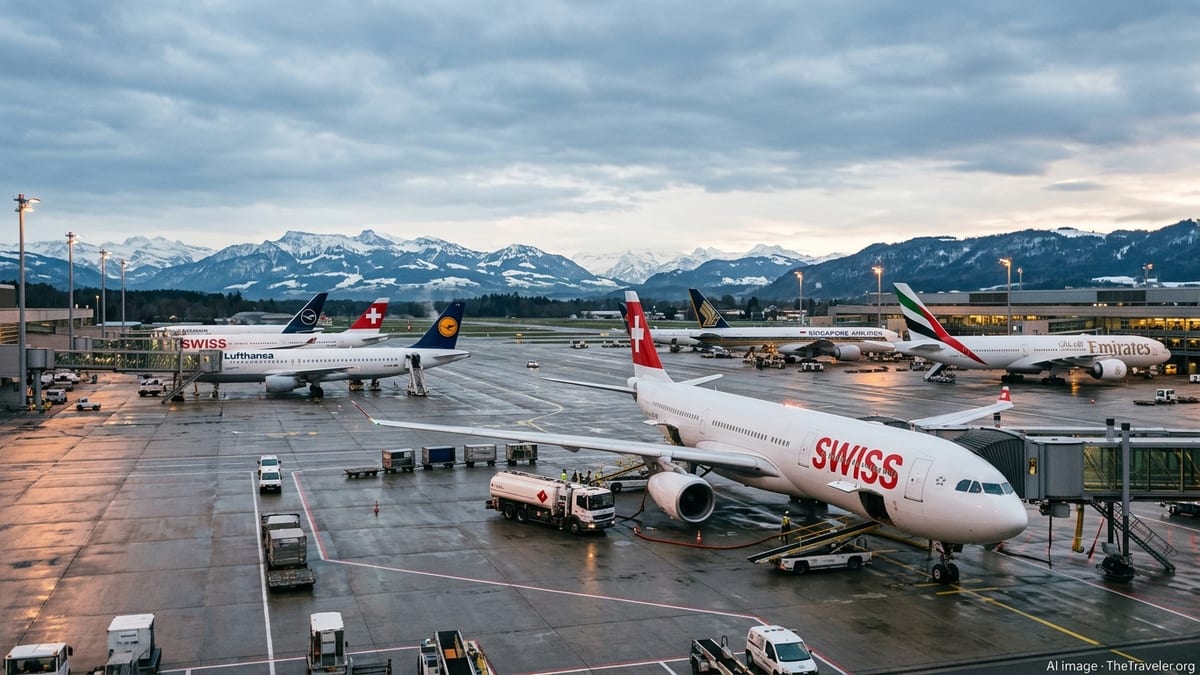
In Switzerland, where Zurich and Geneva serve as important hubs linking Europe with the Middle East, Africa and Asia, the repercussions are direct. Switzerland’s flag carrier and foreign airlines serving the country face elevated jet fuel bills and, on some routes, forced detours that add hours to journeys. Industry coverage indicates that fares on select intercontinental routes have already risen, with further adjustments expected if fuel remains expensive and operational constraints persist.
Travel trade analysis shows that global tourism growth forecasts for 2026 are being revised as higher ticket prices and uncertainty around Middle East connections weigh on demand. For outbound Swiss travelers, holiday budgets are under pressure, while inbound tourism operators fear that long‑haul visitors may delay or downgrade trips as airfare surcharges spread worldwide.
Shockwaves for Trade‑Heavy Economies Like Switzerland
Beyond energy and aviation, the conflict is reverberating across global supply chains. Shipping and logistics advisories published in recent weeks describe container lines suspending or limiting services via the Red Sea and Suez Canal, and increasingly opting to reroute vessels around the Cape of Good Hope. This adds 10 to 14 days to many Asia–Europe journeys, tying up ship capacity and driving higher freight rates.
Market intelligence from freight platforms highlights a pattern that mirrors the earlier Red Sea crisis but at greater scale: longer voyages, equipment imbalances, port congestion at alternative hubs and widespread war‑risk surcharges. These dynamics are contributing to higher costs for manufacturers and retailers in advanced economies, from the United States to Europe and Australia, that depend on just‑in‑time deliveries of components and consumer goods.
For Switzerland, a small but highly globalized economy with major pharmaceutical, machinery and luxury goods exports, higher shipping and input costs threaten competitiveness. Importers of raw materials and semi‑finished products used in Swiss industry are facing new price pressures, while exporters must decide how much of the additional cost to absorb and how much to pass on to customers in key markets such as the European Union, North America and Asia.
Economic research consulted by TheTraveler.org suggests that if freight surcharges and gas prices remain elevated for several months, the impact could show up in reduced investment, hiring freezes and a slowdown in trade volumes. This would place Switzerland alongside other advanced economies experiencing a “second‑round” inflation shock originating from global transport and energy markets rather than domestic demand.
Job Losses and Strain on Expatriate Communities
The conflict is also having a human impact on Swiss and other expatriate workers across the Middle East. As companies scale back operations, suspend projects or temporarily close offices in higher‑risk locations, reports from international chambers of commerce and global firms indicate that contracts are being terminated and staff are being repatriated on short notice.
Corporate travel updates and consular advisories describe a patchwork of evacuation efforts and voluntary departure schemes for foreign nationals based in Gulf states and neighboring countries affected by airspace restrictions, shipping disruptions or security concerns. Thousands of expatriates from Switzerland, the United States, Germany, Japan, Canada, Italy and Australia are understood to be relocating, either back home or to regional hubs considered safer.
The cost of these evacuations is compounded by higher airfares and limited seat availability on remaining routes. Airlines operating emergency or specially arranged flights face the same fuel and routing challenges as regular services, while displaced workers confront abrupt changes to income, housing and schooling arrangements. For host economies in the Middle East that rely heavily on foreign expertise, the outflow of expatriates may delay infrastructure, energy and construction projects.
In Switzerland, business associations and labor analysts warn that job losses among expatriate staff can ripple back into domestic employment as companies reorganize, consolidate regional roles or pause expansion plans. Sectors with significant exposure to Middle Eastern markets, including engineering, construction services and finance, may feel particular strain if the conflict continues to disrupt activity throughout 2026.
Tourism, Confidence and the Outlook for 2026 Travel
Tourism data released in early 2026 had pointed to a robust rebound after the pandemic and earlier supply chain shocks, with strong bookings across Europe, North America and parts of Asia Pacific. The latest tensions, however, are introducing new uncertainty. Industry coverage from major travel fairs and trade bodies notes that while underlying demand remains solid, persistently high airfares and route instability could weigh on growth later in the year.
For Switzerland, a high‑value destination dependent on international visitors for its alpine resorts and city breaks, the shift in sentiment is being watched closely. Travelers may opt for shorter‑haul trips within Europe instead of long‑haul journeys that require transits near conflict‑affected airspace, reshaping patterns of arrivals from markets such as Japan, Australia and North America.
Travel analysts highlight that households in many advanced economies are already facing higher living costs from fuel and imported goods, narrowing the discretionary budgets available for holidays. If global economic conditions deteriorate due to sustained energy and transport disruptions, the knock‑on effects for Switzerland’s hospitality sector could include weaker winter and summer seasons, particularly among price‑sensitive segments.
With developments in the Middle East still fluid, forecasts for fuel prices, freight rates and airline capacity remain highly uncertain. For now, Switzerland finds itself aligned with other advanced economies in confronting a new external shock that is reshaping how people travel, how goods move and how globally engaged workers plan their lives in 2026.