

More news on this day
Morocco enters 2026 as one of Africa’s strongest tourism stories, yet escalating unrest across the wider Middle East is testing how resilient that success can remain over the next 12 months.
Get the latest news straight to your inbox!
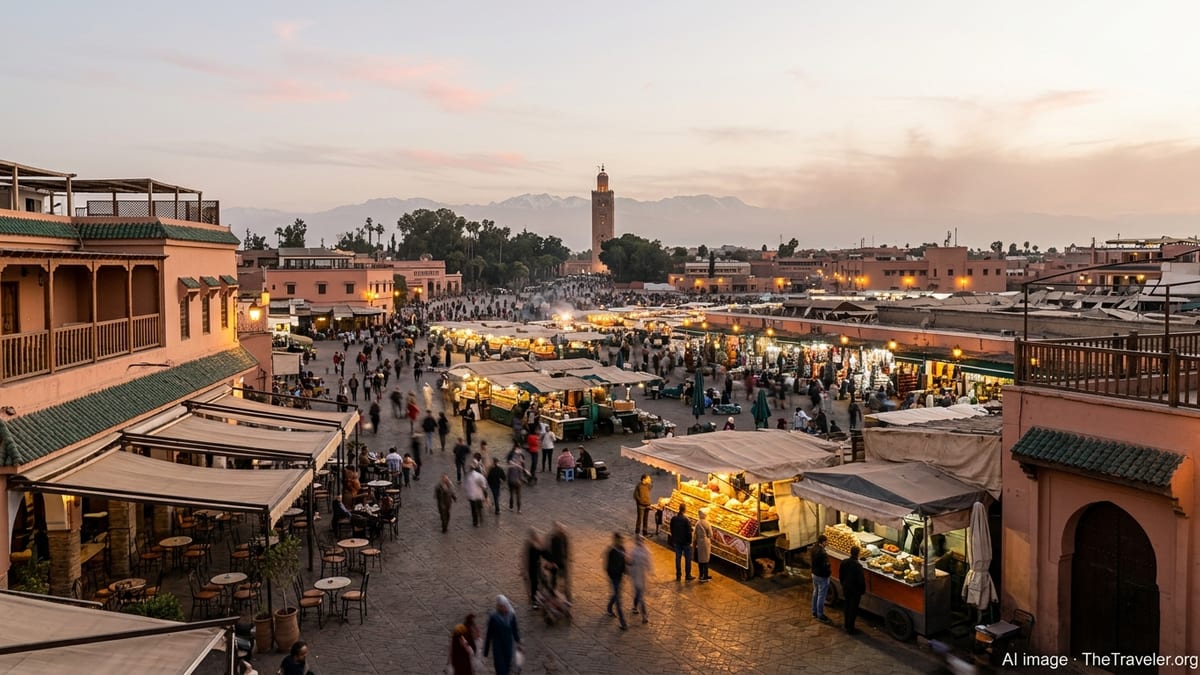
From Record Highs To A More Uncertain Horizon
Over the past three years, Morocco has moved from recovery to outperformance, setting new tourism records and surpassing pre-pandemic benchmarks. Data released by Morocco’s tourism authorities and multilateral institutions for 2024 show around 17.4 million international arrivals, roughly 20 percent higher than in 2023, with travel receipts also hitting historic peaks. Additional estimates and year-end summaries for 2025 point to close to 20 million visitors and double-digit growth in tourism revenues, placing Morocco at the top of Africa’s tourism rankings.
This growth has been guided by a national tourism roadmap for 2023 to 2026 that aims to carry Morocco beyond 20 million visitors while lifting sector revenues and jobs. The plan emphasizes expanded air capacity, new themed “territorial brands” beyond classic city breaks, and higher-quality accommodation stock. Central bank and government reports describe the strategy as largely ahead of schedule, with 2024 arrivals already close to the initial 2026 target.
That momentum now collides with a more volatile backdrop. Since late 2025, the regional environment around the Middle East has deteriorated sharply, including a broader conflict involving Iran that has disrupted air corridors, raised energy prices and unsettled travelers heading to or transiting through the eastern Mediterranean and Gulf hubs. Morocco, far from the front lines, is not directly involved, yet the fallout is beginning to shape flight patterns, pricing and perceptions that will influence the rest of the 2026 tourism year.
Analysts tracking North African tourism note that the region as a whole had been outperforming global averages, with North Africa well above pre-pandemic levels. The recent escalation has not erased those gains, but it introduces new downside risks just as Morocco was preparing to consolidate its position as a stable, reliable gateway between Europe and Africa.
Airspace Disruptions Ripple Through Morocco’s Connectivity
One of the clearest early impacts of regional unrest is visible in air connectivity. International coverage on the 2026 Iran-related conflict describes partial closures of Middle Eastern airspace and disruptions for major carriers that depend on Gulf and Levant hubs for long-haul transfers between Europe, Asia and Africa. That turbulence is now rippling across route maps that feed Morocco’s main gateways in Casablanca, Marrakech and Agadir.
Long-haul travelers from Asia and Oceania have been particularly affected. Many itineraries to Morocco rely on connections through Gulf carriers, Turkish operators or eastern Mediterranean hubs. With detours and suspensions affecting some of these corridors, travel time and uncertainty have increased. Anecdotal accounts shared publicly by travelers in March 2026 describe cancelled itineraries linking Dubai to Casablanca and onward stays in Marrakech, underlining how regional aviation shocks can suddenly affect a trip that never passes anywhere near a conflict zone.
European connectivity, however, remains the backbone of Morocco’s access, and it has been more resilient. Direct flights from France, Spain, the United Kingdom, Germany and other European markets continue to operate at scale, aided by previous capacity agreements and marketing partnerships designed to lift arrivals through 2026 and beyond. Industry observers suggest that, while some seat growth on secondary routes may slow, the core trans-Mediterranean network is expected to hold up as long as safety perceptions in North Africa remain distinct from conditions further east.
Morocco’s tourism planners now face a more complex calculus: maintaining ambitious volume and revenue targets while adapting schedules and promotions to reflect a more fragmented global aviation system. Shorter-haul markets within Europe and the Maghreb, as well as increasingly important sub-Saharan routes, are likely to take on added weight as carriers and destination marketers hedge against Middle Eastern airspace volatility.
Demand Shifts: Perception, Safety Maps And Pricing
Despite the regional turmoil, publicly available tourism statistics and global risk assessments still position Morocco among the safest major destinations in its wider neighborhood. International risk maps updated during 2024 and 2025 categorized the country as relatively low-risk for leisure travel, in contrast to several eastern Mediterranean and Middle Eastern states directly exposed to conflict. This differentiation helped Morocco absorb travelers rerouting away from more volatile destinations, particularly in package and winter-sun segments.
At the same time, perception gaps remain. Travel forums and industry surveys over the past two years have repeatedly highlighted confusion among some long-haul visitors who conflate “Middle East and North Africa” as a single risk zone. Questions about whether unrest in Gaza or the Gulf affects safety in Morocco have been common, even as the country sits thousands of kilometers away and maintains a separate security profile. Some tour operators reported softer bookings from cautious segments in late 2023 and 2024, especially among first-time visitors unfamiliar with North African geography.
Pricing dynamics are also shifting. With parts of the eastern Mediterranean experiencing declines in European arrivals due to security concerns and higher insurance costs, room rates and package prices there have in some cases softened to stimulate demand. Morocco, by contrast, has been operating near capacity in key cities and coastal resorts, helping sustain stronger average daily rates as occupancy remains robust. The risk for 2026 lies in potential demand volatility if economic shocks from the wider conflict, such as higher energy prices in Europe, start to weigh on discretionary travel spending.
This combination creates an unusually mixed picture: Morocco is perceived as a relative safe haven within a troubled region, yet it cannot fully escape the psychological and economic drag of recurring Middle East crises. Destination messaging in 2026 is expected to lean more heavily on clarity about distance from conflict zones, domestic stability and the practical experience of recent visitors.
Strategic Response: Roadmap Adjustments And Market Diversification
Official planning documents and financial-sector analysis of Morocco’s tourism roadmap indicate that authorities had already been prioritizing diversification before the latest Middle East escalation. The 2023 to 2026 strategy calls for new thematic routes around desert experiences, surf and nature, culture and city breaks, as well as MICE and sports tourism, including events linked to Morocco’s role in the 2030 FIFA World Cup co-hosting bid. This approach aims to reduce dependence on a small number of source markets and to extend stays across lesser-known regions.
Regional unrest is likely to accelerate that diversification drive. Market watchers expect more attention to high-potential European secondary cities, North American gateways such as New York and Montreal, and regional links to West Africa. These routes are less exposed to Middle Eastern airspace chokepoints and can be supported by bilateral aviation agreements and targeted co-marketing with carriers.
The investment pipeline inside Morocco also continues to reshape the product on offer. Recent years have seen growth in midscale and upscale hotels in cities such as Tangier, Rabat and Dakhla, along with eco-lodges and riad restoration in historic medinas. Financial disclosures from Moroccan banks and tourism-linked firms highlight ongoing projects scheduled to open through 2026, suggesting confidence that underlying demand remains strong despite geopolitical headwinds.
Observers note, however, that the sector’s focus is subtly shifting from pure volume metrics to resilience and value. With 2024 and 2025 arrival numbers already brushing against initial 2026 targets, the priority for the coming year is less about breaking another records headline and more about consolidating gains, smoothing seasonality and ensuring that small and medium-sized operators can withstand external shocks.
Outlook 2026: Resilience Tested, Opportunity Intact
Looking ahead to the rest of 2026, consensus expectations among tourism analysts and multilateral institutions point to continued growth for Morocco, albeit at a more moderate pace than the surges recorded in 2023 to 2025. The country benefits from diversified demand across city culture, coastal leisure, desert adventures and diaspora travel, alongside a strategic location just a short flight from major European markets.
The main variables lie beyond Morocco’s control: the trajectory of the Middle East conflict, the duration of airspace restrictions and the knock-on effects on global growth and consumer confidence. A prolonged crisis that keeps fuel prices elevated and complicates long-haul itineraries could trim high-spending segments from Asia and the Americas, even as regional and European traffic remains robust.
Yet the same tensions that depress demand in some Middle Eastern and eastern Mediterranean destinations could continue to redirect cautious travelers toward North African alternatives perceived as more stable. Morocco’s challenge in 2026 will be to communicate that distinction clearly, maintain consistent service and safety standards on the ground, and adapt its roadmap to a world where geopolitical shocks are no longer exceptional events but recurring features of the travel landscape.
In that sense, the shadow of the Middle East hanging over Morocco’s 2026 tourism outlook is both a test and an opening. How effectively the country manages this moment will help determine whether the record-breaking surge of recent years hardens into a durable, crisis-resilient success story.