

More news on this day
Global aviation is facing what industry analysts increasingly describe as a fifty‑three billion dollar nightmare, as the escalating war centered on Iran and Israel forces airlines to abandon vital Middle East corridors, rip up schedules, and pass rising fuel and insurance costs on to passengers who had grown used to cheap long-haul fares.
Get the latest news straight to your inbox!
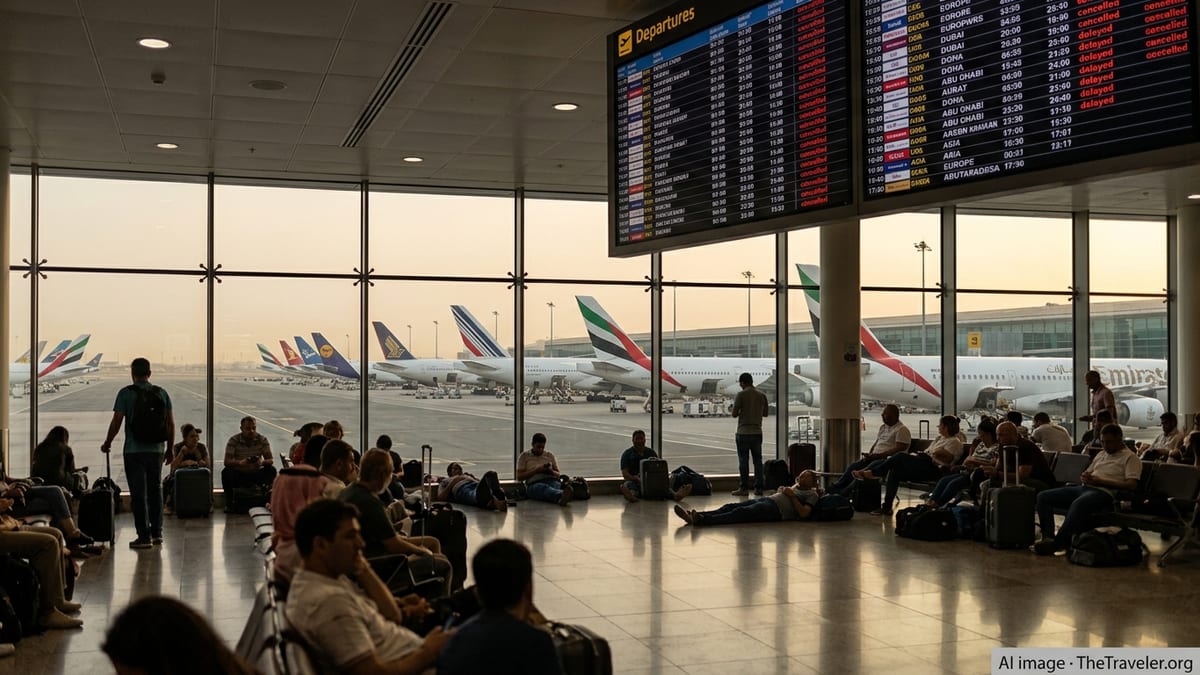
A Strategic Air Bridge Suddenly Cut
The latest phase of the Iran war has shut or heavily restricted swathes of airspace across Iran, Iraq, Israel, Jordan, Qatar, Bahrain, Kuwait, Oman and the United Arab Emirates, turning one of the world’s busiest aviation crossroads into a patchwork of no-go zones. Reports from flight tracking services and news outlets show Dubai, Abu Dhabi and Doha, usually among the world’s most important long-haul hubs, reduced to skeleton operations or temporary standstills as missiles and drones fly overhead.
These hubs became even more critical after Russian and Ukrainian skies were largely closed to Western carriers in 2022. Airlines stitched together a new backbone of global connectivity using Gulf and Levantine routes to bridge Europe, Africa and Asia. With that bridge now fractured by the Middle East war, many Europe–Asia itineraries that once flowed smoothly through the Gulf are being rerouted, cancelled or priced sharply higher.
Travel-focused analyses indicate that flights between Europe and Asia are being pushed north via narrow Caucasus corridors or far to the south over Egypt and the Arabian Sea. Reroutings can add two to five hours to a single long-haul leg, multiplying fuel burn and crew time. For travelers, this means not only longer journeys and missed connections but a fundamental reset of what a “cheap” ticket on these routes can realistically cost.
Airline associations and regional regulators have warned that these closures and advisories may not be short-lived. Safety bulletins issued in recent weeks describe a high risk from missiles, drones and electronic interference at cruising altitudes, making carriers reluctant to return to pre-war routings even during temporary lulls in fighting.
The Bill for Detours, Fuel and War Risk
Behind the scenes, the economics of these detours is brutal. Extended flight paths mean burning dramatically more jet fuel at a time when the conflict is also roiling global energy markets. Recent coverage of oil and fuel trends notes that jet fuel prices have been climbing as attacks and threats in and around the Strait of Hormuz disrupt a waterway that normally carries a significant share of the world’s crude exports. Long-haul routes, the very ones most exposed to Middle East closures, bear the brunt of these higher input costs.
At the same time, aviation insurers are recalculating the risks of flying anywhere near the conflict. War risk premiums, which had already risen after earlier missile strikes and the Red Sea crisis, are being repriced again as drones and ballistic missiles reach deeper into regional skies. For airlines operating widebody fleets through or around the region, this translates into higher fixed costs layered on top of volatile fuel bills.
Industry forecasts from global airline bodies published in late 2025 projected that carriers worldwide would earn around forty billion dollars in net profit in 2025 and slightly more in 2026, on total revenues well above a trillion dollars. Those outlooks already flagged geopolitical conflict as one of the biggest downside risks. The combination of longer stage lengths, pricier fuel, rising maintenance expenses and conflict-related disruptions is now eating into what are historically thin margins of just a few percentage points.
Analysts tracking airline financials suggest that the Middle East war could wipe out tens of billions of dollars in value over a multiyear horizon when higher operating costs, lost demand and disrupted fleet planning are taken together. The “fifty‑three billion dollar nightmare” label reflects not only immediate losses from mass cancellations, but also the structural shift in cost curves that makes pre-war discount pricing unsustainable.
Stranded Passengers and Vanishing Cheap Fares
The human face of this macroeconomic shock has been visible for weeks in airport terminals from Dubai to London. News reports describe hundreds of thousands of passengers stranded or diverted after coordinated attacks on Iran and retaliatory strikes prompted abrupt airspace closures across the region. Travelers on once-routine itineraries have found themselves sleeping on terminal floors, rerouted across continents, or stuck waiting days for scarce alternative seats.
Premium passengers and the wealthy have in some cases turned to private jets and ad hoc charters, paying steep sums to escape regional bottlenecks. Coverage from Gulf airports notes that charter prices and last-minute business-class fares have surged as demand for any available seat out of the region collides with a severe reduction in capacity. For most travelers, however, the problem is not how to pay for a way out, but whether a way out exists at all.
Even where flights continue, the era of abundant discount inventory on Middle East–linked long-haul routes appears to be fading. Airlines faced with higher variable costs and growing uncertainty are removing the cheapest fare buckets, tightening advance-purchase deals, and experimenting with dynamic pricing that reflects elevated risk. Travel search data already shows sharp rises in average fares on popular Europe–Asia city pairs that once relied on fast connections through Gulf hubs.
Budget-conscious travelers who had come to rely on low-cost one-stop itineraries between Europe and South or Southeast Asia are being pushed toward more expensive nonstops on European or Asian carriers, when those exist, or toward more complex routings through secondary hubs. The result is a creeping normalization of higher prices that could outlast the immediate hostilities, particularly if airlines decide that consumers have grudgingly accepted the new baseline.
Airlines Rethink Networks in a Fragmented Sky
The conflict is accelerating a strategic rethink among carriers and regulators about how fragile the global route network has become. Within a few years, airlines have had to adapt to losing easy access first to Russian and Ukrainian skies, then to large portions of the Middle East. What was once a relatively seamless web of great-circle routes has fractured into a set of politically constrained corridors that add distance, risk and complexity.
European and Asian airlines are quietly revisiting which hubs they depend on, how much traffic they send over volatile regions, and whether older aircraft with shorter range still make sense in a world of frequent detours. Some are redeploying capacity to North American routes or intra-Asian networks that are less exposed to Middle Eastern airspace drama. Others are investing in longer-range aircraft capable of bypassing the region altogether on ultra-long-haul flights, despite the higher unit costs those flights entail.
Regulatory agencies are supplementing formal airspace closures with persistent advisories that effectively narrow the viable choices even when skies are technically open. Safety circulars now caution against wide swaths of territory in the Middle East, citing the reach of modern missiles and drones, as well as widespread interference with satellite navigation. Airlines that might once have accepted a degree of overflight risk are increasingly reluctant to do so, knowing that a single incident could carry enormous financial and reputational consequences.
All of this reinforces a trend toward fragmentation in the global aviation system. The traditional model of a few mega-hubs stitching together continents is under pressure as conflicts, sanctions and security concerns carve the map into zones of relative stability and persistent hazard. For travelers, that fragmentation tends to mean fewer options, less competition on key routes and higher average fares.
What It Means for the Future of Affordable Travel
Before the recent escalation, global airline traffic had finally surpassed pre-pandemic levels, with industry bodies projecting record passenger numbers and modestly improving profitability into 2026. Low-cost carriers were expanding across Europe, Asia and the Middle East, and full-service airlines were restoring dense long-haul networks that had underpinned a decade of affordable international leisure travel.
The Middle East war threatens to reverse some of that progress. Higher operating costs and persistent geopolitical risk are likely to make airlines more cautious about adding capacity on marginal routes, especially those that depend on circuitous paths around conflict zones. That, in turn, reduces the oversupply that had previously driven down fares in peak seasons and on highly competitive corridors.
Travelers may continue to see headline-grabbing sales and promotional fares, but these are likely to be more restricted by date, route and booking conditions than in the past. The baseline cost of connecting Europe, Africa and Asia is rising as fuel, insurance and navigation expenses climb and as airlines bake extra flying time into schedules to account for sudden airspace closures. Even if peace returns to the region, the memory of repeated shutdowns may keep many carriers from fully resuming their old routings.
In practical terms, the industry appears to be entering an era where cheap long-haul tickets via the Middle East are no longer something travelers can take for granted. The fifty‑three billion dollar price tag often cited in current analysis captures only part of the story. The deeper cost may be a structural shift in how global aviation balances risk and affordability, with travelers paying more and flying longer in a world where strategic corridors can vanish overnight.