

More news on this day
A rapidly escalating conflict centered on Iran and the wider Gulf is rippling through global aviation in 2026, triggering mass flight cancellations, sharp airfare increases, and a breakdown of tourism flows far beyond the Middle East itself.
Get the latest news straight to your inbox!
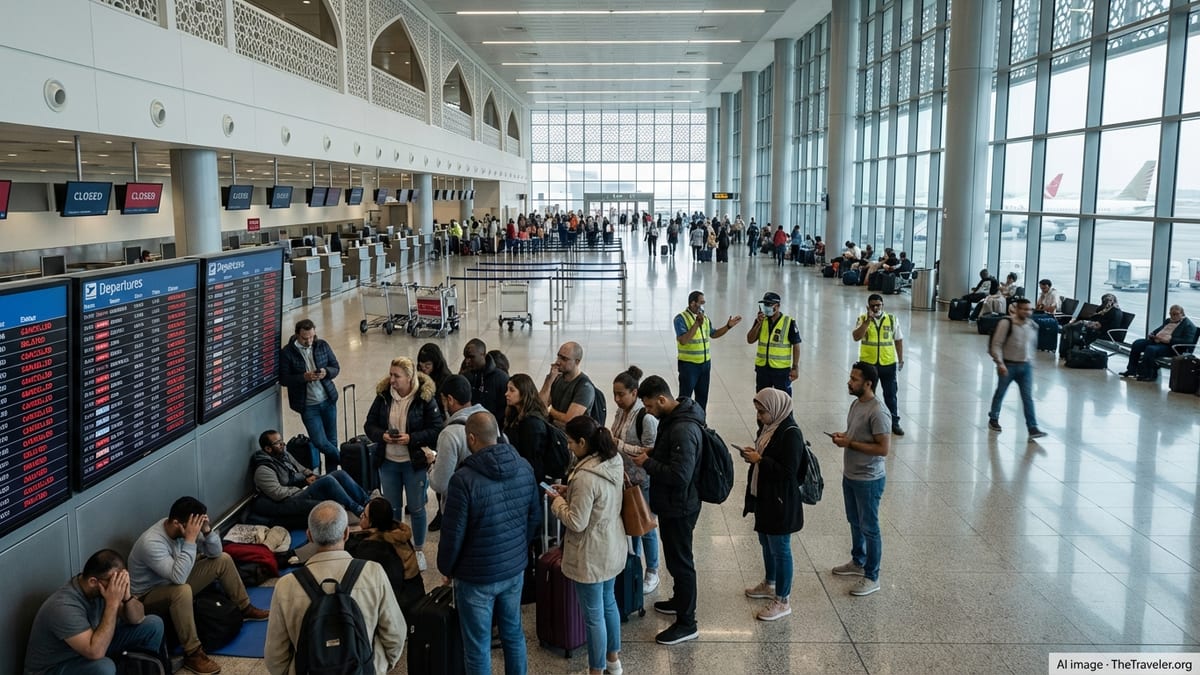
Airspace Closures Turn a Regional War into a Global Flight Crisis
What began as a regional confrontation has quickly evolved into one of the most disruptive shocks to commercial aviation since the pandemic. Publicly available information shows that airspace over Iran, Iraq, Kuwait and parts of the United Arab Emirates has become a patchwork of closures and heavy restrictions, effectively shutting down one of the world’s most important east–west corridors between Europe, Asia and Africa.
Analyses of flight data indicate that more than 50,000 flights to and from the broader Middle East have been canceled since late February 2026, with additional services operating on extended contingency routings. Capacity out of the central Gulf region has fallen by around half compared with 2025 levels, according to recent aviation advisory notes, as carriers slash schedules or pull out of key hubs entirely.
Major regional and European airlines have suspended or severely reduced services to hubs such as Doha, Dubai and Riyadh, while several Gulf states temporarily closed their airspace as missile and drone attacks intensified. Even where airports remain technically open, war risk assessments and operational constraints are forcing airlines to avoid the most direct routes, adding time, distance and cost to long-haul operations.
The disruption is not limited to passenger flights. Airfreight capacity through the Middle East, a critical bridge for Europe–Asia cargo flows, has contracted sharply as Gulf carriers ground fleets or redeploy aircraft away from the conflict zone. Logistics advisories estimate that global airfreight capacity has dropped by well over 10 percent as a result of the crisis, feeding directly into higher costs and slower deliveries worldwide.
Jet Fuel Shock Sends Airfares Higher Worldwide
The war’s impact on energy markets is compounding the aviation turmoil. Oil and gas flows through chokepoints such as the Strait of Hormuz and the Bab el Mandeb have been disrupted by military activity and renewed threats against shipping. Industry reports indicate that around 20 percent of global seaborne oil trade and a substantial share of liquefied natural gas exports are directly exposed to these routes, making aviation fuel prices highly sensitive to the crisis.
Recent market data cited by analysts and consultancies suggests that jet fuel prices have roughly doubled in a matter of weeks, a dramatic swing for an industry where fuel normally accounts for 20 to 35 percent of total operating costs. Airlines are responding by raising base fares where demand allows and, increasingly, by loading additional carrier-imposed surcharges labeled as fuel or international supplements on long-haul tickets.
Travel coverage from multiple outlets shows that economy tickets between Europe and Asia routed via safer northern paths have risen 15 to 25 percent on average since late February, with some premium and last-minute fares spiking much higher. On transatlantic and transpacific routes, where demand remains strong, airlines are more selectively increasing prices in higher fare classes, but travelers are still seeing noticeable jumps compared with pre-crisis levels.
For consumers, the new fare structure can be confusing. A fare that once consisted mostly of a base ticket price plus taxes is now often dominated by opaque surcharge lines that capture the volatility of fuel and war risk insurance. While some carriers argue these add-ons are temporary, aviation economists warn that if the conflict and oil constraints persist through the northern summer, higher pricing could become embedded for the rest of 2026.
Rerouted Flights, Longer Journeys and Stranded Passengers
With large swaths of Middle Eastern airspace classified as no-go or high-risk, airlines are redrawing global route maps in real time. Flight trackers show that many Europe–Asia and Europe–Africa services that once cut across Iran and the Gulf are now doglegging north over Central Asia or south around the Arabian Peninsula, significantly extending distances.
In practical terms, travelers are seeing additional flying times of two to four hours on a range of routes, from Southeast Asia to Europe and from Southern Africa to North America. These detours not only increase fuel burn and crew costs but also compress already tight connection banks at major hub airports, making missed connections and rolling delays far more likely.
Travel advisories compiled by consumer groups and legal organizations describe a familiar pattern: sudden cancellations as airlines adjust schedules, rebookings onto alternative routings through Southeast Asia or northern Europe, and overnight backlogs at key transit points. Some Gulf hubs have reported hundreds of canceled departures over a few days, affecting tens of thousands of passengers in a single week.
Insurance companies and passenger rights advocates are warning travelers that compensation rules vary widely by jurisdiction and airline. In many cases, carriers classify war-related disruptions as extraordinary circumstances, limiting cash compensation obligations even if rebooking or refunds are offered. Travelers are advised to scrutinize policy wording for war, terrorism and airspace-closure exclusions before assuming they are covered.
Tourism Collapse Across the Middle East and Knock-On Effects Elsewhere
The tourism fallout inside the Middle East itself has been stark. Recent regional tourism analyses describe a “systemic collapse” of visitor arrivals, with bookings to major leisure destinations in the Gulf, Levant and parts of North Africa evaporating almost overnight. National strategies centered on mega-projects and high-spend international tourists have been paused or drastically scaled back as security concerns dominate.
Popular city-break and pilgrimage destinations that once relied on connecting traffic through hubs like Dubai, Doha and Jeddah are now facing empty hotels, shuttered tour operations and widespread job losses. Industry bodies in the region are warning that, depending on how long the conflict lasts, the setback to tourism investment could reverberate for years, pushing back long-term diversification plans.
The shock is also being felt in destinations far from the conflict zone. As airlines withdraw capacity from the Middle East and reroute aircraft to alternative hubs, some European and Asian cities are seeing a surge in transfer traffic. Tourism boards in southern Europe, for example, report increased interest from travelers who previously routed via Gulf hubs to reach Africa or the Indian Ocean and are now opting for itineraries via Madrid, Rome or Athens instead.
However, this diversion effect does not fully offset the broader downturn. Higher fares, longer travel times and pervasive uncertainty are already prompting some consumers to scale back or postpone long-haul trips altogether. Analysts note that if the war drags into the peak northern summer season, global tourism growth forecasts for 2026 will likely be revised downward, with emerging markets that depend on long-haul arrivals hit hardest.
What Travelers Can Do Now: Practical Steps in an Unstable Landscape
With conditions changing by the day, travelers planning international trips in 2026 face an unusually complex risk environment. Publicly available guidance from aviation regulators, consumer watchdogs and travel insurers suggests a few consistent strategies for reducing exposure to disruption and unexpected costs.
First, flexibility has become essential. Fully refundable tickets or changeable fares, which once seemed like a luxury, now offer valuable protection if routes are canceled or advisories tighten. Where budgets allow, booking directly with an airline rather than through multiple intermediaries can simplify rebooking in the event of sudden schedule changes.
Second, travel insurance should be examined carefully, not just purchased by default. Many basic policies exclude claims related to declared wars, terrorism or known events, particularly once a government has issued formal travel warnings. Specialist policies that explicitly cover trip interruption due to airspace closures or indirect impacts such as extended rerouting may cost more but can be significantly more useful in the current environment.
Finally, travelers are being encouraged by consumer organizations to think in terms of corridors rather than single destinations. Routes that avoid the Middle East entirely, even if longer, may offer greater reliability in the months ahead. Monitoring airline advisories, government travel notices and reputable aviation news outlets before departure and during a trip can help travelers adapt quickly as the crisis continues to reshape global skies.