

More news on this day
Airports across the Arabian Peninsula are facing their worst disruption in years as the escalating US-Israeli war with Iran triggers mass flight cancellations, emergency airspace closures and a sudden standstill in one of the world’s fastest-growing tourism regions.
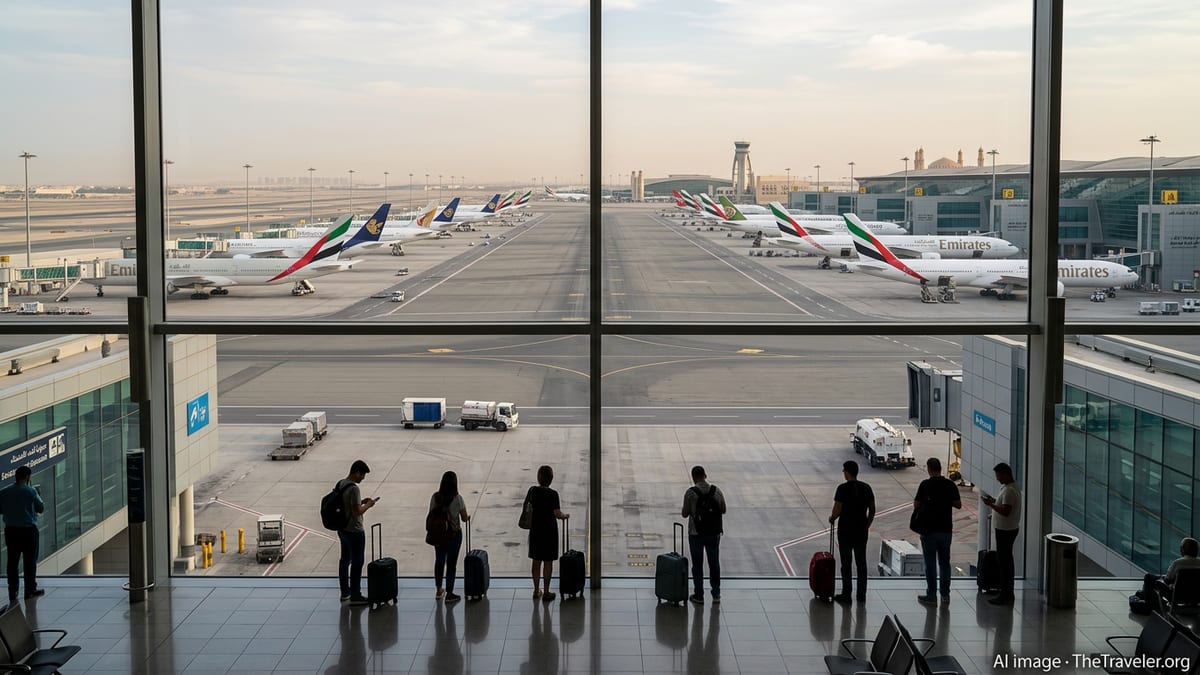
Airspace Shutdowns Cripple Gulf Aviation Hubs
Since joint US and Israeli strikes on Iran began on February 28, airspace restrictions have rapidly expanded across the Middle East, forcing airlines to cancel or divert thousands of flights that normally cross the Arabian Peninsula’s skies each day. Aviation data firms report more than 23,000 flights canceled across the wider region in less than a week, with nearly 25,000 grounded since the first salvos of the conflict, knocking out much of the connectivity that turned Gulf hubs into global crossroads.
Iran, Israel, Iraq, Qatar, Bahrain, Kuwait and Syria have closed their airspace entirely, while the United Arab Emirates and Saudi Arabia are operating only partially, under tight security controls. Dubai International, Abu Dhabi, Doha and other Gulf airports that usually bustle with transit passengers connecting between Europe, Asia and Africa are operating on a skeleton schedule, with most widebody jets parked on the apron and only a trickle of evacuation and special relief flights taking off.
The European Union Aviation Safety Agency has issued conflict-zone warnings that effectively bar European carriers from flying through much of the region, compounding local restrictions. Long-haul airlines from Asia and Europe are now forced to route north over Central Asia or south over the Arabian Sea, adding up to two hours to flight times and sharply driving up fuel costs.
While some Gulf governments have begun cautiously reopening limited corridors for emergency operations, civil aviation authorities across the peninsula have made clear that normal commercial traffic will not resume until the risk from missile strikes and electronic warfare abates significantly.
Gulf Carriers Slash Schedules as Passengers Are Stranded
Flag carriers based on the Arabian Peninsula, long marketed as the backbone of modern global travel, have been forced into drastic cuts. Emirates and Etihad in the United Arab Emirates, Saudia in Saudi Arabia and Qatar Airways have all canceled or suspended large portions of their schedules, with services to key regional destinations such as Tel Aviv, Beirut, Amman, Doha and Kuwait City halted and many long-haul routes temporarily dropped.
Saudi Arabia’s Saudia has extended suspensions on flights linking major Gulf capitals, while budget and regional airlines have followed suit, citing closed air corridors and insurance restrictions. International carriers including Air France-KLM, Lufthansa Group, Air India, Cathay Pacific and several US airlines have pulled back from Dubai, Abu Dhabi, Doha and Riyadh, or are flying only occasional recovery services to pick up stranded nationals.
For passengers, the result has been days of uncertainty. Tens of thousands of travelers are sleeping on terminal floors or in hastily arranged transit hotels from Dubai to Muscat as rolling cancellations erase departure boards. Airlines have issued flexible rebooking waivers, but with such limited capacity operating, many tourists and migrant workers are being told it could be a week or more before they can secure a seat out of the region.
Some wealthier travelers are turning to private charters, paying premium rates to escape via secondary airports where restricted corridors remain open. For most, however, options are few, and consular hotlines are overwhelmed with calls from citizens seeking guidance on how to leave or whether to stay put.
Tourism Boom in Arabian Peninsula Reverses Overnight
The timing of the conflict is particularly painful for Arabian Peninsula destinations that had spent the past decade reinventing themselves as global tourism magnets. In 2025, Gulf and neighboring states such as Saudi Arabia, the United Arab Emirates, Oman and Qatar welcomed tens of millions of visitors, surpassing pre-pandemic arrivals as they invested heavily in new resorts, cruise terminals, cultural attractions and mega-events.
That boom has been abruptly interrupted. Tour operators report a wave of cancellations from Europe, Asia and North America for spring and summer holidays in Dubai, Abu Dhabi, Riyadh and coastal resorts along the Red Sea and Arabian Gulf. Corporate travel, a key revenue stream for Gulf carriers and hotels, has also slowed to a near halt as multinational firms suspend staff trips to the region amid heightened security warnings.
The damage is being felt far beyond luxury hotels and airline premium cabins. Small tour companies, desert safari operators, guides, restaurateurs and ride-hailing drivers who rely on visitor spending say new bookings have vanished in a matter of days. Industry analysts warn that if the conflict and airspace closures persist for more than a few weeks, the Arabian Peninsula could see a sharp drop in tourism revenue for 2026, undermining economic diversification plans that hinge on turning Gulf states into transit and leisure powerhouses.
Credit rating agencies and tourism economists are already revising down growth forecasts for regional aviation and hospitality, noting that the duration of the conflict will determine whether this is a short, sharp shock or the start of a more prolonged downturn in Middle East travel.
Governments Race to Evacuate Citizens and Manage Risk
As commercial networks fray, governments across the world are scrambling to organize special flights to extract their citizens from Gulf states and nearby conflict-affected areas. The United States has issued an urgent advisory urging Americans in a broad swath of Middle Eastern countries, including Saudi Arabia, the United Arab Emirates, Oman and Qatar, to leave while limited commercial options remain, and has begun operating charter flights where necessary.
European and Asian governments are pursuing similar strategies, negotiating narrow safe corridors with Gulf aviation authorities to move evacuees through a handful of remaining gateways such as Dubai, Riyadh and Muscat. These operations are constrained by tight curfews, shifting risk assessments and the need to coordinate with militaries controlling congested skies, making it impossible to guarantee seats for all who wish to depart.
Inside the Arabian Peninsula, tourism and transport ministries are working with airlines and airport operators to maintain essential domestic connectivity and ensure that critical cargo, including medical supplies and food, can still move despite the collapse in passenger demand. The focus, officials say, is on safety first, with commercial tourism taking a distant back seat to crisis management.
Diplomats and industry leaders are lobbying for rapid de-escalation, warning that the longer the conflict drags on, the harder it will be to restore traveler confidence in the region’s skies. Even if airspace reopens in the coming weeks, insurers may keep premiums high and corporate risk managers may be slow to sign off on renewed travel to the Arabian Peninsula.
Long-Term Questions for Middle East Travel and Tourism
Beyond the immediate chaos of grounded flights and marooned passengers, the war is prompting deeper questions about the resilience of a global travel system so heavily reliant on a handful of Gulf hubs. For years, airlines based in the Arabian Peninsula have marketed their geography as an unbeatable advantage, stitching together continents with one-stop itineraries through Dubai, Doha and Abu Dhabi. The current conflict has revealed how quickly that advantage can turn into a vulnerability when regional skies become a conflict zone.
Some aviation analysts predict that airlines in Europe and Asia will accelerate diversification of their route networks, investing more in non-stop long-haul services that bypass the Middle East entirely where aircraft range allows. Others argue that the geographic logic of the Gulf as a crossroads is too strong to ignore and that, once the conflict subsides, traffic will eventually return, just as it did after previous regional crises.
For tourism boards and investors across the Arabian Peninsula, the priority will be rebuilding trust. That will likely require not only a stable ceasefire but also visible upgrades to air defense systems, crisis communications and contingency planning to reassure cautious travelers. Until then, the region’s gleaming terminals and new beach resorts will remain stark symbols of an interrupted journey, waiting for the day when the flow of visitors can safely resume.