

More news on this day
Global air travel was thrown into turmoil this weekend as war in the Middle East forced governments to shut vast swathes of airspace and close key hubs in the United Arab Emirates, Qatar, Kuwait and Israel, triggering the cancellation of thousands of flights and leaving hundreds of thousands of passengers stranded worldwide.
Major Hubs Go Dark as Airspace Closes
The rapidly escalating conflict, sparked by coordinated United States and Israeli strikes on Iran on February 28 and followed by Iranian missile and drone retaliation, has led to one of the most severe shocks to commercial aviation in years. Authorities in Iran, Israel, Iraq, Qatar, Kuwait and Bahrain have closed their airspace to civilian traffic, while the United Arab Emirates has imposed partial but sweeping restrictions.
At the center of the disruption are the Gulf megahubs that knit together long haul traffic between Europe, Africa, Asia and Australasia. Dubai International Airport, regularly ranked as the world’s busiest for international passengers, remains shut after reported damage from overnight strikes. Nearby Abu Dhabi’s Zayed International Airport and Doha’s Hamad International Airport are also largely at a standstill as regional skies empty of commercial jets.
Flight tracking and aviation analytics firms report that by Sunday, more than 3,400 flights involving Middle Eastern airports had been cancelled in a single day, on top of thousands scrubbed on Saturday. Data from Cirium shows that leading Gulf carriers Emirates, Etihad and Flydubai have cancelled between 30 and 50 percent of scheduled services, while Qatar Airways has suspended large parts of its regional and long haul network.
Israel’s Ben Gurion Airport, the country’s primary international gateway, is officially closed to commercial traffic until at least Monday evening as Israel maintains a blanket airspace shutdown. Foreign airlines including Lufthansa Group, Wizz Air and others have already extended their suspension of flights to Israel through March 7 or later, underscoring expectations that the disruption will not be short lived.
Stranded Passengers Face Uncertainty and Overcrowded Terminals
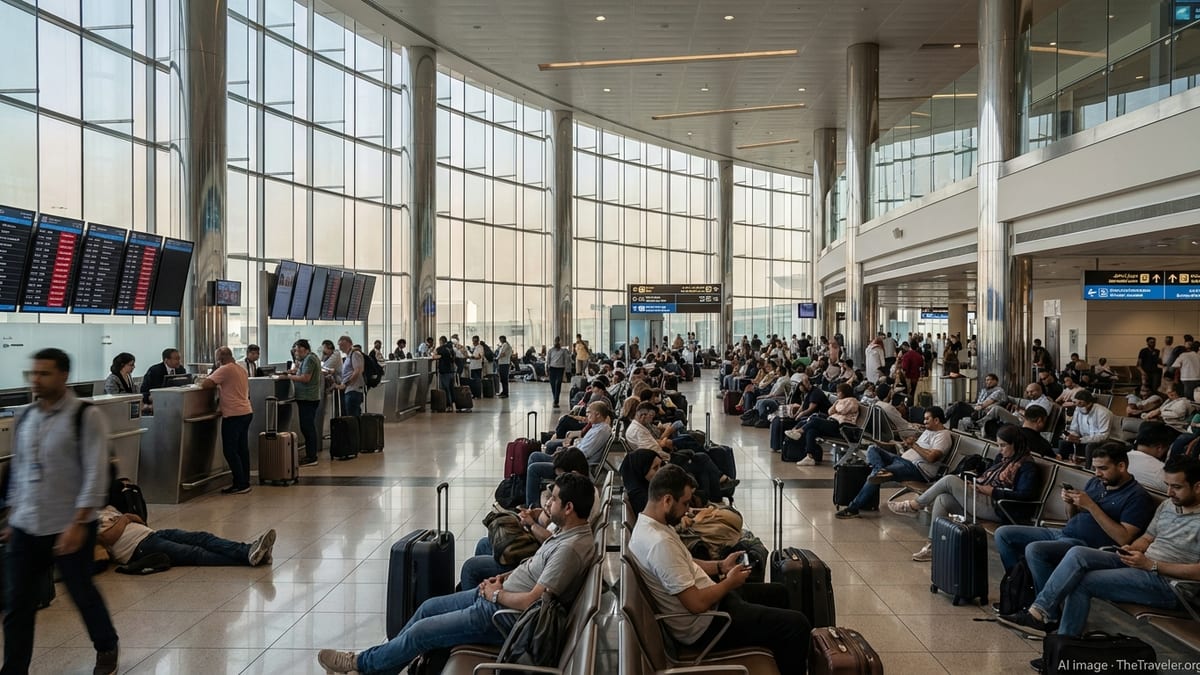
Across the region, images and eyewitness accounts describe scenes of exhausted families sleeping on terminal floors, lines stretching far beyond check in halls and departure boards filled with red cancellation notices. In Dubai, where more than 1,000 flights ordinarily take off and land each day, travellers report being asked not to come to the airport unless specifically instructed by their airline.
In Doha and Abu Dhabi, passengers on once routine connection itineraries between Europe and Asia have found themselves suddenly marooned with limited information about when they might move. With airspace closures extending well beyond the immediate conflict zone, rerouting options are constrained and remaining seats on alternative routes are scarce and expensive.
Similar scenes are playing out far from the Middle East as the shock radiates through global networks. In London, Frankfurt, New York, Toronto and Singapore, travellers bound for Dubai, Doha, Tel Aviv or onward destinations have seen flights scrubbed at short notice. Airlines have urged passengers to check their flight status before travelling and to expect extended hold times as call centers struggle to cope with the surge in rebooking requests.
Many travellers are turning to consulates and embassies for assistance. The United Kingdom has begun planning large scale evacuation flights for tens of thousands of nationals in the Gulf, while other governments are weighing similar operations should commercial capacity remain constrained. For now, most passengers are being advised to shelter in place, stay in touch with their carriers and monitor official travel advisories.
Airlines Grapple With Rerouting, Fuel Costs and Safety Risks
Airlines that normally overfly the Middle East without landing are also caught in the turmoil. With Iranian, Iraqi, Israeli, Qatari and parts of Emirati airspace effectively off limits, carriers connecting Europe with South and Southeast Asia are being forced to take longer detours over Turkey, the Caucasus and the Arabian Sea, or to cut services entirely.
Industry analysts warn that these reroutings are burning significantly more fuel, adding tens of minutes or more than an hour to some journeys and squeezing already tight margins. Executives quoted in specialist aviation outlets say that if the closures persist for more than a few days, higher operating costs are likely to feed through into ticket prices on key long haul routes.
For Gulf network carriers whose business models depend on dense banks of short connection times in their hubs, the impact is even more immediate. With aircraft and crews stranded in outstations and connecting waves broken apart, rebuilding coherent schedules will take days even after airspace reopens. Airlines such as Emirates, Qatar Airways and Etihad have temporarily suspended ticket sales on many routes and are prioritising affected passengers for the limited seats available.
Safety concerns are paramount. Following the strikes and retaliatory barrages, several carriers and national regulators have formally designated large parts of the region as high risk airspace. Insurers are reassessing war risk coverage, and some pilots’ associations have urged members not to operate flights in or near affected skies until the threat picture clarifies.
Global Ripple Effects Reach Far Beyond the Region
The closures come at a time when Middle Eastern hubs play an outsized role in global connectivity, especially after the earlier loss of Russian airspace for many Western airlines following the invasion of Ukraine. Routes that once flew across Russia and Central Asia had already been pushed south through the Gulf; with that corridor now partly blocked, options are narrowing.
European, North American and Asian carriers have announced a patchwork of suspensions and diversions. Major European airlines have halted flights to Dubai, Abu Dhabi, Doha, Tel Aviv, Beirut, Amman and several Gulf cities for at least several days. North American carriers have suspended services to Israel and key Gulf hubs, while large Asian airlines including India’s leading carriers, Cathay Pacific and Garuda Indonesia have paused or curtailed operations to multiple Middle Eastern destinations.
Beyond passenger travel, the disruption is also hitting cargo flows. Gulf carriers are among the world’s largest freight operators, moving everything from pharmaceuticals and electronics to fresh food through their hubs. Logistics specialists warn of looming delays and higher freight rates as shippers scramble to rebook consignments or divert via alternative airports in Turkey, North Africa or Southern Europe.
Corporate travel managers and multinational companies with regional hubs in Dubai, Doha and Abu Dhabi are advising staff to work remotely and postponing non essential trips. Some global banks and professional services firms have activated contingency plans, shifting critical teams to back up locations in Europe and Asia as they reassess security and connectivity in the Gulf.
Governments Issue Warnings as Travellers Scramble for Alternatives
Governments worldwide are updating travel advisories by the hour, urging citizens to avoid non essential travel to affected countries and to exercise extreme caution if already in the region. Foreign ministries in Europe, North America and Asia have warned that consular assistance may be limited if security conditions deteriorate further or if commercial flight options remain severely restricted.
Neighbouring states that still have open airports, such as Oman and parts of Saudi Arabia, are seeing a surge in demand as travellers look for alternative escape routes. Overland journeys to these gateways, however, can be lengthy and may not be feasible or safe for all, particularly for families or those without valid visas.
Analysts say the pace of developments will dictate how quickly the aviation system can absorb the shock. If airspace closures are eased in the coming days, a gradual resumption of flights and a messy but manageable rebalancing of schedules is likely. A prolonged shutdown, or further strikes on airport infrastructure, would raise the prospect of a deeper and more sustained global aviation crisis.
For now, passengers are caught between fast changing security assessments and the realities of a tightly interconnected air transport network. With no clear timeline for the reopening of key hubs, the Middle East’s role as a vital crossroads of global travel has been abruptly and painfully underscored.