

More news on this day
Air travel across the Middle East has descended into turmoil as a fast‑escalating war involving Iran, Israel and the United States triggers sweeping airspace closures, mass flight cancellations and a scramble among wealthy travelers to secure scarce private jets out of the region.
Airspace Shut, Thousands of Flights Grounded
What began on February 28 with US and Israeli strikes on Iran has rapidly morphed into a cascading aviation crisis, as Iran’s retaliatory missile and drone attacks prompted at least a dozen countries to close or heavily restrict their skies. Aviation data firms estimate that by March 1, more than 19,000 flights worldwide were affected, with roughly 3,400 cancelled in a single day as airlines ripped up schedules and scrambled to find safe alternative routings.
Airspace over Iran, Iraq, Israel, Qatar, Bahrain, Kuwait and Syria is now effectively closed, while the United Arab Emirates and Saudi Arabia are operating on partial restrictions. That has choked off some of the world’s busiest long haul corridors linking Europe, Asia, Africa and Oceania, many of which rely on Gulf super‑connector hubs for onward connections.
The knock‑on effects have been immediate and global. Airlines in Europe and Asia have been forced to ground or reroute widebody fleets that only recently recovered from the pandemic. For many carriers, the Middle East is not just a destination but a bridge between continents, meaning a single airspace closure can ripple through dozens of city pairs.
In New York, London, Singapore and Sydney, departure boards now regularly flash long strings of delays and cancellations tied to the conflict. Aviation analysts warn that if the war drags on through March, the disruption could rival or even surpass the outages caused by the volcanic ash crisis of 2010 in its impact on global connectivity.
Gulf Hubs Paralyzed as Airlines Slash Schedules
Nowhere is the shock more visible than in Dubai, Doha and Abu Dhabi, normally among the world’s most reliable hubs. With Iranian and Iraqi airspace sealed and missile threats extending over parts of the Gulf, Emirates, Qatar Airways and Etihad have cancelled or severely curtailed flights into and out of their bases, turning terminals built for seamless connections into holding pens for stranded passengers.
Data from flight tracking and scheduling services show thousands of seats removed from sale on routes touching the region since the first strikes. European carriers including Air France and KLM have suspended services to Tel Aviv, Beirut, Dubai and Riyadh for days at a time, while several Asia‑Pacific airlines have halted Middle East routes outright or shifted Europe‑bound flights onto far longer detours that bypass the conflict zone.
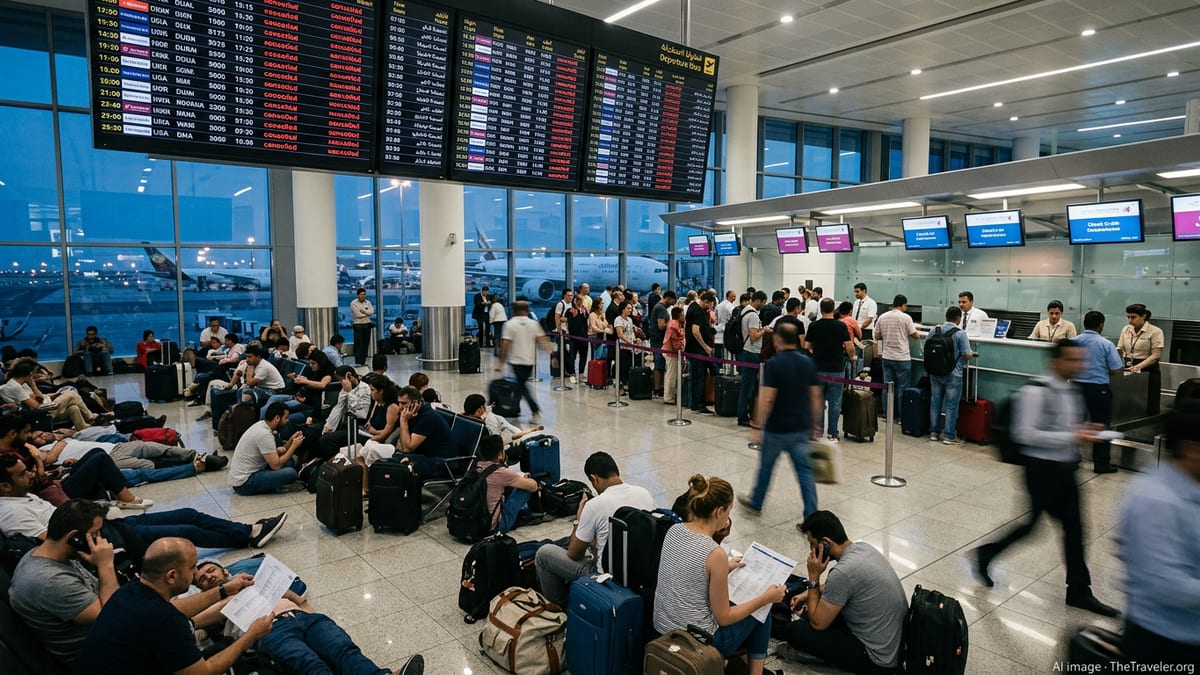
On the ground, the human toll is growing. At Dubai International and Doha’s Hamad International Airport, families sleep in departure halls as they wait for rebookings that may be days away, while migrant workers bound for the Gulf find themselves stuck in transit cities from Istanbul to Kuala Lumpur. Governments have begun organizing limited evacuation flights from the United Arab Emirates and other states, but demand far exceeds available seats.
Airport operators and civil aviation authorities insist they are working around the clock to restore partial connectivity where security conditions allow. Yet the combination of radar disruptions, GPS jamming reports and ongoing missile activity has kept risk levels high, leaving airlines with little choice but to prioritize crew and passenger safety over schedule integrity.
Long Detours, Soaring Fares and Lengthy Delays
For passengers whose flights are still operating, journeys that once took seven or eight hours are stretching to ten or more as aircraft snake around closed airspace. With the Russian and Ukrainian skies already off‑limits to many Western carriers, the shutdown over large parts of the Middle East has squeezed traffic into narrow corridors over the Caucasus, North Africa and the Indian Ocean.
Carriers have mapped out emergency routings that skirt Iran and Iraq via Turkey and the Black Sea or swing south along Egypt and the Arabian Sea, adding two to five hours of flying time and sharply higher fuel burn. In some extreme cases, long haul jets have been forced to return to their points of origin after spending more than a dozen hours in the air without finding a safe way to complete their route.
The operational costs are feeding quickly into ticket prices. Travel agencies in Europe and Asia report sharp fare spikes on itineraries that avoid Gulf hubs, as demand shifts to remaining alternatives such as Istanbul and select nonstop Europe–Asia services. Flexible rebooking policies have softened the financial blow for some travelers, but stranded passengers without travel insurance are absorbing the cost of extra hotel nights, meals and last‑minute tickets home.
Industry groups are pressing regulators for temporary relaxations of crew duty time rules and airport slot regulations to give airlines more leeway to add recovery flights once corridors reopen. For now, though, the message from carriers and aviation safety bodies is blunt: anyone planning to fly to, from or over the broader Middle East in the coming weeks should be prepared for sudden changes, extended journeys and the very real possibility of last‑minute cancellations.
Private Jet Market Overheats as Wealthy Flee
As commercial options vanish, a small but growing number of travelers are reaching for their credit cards and chartering private aircraft to escape the region. Brokers and operators say inquiries for departures from the United Arab Emirates, Qatar and neighboring countries have surged since the first missiles flew, with many requests for same‑day flights to Europe, India and safe havens farther afield.
Charter specialists describe a frenetic market in which available jets are being repositioned from Africa and Europe to secondary airports on the edge of the conflict zone, such as Riyadh and Muscat, to operate onward legs for high net worth clients. Prices for these emergency charters have in some cases doubled, with reports of families paying well over 150,000 dollars for a one‑way wide‑cabin jet to Western Europe.
The boom is not limited to ultra‑rich individuals. Multinationals with staff based in Gulf states are turning to business aviation to extract key personnel, while some governments quietly contract private operators to supplement official evacuation efforts. Security companies are fielding parallel demand for armored ground transfers to reach open airports, adding to the overall cost and complexity of leaving the region.
Yet even in the private jet world, capacity is finite. Many aircraft are stranded at closed airports, and operators must navigate the same web of overflight bans and conflict‑zone advisories as commercial airlines. For travelers without deep pockets or corporate backing, the surge in private flying is more a symbol of inequality in access to mobility than a practical solution to the broader crisis.
Global Travel and Tourism Face a New Shock
The unfolding aviation turmoil is the latest in a series of shocks to hit global travel and tourism, an industry still healing from the pandemic, regional wars and supply chain breakdowns. Tour operators report cancellations of tours and cruises across the Eastern Mediterranean and Gulf, while hotel groups in major Middle Eastern cities brace for an abrupt drop in occupancy as both business and leisure travelers reconsider plans.
Beyond the region, the impact will be felt in destinations that depend heavily on feeder traffic from Gulf hubs, from Indian Ocean resorts to East African safari lodges. Travel economists warn that a prolonged conflict could shave billions of dollars from tourism receipts worldwide, particularly if higher oil prices translate into sustained increases in airfares.
Insurers and corporate travel managers are hurriedly revising risk assessments, with some companies imposing blanket bans on nonessential trips to a swath of countries spanning from the Levant to the Gulf. Universities and humanitarian organizations with staff on assignment in the region are likewise racing to update evacuation plans and ensure that those who choose to stay understand the growing constraints on mobility.
For ordinary travelers, the message from governments and airlines has converged in recent days: avoid nonessential travel to the Middle East, leave while commercial routes still exist if you are already there, and expect that any itinerary touching the region could change overnight as the conflict evolves.