

More news on this day
Global air travel has been plunged into disarray as war in the Middle East forces governments to close swathes of airspace and shut down key hubs including Dubai, Abu Dhabi and Doha, triggering thousands of flight cancellations and leaving passengers stranded on every continent.
Major Hubs Fall Silent as Airspace Closes
The aviation crisis escalated over the weekend after coordinated U.S. and Israeli strikes on Iran and subsequent Iranian missile and drone attacks prompted Bahrain, Iran, Iraq, Israel, Jordan, Kuwait, Qatar and the United Arab Emirates to impose sweeping airspace restrictions. Aviation data providers reported that, at the peak of the shutdown, skies over much of the Gulf and Levant were virtually empty, an unprecedented sight for one of the world’s busiest flight corridors.
Dubai International Airport, routinely ranked among the world’s busiest for international traffic, halted operations after suffering damage during overnight strikes. Abu Dhabi and Kuwait City airports were also hit, with authorities confirming casualties and infrastructure damage that will take time to assess and repair. Doha’s Hamad International Airport suspended regular passenger operations as Qatari officials temporarily closed the country’s airspace.
Industry analysts warn that the closure of these three Gulf super-hubs instantly severs a central artery of global aviation. Emirates, Qatar Airways and Etihad alone normally connect tens of thousands of passengers a day between Europe, Asia, Africa and the Americas through tightly timed connections that are now either cancelled or forced into lengthy detours.
According to flight tracking and analytics services, more than 1,800 flights into and out of the Middle East were cancelled in a single day, while global knock-on effects pushed delays into the tens of thousands. Airlines have described the situation as one of the most severe operational shocks since the early days of the pandemic.
Airlines Worldwide Slash Schedules and Reroute
Airlines across Europe, North America, Asia and Africa moved rapidly to cut exposure to the conflict zone. Carriers such as Emirates, Etihad, Qatar Airways, Gulf Air and EgyptAir suspended large portions of their regional networks, while also halting long haul services that rely on Gulf connections. Many have offered free rebooking or refunds, but warn that limited capacity on alternative routings makes rapid recovery unlikely.
European heavyweights including Air France, British Airways, Lufthansa, Swiss and Turkish Airlines have cancelled flights to cities such as Dubai, Abu Dhabi, Doha, Tel Aviv, Beirut, Amman and Tehran, and are avoiding airspace over multiple Middle Eastern countries. Russia’s aviation regulator ordered all commercial services to Israel and Iran suspended until further notice, adding another layer of disruption to east west flows.
In North America, major carriers including Delta Air Lines, American Airlines, United Airlines and Air Canada have paused services to Tel Aviv and key Gulf destinations for at least several days, with some suspensions stretching into the second week of March. Schedules are being rewritten day by day as operators weigh security assessments, insurance restrictions and the availability of safe alternative routings around the closed skies.
Asia Pacific airlines have also been hit hard. India’s largest private carriers IndiGo and Air India suspended flights to all Middle Eastern destinations, while Pakistan International Airlines halted services to the UAE, Bahrain, Doha and Kuwait. Cathay Pacific, Singapore Airlines, Garuda Indonesia and Philippine Airlines have each announced cancellations or temporary suspensions on routes touching the Gulf, compounding the pressure on passengers trying to transit between Asia and Europe.
Passengers Stranded from Europe to Asia-Pacific
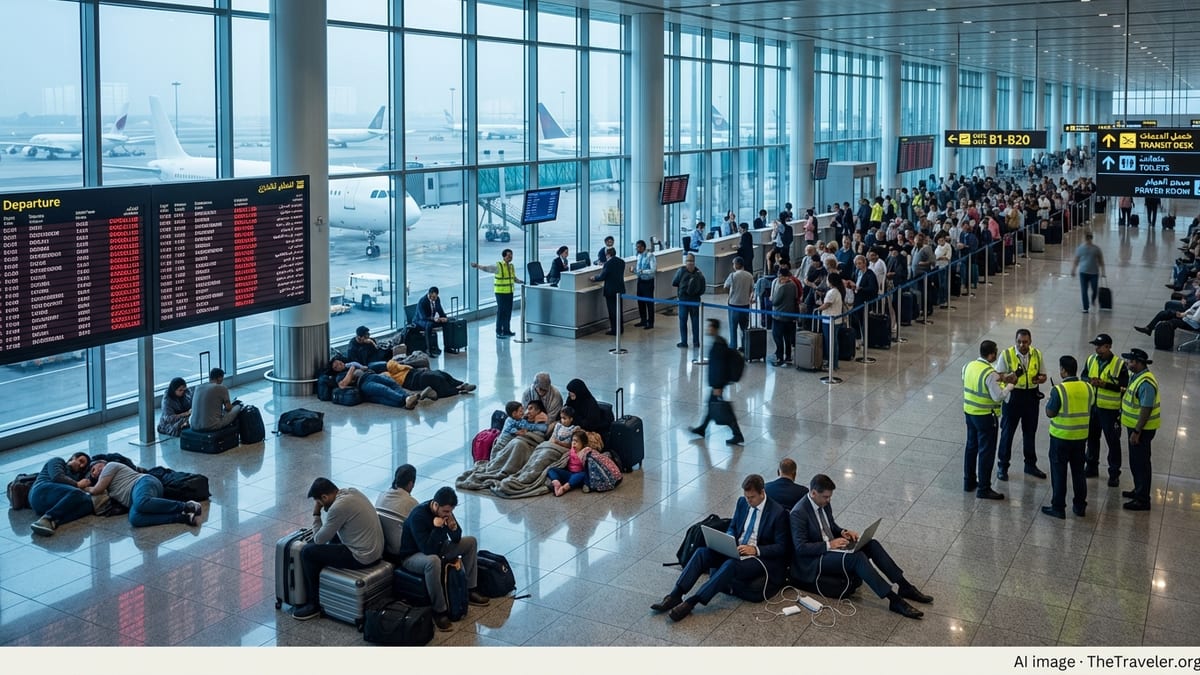
The immediate human impact has been visible in crowded terminals from Newcastle to Mumbai and from Dubai to Melbourne, where departure boards have filled with red cancellation notices. Hundreds of thousands of travelers are estimated to be stranded or forced into lengthy detours, with some journeys extended by a day or more as aircraft are rerouted via longer, more northerly tracks.
At Gulf airports, passengers have been sleeping on terminal floors after sudden shutoffs to operations left them in transit without onward flights. With local authorities prioritising safety and damage assessments, airlines have struggled to offer concrete timelines for resuming services, leaving many travelers in limbo. Some governments have begun planning evacuation and repatriation flights once secure corridors can be established.
Ripple effects are being felt far from the conflict zone. In Europe, Germany’s main gateways reported dozens of additional cancellations as flights that would normally route via the Gulf were scrapped or reconfigured. In India, Mumbai’s airport recorded scores of cancellations in a matter of hours, while authorities temporarily declined to accept further diversions due to lack of parking space for stranded aircraft.
Travelers connecting between Australia, Asia and Europe are particularly exposed. Airports in cities such as Melbourne and Sydney have warned of significant disruptions to passengers booked on itineraries through Dubai, Abu Dhabi or Doha and have urged anyone with upcoming departures to check directly with their airline before heading to the airport.
Longer Routes, Higher Costs and Operational Strain
With key Middle Eastern corridors effectively off limits, airlines are scrambling to establish alternative routings that skirt the closed airspace. Many long haul services between Europe and Asia are being pushed northward over Turkey, Central Asia or Russia where possible, adding hours of flying time, increasing fuel burn and complicating crew scheduling.
Aviation analysts say the sudden loss of Gulf hubs shows how concentrated global traffic flows have become. Carriers that built their networks around one stop connections via Dubai, Doha or Abu Dhabi now face the challenge of either cancelling flights outright or stringing together complex detours that raise costs and erode the convenience that made these routes popular with both leisure and business travelers.
Higher operating expenses are likely to be passed on to consumers, at least in the short term. Early data from affected markets such as India show fares on remaining Europe bound services spiking sharply as capacity tightens and demand from stranded passengers surges. Some airlines are deploying larger aircraft or adding ad hoc segments where airspace remains available, but warn that these are temporary fixes rather than a sustainable solution if the conflict drags on.
There are operational challenges on the ground as well. Airports that previously handled only modest transfer traffic are now grappling with unplanned waves of rerouted passengers, stretching everything from immigration desks to baggage systems and hotel capacity in nearby cities. Ground handlers and air traffic controllers are dealing with volatile schedules that can change multiple times a day.
Uncertain Timeline Keeps Travelers on Edge
How long the disruption will last remains unclear. Civil aviation authorities in the region have largely framed their closures as temporary and subject to ongoing security reviews, but have not set firm reopening dates for the most affected airspaces and airports. Military activity and the risk of further missile and drone attacks continue to dictate the operational picture.
Airlines and global aviation bodies are in constant contact with governments as they assess the safety of potential corridors and the resilience of critical infrastructure. Until confidence is restored and insurers are willing to back operations through or near conflict zones, carriers are expected to maintain a conservative posture, keeping many routes suspended or significantly altered.
For now, travel industry experts advise passengers with itineraries touching the Middle East in the coming days to remain flexible, monitor airline communications closely and avoid making non refundable onward arrangements. The sheer scale of cancellations means that even if key hubs begin to reopen gradually, it could take days for schedules and aircraft rotations to stabilise.
The crisis has reignited debate over the vulnerability of global aviation to regional conflicts and the concentration of international traffic through a handful of strategic hubs. As the situation evolves, both airlines and travelers face an extended period of uncertainty, underscoring how quickly a geopolitical flashpoint can cascade into a worldwide travel nightmare.