

More news on this day
Global tourism is facing its gravest security shock since the pandemic as the United States and Israel’s Operation Epic Fury against Iran triggers sweeping airspace closures, mass flight cancellations and an unprecedented surge in travel warnings for 2026.
Operation Epic Fury Turns Tourism Into Collateral Damage
The US-led campaign known as Operation Epic Fury, launched in late February in coordination with Israel, has rapidly reshaped the global travel risk map. What began as a concentrated military operation against Iranian targets has cascaded into a regional conflict spanning the Gulf, the Levant and key Red Sea corridors, all of them essential arteries for intercontinental air travel.
Within hours of the first strikes, Iran, Iraq, Kuwait, Bahrain, Syria, Qatar, Israel and the United Arab Emirates either fully or partially closed their airspace to civilian traffic. Major aviation hubs including Dubai, Abu Dhabi and Doha saw operations suspended or severely curtailed after being directly threatened or hit in retaliatory attacks, grounding aircraft that usually connect Europe and Africa with Asia.
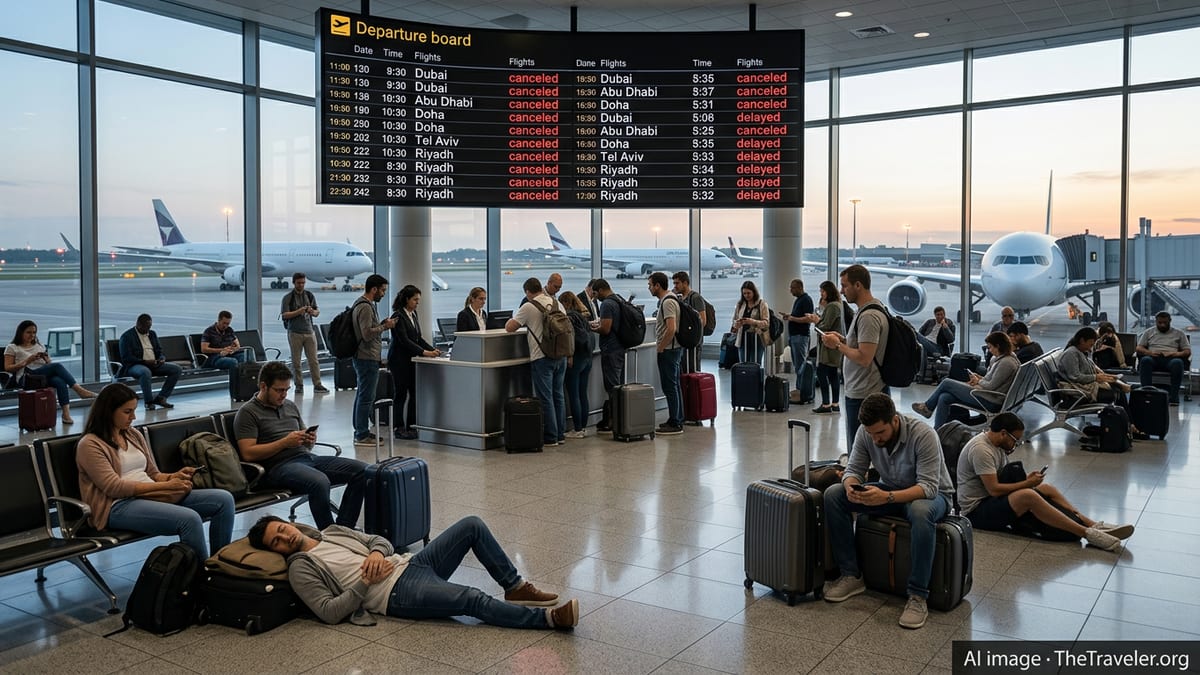
Aviation trackers and airline statements suggest that, at the peak of the disruption, more than 4,000 flights a day were cancelled or rerouted around the Middle East, making this the most far reaching aviation shock since COVID era border closures. Stranded passengers have been left sleeping in terminals from Bangkok to Istanbul, as carriers scramble to reposition crews and aircraft around an evolving conflict zone.
Israel has declared a nationwide state of emergency, with civilian air travel from Ben Gurion Airport largely suspended since February 28. While limited evacuation and special services continue, regular tourism flows to the country and surrounding territories have effectively stopped, compounding the impression that the Eastern Mediterranean is once again a frontline rather than a leisure playground.
US and Allied Governments Issue Sweeping 2026 Safety Warnings
As the military tempo has increased, diplomatic language around travel has hardened. The US State Department this week urged its citizens to leave a broad swathe of the Middle East immediately, citing serious safety risks tied directly to Operation Epic Fury and Iran’s response. The advisory covers Israel, the West Bank and Gaza, Lebanon, Egypt, Jordan, Saudi Arabia, the United Arab Emirates, Qatar, Oman, Bahrain, Kuwait, Iraq, Syria, Yemen and Iran.
Many of these destinations were already under heightened alert levels, but the latest messaging marks a shift from caution to outright urgency. Several are now rated at the highest “Do Not Travel” level for American citizens, while others carry warnings to reconsider any non essential trips and to depart as soon as commercial options permit.
European governments have followed with their own advisories, often mirroring Washington’s assessment. Officials in London, Paris and Berlin have updated guidance for nationals in the Middle East, warning of potential missile and drone strikes, spontaneous protests, cyber disruption and the risk of Western branded hotels, malls and tourist districts becoming symbolic targets.
The political rhetoric framing Operation Epic Fury as a decisive answer to Iranian aggression is, for now, at odds with the practical advice being issued to travelers. Consular authorities acknowledge a widening gap between official calls to leave and the limited number of seats available on the few flights still operating out of affected countries, turning many travel warnings into logistical puzzles that stranded tourists must solve on their own.
Airlines Slash Routes as Global Networks Bend Around the Gulf
Airlines have responded with a mix of cancellations, diversions and emergency waivers that underscore how central Middle Eastern skies have become to modern tourism. Carriers such as Lufthansa, Air France KLM, Turkish Airlines, Air India and several Gulf based airlines have suspended services to multiple cities across Israel, Iran, Iraq, Lebanon and the Gulf states, some through at least early March and in certain cases for longer.
Even where flights continue, routes have been stretched and bent to avoid Iranian, Iraqi and Syrian airspace. Journeys between Europe and South or Southeast Asia that previously relied on efficient great circle tracks over the Gulf now loop north via Turkey and the Caucasus or far south over the Arabian Sea and Red Sea. Flight times of two to four extra hours are becoming common, raising fuel costs, straining crews and complicating aircraft rotations.
Corporate travel managers report a surge in requests from multinationals to reroute staff away from the region entirely, even if that means longer itineraries and premium fares. Major US carriers have issued expanded change fee waivers for tickets touching the Middle East, while some Asian airlines are quietly reviewing the commercial viability of marginal routes that now require costly detours.
For leisure travelers, particularly those connecting between Europe and popular destinations in Thailand, Indonesia, the Maldives and East Africa, the knock on effects are immediate. Full aircraft, longer flights, tighter crew duty limits and rolling airspace notices are feeding into higher fares and growing uncertainty for peak summer 2026 bookings.
Tourism Hotspots Confront a Fragile New Reality
The conflict comes just as global tourism was poised to consolidate a robust recovery from the pandemic. UN Tourism data showed international arrivals in 2025 at roughly 1.5 billion, near record territory, with forecasts in January suggesting a further three to four percent growth in 2026. That optimism rested partly on expectations of stability in key long haul markets anchored around Middle Eastern hubs.
Instead, destinations that have invested heavily in tourism as an economic lifeline now face an abrupt reversal. Gulf cities that welcomed tens of millions of visitors in 2025 are reporting mass cancellations across luxury resorts, shopping festivals and business events, while source markets in Europe and Asia hesitate to promote packages that depend on uncertain connections through the region.
North African destinations such as Egypt, Morocco and Tunisia, which rely on Mediterranean and Red Sea flows, are also exposed. Even where local security conditions remain relatively calm, the psychological impact of images of missile strikes and closed terminals has chilled demand. Tour operators describe a sharp rise in inquiries about safety and insurance coverage for 2026 departures, with many clients delaying decisions or switching to perceived “safe haven” destinations in Southern Europe or the Americas.
Industry economists warn that the hit to confidence could ripple far beyond the conflict zone. Higher jet fuel costs, extended routings and tighter security protocols may squeeze airline and tour operator margins worldwide, potentially pushing up prices just as travelers had become accustomed to a more normal post pandemic marketplace.
Travelers Navigate a Landscape of Heightened Risk
For individual travelers, the new environment demands a sharper focus on risk management. Insurance providers are updating policies and exclusions related to war, terrorism and airspace closures, while consular services stress the importance of registering trips, monitoring official alerts and maintaining flexible itineraries that can absorb last minute changes.
At airports from Dubai to Athens and Singapore, scenes of stranded families, business travelers and pilgrimage groups highlight how quickly a regional conflict can scramble even the best laid plans. Passengers are learning in real time that a journey booked through a single online transaction may in fact depend on a patchwork of national airspace decisions, corporate risk thresholds and military calculations far beyond their control.
Despite the turmoil, industry bodies insist that travel will adapt rather than collapse. Airlines are exploring alternative routings, secondary hubs are courting displaced traffic and tourism boards outside the immediate danger zone see an opportunity to position themselves as stable options for 2026. Yet as Operation Epic Fury enters its second week, the central message from governments and aviation experts alike is clear: the security assumptions that underpinned global tourism over the past decade can no longer be taken for granted.