

More news on this day
A widening war in the Middle East is rippling through global aviation, grounding thousands of flights on key Gulf routes and sending European holidaymakers in search of alternative sunshine in the Caribbean and Spain.
Get the latest news straight to your inbox!
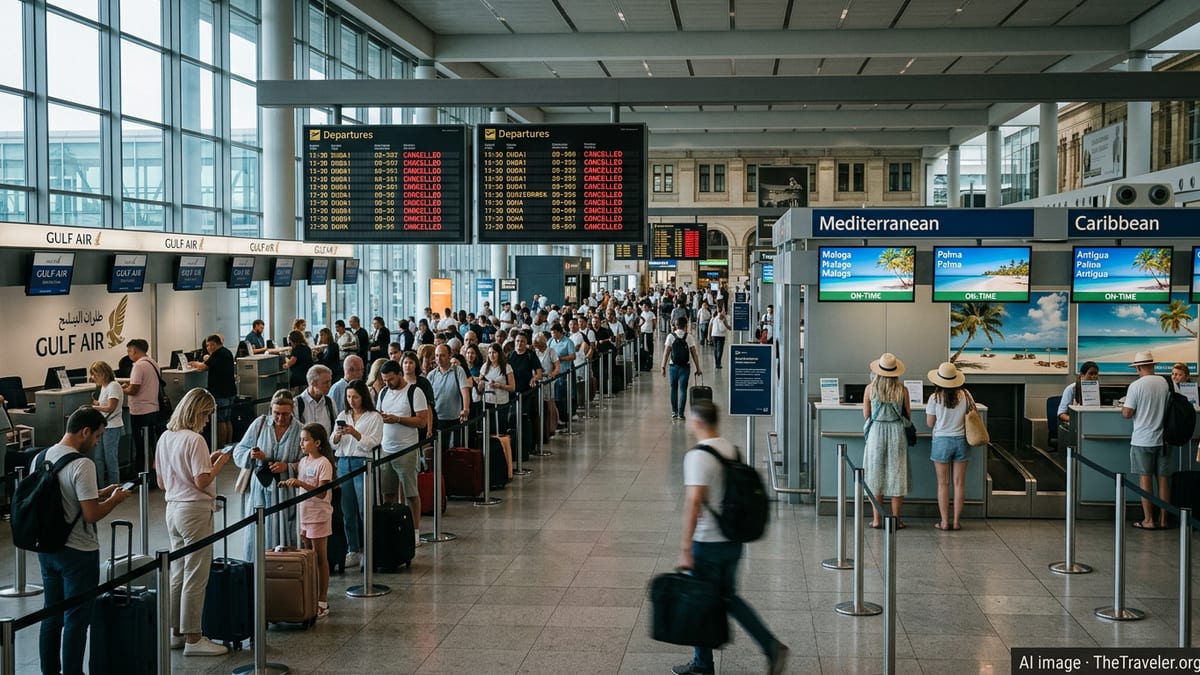
Gulf Hubs Partially Paralyzed by Airspace Closures
Since late February, airspace closures across Iran, Qatar, the United Arab Emirates and several neighbouring states have sharply curtailed operations at the region’s biggest hubs. Data from aviation analytics firms indicate that more than half of all flights scheduled to operate to or from the broader Middle East in the first two weeks of March have been cancelled, stripping millions of seats from global capacity and severing vital connections between Europe, Asia and Africa.
Emirates, based in Dubai, has been among the hardest hit. Industry trackers estimate it has temporarily grounded hundreds of services as the United Arab Emirates restricted airspace and briefly halted movements at Dubai International after missile interceptions near the city. While the carrier has begun rebuilding a reduced schedule using approved safe corridors, it is still operating well below normal levels and warning passengers to expect last minute changes.
Qatar Airways remains even more constrained. Qatar’s airspace has been under tight restrictions since Iranian strikes prompted authorities to limit movements in and out of Doha. The airline has cancelled large portions of its network and is focusing on a limited number of repatriation and relief flights to key European and Asian capitals. Travellers connecting via Doha continue to face rolling cancellations and long delays, with aircraft forced to detour around closed skies.
The broader effect is a sudden rupture in the Gulf’s role as a global super-connector. Routes that once relied on seamless one stop links via Dubai, Doha or Abu Dhabi now require complex re-routing via secondary hubs in Europe or Turkey, stretching journey times and squeezing already scarce seat availability.
British Airways Cuts Gulf Services as Detours Lengthen
The disruption is not confined to Gulf carriers. British Airways has suspended flights to several Middle Eastern destinations, including Abu Dhabi, Bahrain, Doha, Dubai and Tel Aviv, at least through mid March as it navigates the shifting security picture and airspace map. The move has already led to the cancellation of hundreds of UK linked flights, stranding passengers across the region and forcing the airline to mount repatriation services from selected cities.
For the flights that remain, routing has become significantly more complicated. Services from London to parts of Asia are now being re-planned to avoid large swathes of Middle Eastern airspace, often flying north over Turkey or south via the Red Sea. Aviation analysts report that detours can add three to five hours to a typical long haul journey, driving up fuel burn, crew costs and the risk of further disruptions if aircraft or staff end up out of position.
British Airways is offering affected customers a mix of refunds, free rebooking and, in some cases, re-routing on partner airlines. However, with Emirates and Qatar Airways simultaneously slashing capacity, options to move passengers quickly are limited. Phone lines and airport service desks have been inundated, as travellers whose trips touch the region scramble to piece together alternative itineraries or abandon their plans entirely.
European rivals are attempting to fill some of the gap. Lufthansa, Air France KLM and other network carriers have announced additional capacity on select routes to Asia and Africa, seeking to capture demand that would normally flow through the Gulf. Yet they too must navigate longer routings and operational constraints, limiting how quickly they can respond.
Tourists Pivot From Middle East to Caribbean and Spain
The immediate fallout for Middle Eastern tourism has been severe. Governments in the Gulf and the wider region are warning of a sharp drop in international arrivals this year as war concerns and flight chaos deter leisure visitors. Travel economists estimate that inbound tourism to affected countries could fall by double digit percentages if the conflict and airspace closures persist into the peak summer season.
Many European holidaymakers, particularly from the United Kingdom, Germany and Scandinavia, are already shifting bookings to perceived safer, more reliable destinations. Tour operators report a marked swing away from winter sun stays in the Gulf and nearby countries towards classic long haul beach favourites in the Caribbean, including the Dominican Republic, Barbados and Jamaica. Direct services from major European hubs to these islands remain largely unaffected, and airlines have scope to upgauge aircraft to meet the surge in demand.
Spain is experiencing a similar bump. With its extensive flight network, diverse coastal resorts and relatively short flying time from northern Europe, the country has emerged as an attractive substitute for travellers wary of transiting the Middle East. Airports serving the Canary Islands, the Costa del Sol and the Balearic Islands are seeing stronger than expected bookings for late spring and early summer, as travellers rebook cancelled Gulf trips closer to home.
Travel agencies say the trend is most pronounced among families and older travellers who are more sensitive to perceived security risks and logistical uncertainty. Rather than rebooking complex multi stop itineraries that depend on volatile transit hubs, they are choosing straightforward point to point flights to well established leisure markets.
Price Volatility and Capacity Crunch for European Sun Routes
The sudden redirection of demand is already feeding through to airfares. Industry pricing data show rising ticket prices on key leisure routes from northern Europe to Spanish resorts and popular Caribbean islands, particularly for departures over school holidays and long weekends. Capacity that was carefully calibrated months in advance is now being stretched as airlines race to respond to shifting booking patterns.
Some carriers are redeploying wide body aircraft from suspended Middle Eastern routes to high demand leisure services, adding seats without having to secure new take off and landing slots. Low cost airlines are also adjusting schedules to increase frequencies on routes from secondary European cities to Spain’s coastal airports, seeking to capture last minute bookers displaced from more exotic itineraries.
However, constraints remain. Airport slot rules, crew availability and aircraft maintenance windows limit how quickly airlines can pivot their operations. Tour operators warn that while there are still deals to be found, travellers who delay rebooking risk paying significantly more for peak period travel to southern Europe and the Caribbean compared with previous years. Hoteliers in popular resorts report an uptick in occupancy forecasts, but say there is still spare capacity if the war drags on and more travellers change course.
Insurance considerations are also shaping behaviour. Many standard policies exclude coverage for trips to active conflict zones, while offering full protection for holidays in established leisure destinations such as Spain. That differential is pushing cautious travellers to switch rather than simply postpone Middle Eastern trips.
Uncertain Outlook Keeps Travelers in Limbo
How long the current disruption will last depends largely on the trajectory of the conflict and the associated airspace restrictions. Middle Eastern regulators have signalled that they will only fully reopen skies once they are satisfied that missile and drone risks have receded, a judgment that could change rapidly as the military situation evolves.
Emirates, Qatar Airways and British Airways are all reviewing schedules on a rolling basis, typically adjusting flights only a few days at a time. This incremental approach helps them avoid wholesale cancellations if conditions improve, but leaves passengers planning trips for later in the year in a state of uncertainty. Corporate travel managers and tour operators say they are modelling multiple scenarios, from a gradual restoration of Gulf connectivity by early summer to a prolonged shutdown that reshapes long haul travel patterns well into 2027.
For now, the message from airlines and travel advisers is consistent: anyone booked to transit the Middle East in the coming weeks should monitor their reservations closely, ensure contact details are up to date and consider flexible tickets where possible. At the same time, demand for reliable sun destinations is expected to keep climbing, cementing a near term boom for Caribbean islands and Spanish resorts even as the Middle East grapples with one of the most disruptive aviation crises in its history.