

More news on this day
A female airline passenger’s frustrated account of being wedged into a middle seat between two “manspreading” seatmates is resonating with flyers worldwide, renewing scrutiny of shrinking legroom, gendered behavior and basic etiquette in the air.
Get the latest news straight to your inbox!
Viral Complaint Captures a Common In-Flight Frustration
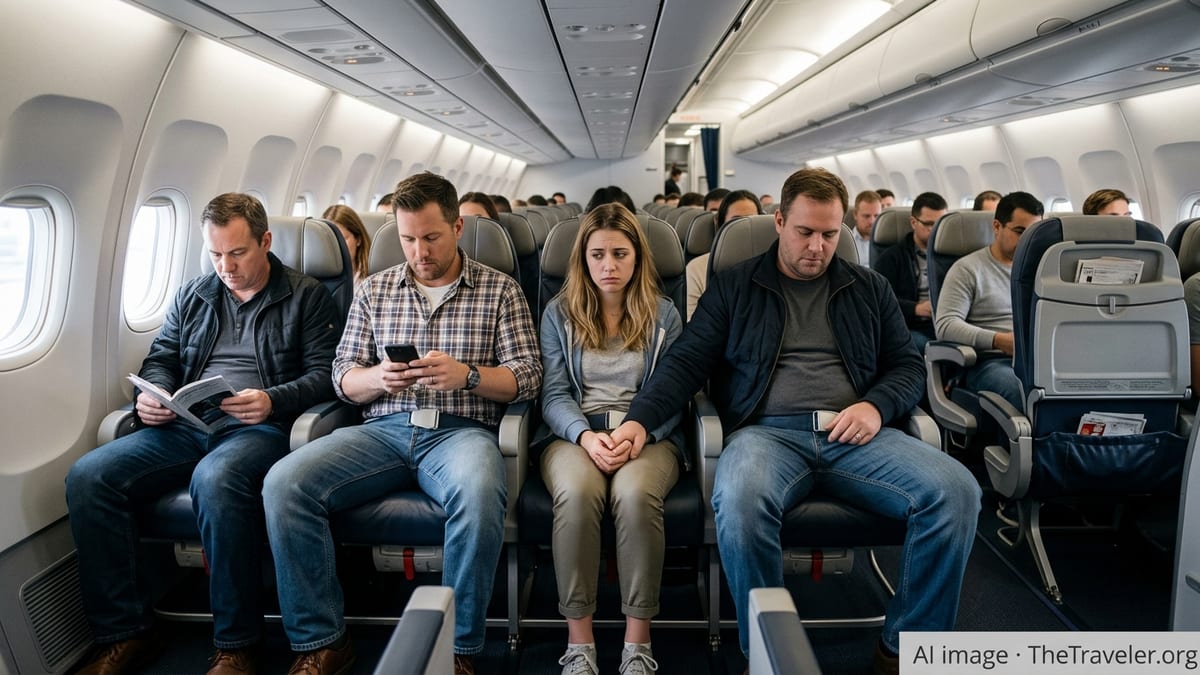
According to recent social media posts and forum discussions on popular travel and airline communities, a woman described boarding a full flight and finding herself in the middle seat between two men who quickly expanded into her limited space. She recounted how both men spread their legs wide and claimed the shared armrests, leaving her squeezed in with little room to move and prompting her to ask whether they would have done the same if a man had been seated in her place.
Her comments, echoed in similar first-person accounts, describe a familiar dynamic for many women travelers: male passengers extending knees beyond the armrest line and pushing feet into their neighbors’ under-seat area. Some posters say they are forced to sit with their legs tightly pressed together for hours, or to repeatedly push back just to reclaim the space of the seat they paid for.
The latest story gained traction because of its clarity and tone, with the traveler explicitly challenging what she viewed as a double standard. In her telling, the men appeared unconcerned about physical contact or discomfort when the person wedged between them was a woman, while other commenters speculated that they might have pulled back more quickly if a man had pushed back just as firmly.
Shrinking Seats and Rising Tension in Economy Cabins
The reaction to the post comes amid long-running concern about tighter aircraft cabins. Publicly available data compiled by aviation analysts show that average seat pitch in many North American and European economy cabins has fallen compared with the 1990s, while airlines have added extra rows to boost revenue. Wider shoulders and longer legs now compete for less personal space, particularly for taller passengers or those seated three across.
Middle seats are often where these tensions are most visible. Travelers routinely describe scenarios in which window and aisle passengers encroach into the middle seat’s limited territory, sometimes lifting armrests to expand their space or stretching knees beyond the metal supports. Commenters on airline-specific forums recount women, smaller-framed passengers and solo travelers bearing the brunt of this behavior, reporting that pushing back can feel confrontational in the close quarters of a packed cabin.
Some frequent flyers argue that tighter layouts make a certain amount of awkward contact unavoidable, especially for very tall people. Others counter that physical constraints do not excuse ignoring armrest boundaries or forcing seatmates to twist or shrink into uncomfortable positions for the length of a flight. The middle seat, they note, may be the least desirable position on board, but it remains a full-fare seat entitled to the same share of personal space as any other.
Gender, Power and the ‘Manspreading’ Debate at 35,000 Feet
The language used by the middle-seat passenger, including references to “manspreading,” connects her experience to a broader cultural conversation about how social expectations differ for men and women in shared public spaces. The term typically describes men sitting with their legs widely apart on public transport or in waiting areas, occupying more room than necessary and limiting the space available to others.
In aviation-focused forums, women describe patterns they interpret as gendered: men assuming control of both armrests, refusing to move their legs when asked, or reacting dismissively when a woman attempts to reclaim space. Several male travelers have also reported dealing with aggressive legroom encroachment, but many contributors say that women are less likely to be taken seriously when they voice objections, especially if neighboring passengers frame their own size or discomfort as justification.
Academic work on gender and public space has long highlighted how social norms can shape who feels entitled to take up room and who feels pressure to retreat. The airplane cabin, with its rigid seats, fixed armrests and limited options for escape, amplifies those dynamics. The viral middle-seat complaint reflects this imbalance, with the traveler questioning whether her neighbors would have pressed quite so far into another man’s space or brushed off his discomfort in the same way.
Informal Etiquette: Who Owns the Armrests?
While airlines typically set rules on baggage, seat assignments and onboard conduct, detailed guidance on personal-space etiquette is rarely spelled out in ticket conditions. In the absence of formal rules, flyers have developed their own informal “codes” for sharing a row. Among the most widely discussed is the idea that the middle-seat passenger, who lacks both a wall and an aisle, should reasonably expect first claim on at least one, and often both, armrests.
Travel columnists, bloggers and cabin-crew commentators have informally endorsed this principle for years, arguing that it compensates for the middle seat’s disadvantages. In practice, though, accounts from passengers suggest that many window and aisle occupants still treat the armrests as extensions of their own seats, planting elbows and shoulders in ways that narrow the middle passenger’s already limited space.
Other unwritten norms include keeping knees within the width of one’s assigned seat, avoiding under-seat “sprawl” into a neighbor’s footwell and promptly responding if someone points out that an arm or leg has crossed the boundary. Reports from frequent flyers indicate that respectful communication can resolve many conflicts quickly, but that middle-seat travelers, particularly women or younger passengers, may hesitate to speak up when the person encroaching appears older, larger or more assertive.
Calls for Clearer Guidance and More Respectful Travel
The resurgence of attention to the latest manspreading complaint comes at a time when public discussion is already focused on civility in crowded travel environments. Incidents involving seat disputes, arguments over recline and conflicts about assigned seats routinely attract wide coverage, as travelers document them online and airlines confront reputational fallout.
Some consumer advocates argue that carriers could reduce tensions by publishing clearer language on personal-space expectations, reinforcing that each passenger is entitled to the full width of their seat and that armrests divide, rather than erase, those boundaries. Others point to long-term solutions such as rethinking seat density and cabin layout, though such changes would carry significant cost implications and are unlikely to appear quickly.
For now, many seasoned travelers say the most practical steps are individual: recognizing the constraints of modern economy cabins, staying within one’s allotted space as much as possible and adjusting promptly if a neighbor indicates discomfort. The woman whose account sparked the latest debate framed her experience as a plea for simple consideration, highlighting how a few inches of shared courtesy can determine whether a middle-seat flight feels tolerable or claustrophobic.