

More news on this day
Spring break travelers across Texas and the Rocky Mountain region faced fresh disruption on March 8, 2026, as delays and cancellations at Midland International Air and Space Port rippled out to major hubs including Dallas, Denver and Houston.
Chain Reaction From a Small but Strategic Airport
Midland International Air and Space Port, a modest commercial gateway serving the Permian Basin, found itself at the center of wider travel turmoil on Sunday as three departures were delayed and seven flights were canceled, according to airport and airline operational updates. While the numbers were small compared with the hundreds of disruptions at the nation’s largest hubs, the concentration of Midland’s schedule meant that a significant share of its daily traffic was affected.
The airport connects oil and gas workers, business travelers and visiting families to major hubs such as Dallas Fort Worth, Denver International and Houston’s airports. With only a limited number of daily departures on key routes, each delay or cancellation can quickly strand passengers with few same-day alternatives and create a cascading effect on downline connections.
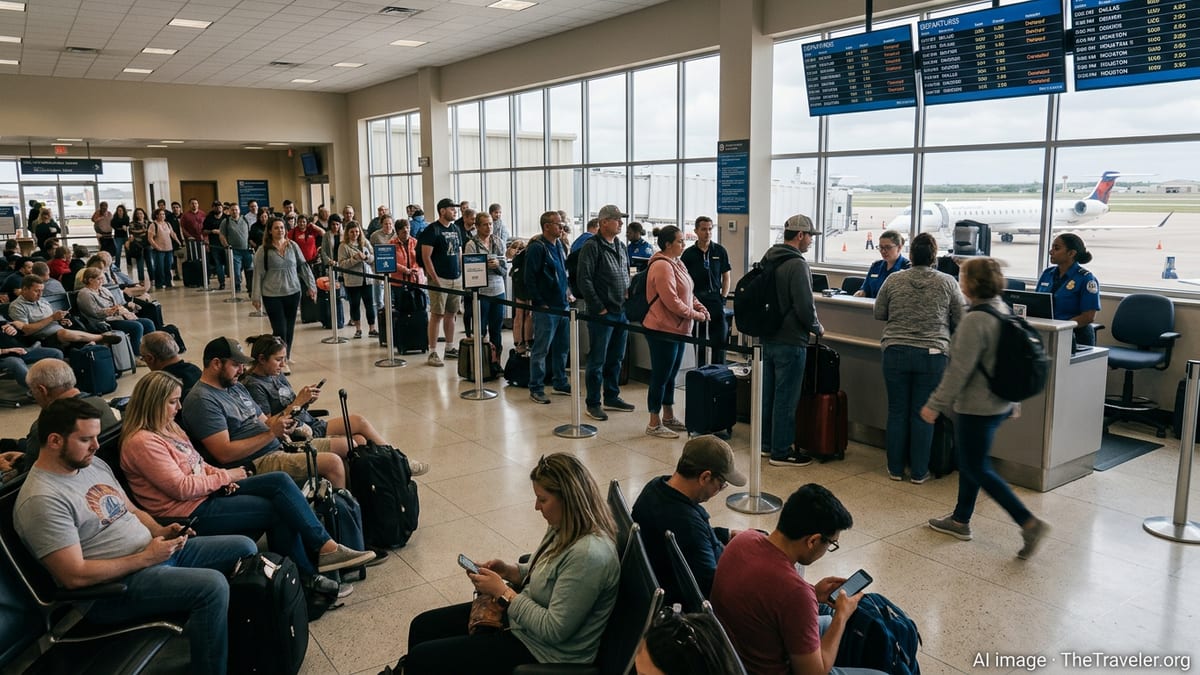
On Sunday, passengers arriving at the Midland terminal reported packed gate areas, long lines at airline counters and a scarcity of open seats on later flights as carriers worked to rebook travelers. Many were headed to onward connections in Dallas, Denver and Houston, where weather and staffing strains were already putting pressure on flight schedules across the region.
Airport operations staff said the disruptions underscored the vulnerability of smaller regional airports when systemwide stress meets concentrated local demand, especially at the start of the busy spring break period.
Weather, Staffing and a Stretched National Network
The Midland disruptions came on the heels of severe thunderstorms and low ceilings that swept through parts of the central United States over the weekend, prompting ground stops and departure restrictions at major hubs including Dallas Fort Worth. Airlines were still working through the residual impact of those weather events on March 8, with crews and aircraft out of position and schedules compressed.
At the same time, airports in Houston and other Gulf Coast cities were grappling with long security lines and staffing shortages at federal checkpoints, adding another layer of unpredictability for travelers with tight connections. Industry analysts say the combination of weather volatility, lean staffing and high seasonal demand has left the national air travel system less able to absorb even modest shocks at regional airports.
For Midland passengers booked to Dallas, Denver and Houston, that meant a higher likelihood that a delay leaving West Texas would translate into missed connections at their next stop. Several travelers waiting in the Midland concourse on Sunday described refreshing airline apps repeatedly and weighing whether to attempt reroutes through other hubs or postpone trips entirely.
Carriers serving Midland have emphasized that safety and crew duty-time rules dictate when flights can depart, particularly when earlier disruptions have compressed the day’s flying. With aircraft scheduled for multiple short segments, a delay on a morning departure can reverberate across an entire route network by afternoon.
Travelers Stranded Between Midland and Major Hubs
For passengers trying to reach Dallas, Denver and Houston on Sunday, the cancellations and rolling delays at Midland translated into missed family gatherings, business meetings and long-awaited vacations. In gate areas, parents tried to keep children occupied while standing by for standby lists, and business travelers huddled over laptops as they searched for alternate routings.
Some passengers arriving from smaller West Texas communities said they had chosen Midland specifically to connect through Dallas or Denver because of the broader range of domestic and international options from those hubs. When their Midland departure was scrubbed, options narrowed quickly. Same-day rebooking often meant accepting late-night arrivals, overnight connections or routing through entirely different cities.
Airline agents at Midland worked through queues of frustrated travelers, offering hotel and meal vouchers in some cases and advising others to consider driving several hours to larger airports if they needed guaranteed departures on Monday. Rental car counters reported heavier-than-usual demand as a subset of travelers opted to drive to Dallas or Houston to salvage their trips.
Despite the tension, many passengers expressed sympathy for front-line staff and cabin crews, noting that frequent bouts of disruption have become a defining feature of air travel during peak seasons.
Midland’s Growing Role Amid Expansion Efforts
The latest disruptions landed at a time when Midland International Air and Space Port is investing in expanded facilities to handle growing demand from the energy sector and regional population growth. Local officials recently broke ground on a terminal expansion that will add more passenger space and additional security screening lanes intended to reduce choke points during busy periods.
The project reflects Midland’s evolution from a purely regional outpost into a more strategic connector in West Texas, particularly for workers commuting to and from the Permian Basin’s oil and gas fields. Airlines have tailored schedules to match shift changes and project cycles, increasing the stakes when even a handful of flights fall out of the day’s plan.
Sunday’s wave of delays and cancellations highlighted how, despite the planned upgrades, Midland’s current configuration leaves little slack in the system during surges. Congestion at security and boarding areas intensified as more passengers than usual were forced to remain in the terminal, waiting for rebooked flights and uncertain departure times.
Local business leaders say improving the reliability and resilience of air service is critical for the region’s economic competitiveness, particularly as companies weigh where to base operations and how easily employees can move in and out of West Texas.
What Passengers Should Do if Their Midland Flight Is Hit Next
Travel experts say the Midland episode offers lessons for passengers across the country, especially those traveling through smaller regional airports tied closely to a few major hubs. They recommend that travelers departing Midland build in longer connection times when routing through Dallas, Denver or Houston during the volatile spring months, and that they monitor forecasts as closely as airline schedules.
Before heading to the airport, passengers are advised to check their flight status through airline apps and sign up for text or email alerts. In the event of a cancellation, rebooking options are often more plentiful when pursued digitally than at the airport counter, where lines can form quickly. Travelers with flexible plans may benefit from accepting reroutes through alternative hubs, even if those involve longer total travel times.
For those already in the terminal, having essential medications, chargers, snacks and a change of clothes in carry-on bags can make unexpected waits more manageable. Travel advocates also urge passengers affected by substantial delays or cancellations to review their airline’s contract of carriage and, where applicable, explore potential reimbursement or compensation options under airline policies.
With spring break in full swing and weather patterns still unsettled across much of the United States, aviation analysts expect intermittent pockets of disruption to continue. For Midland and its links to Dallas, Denver, Houston and beyond, Sunday’s troubles served as a reminder that even a small cluster of delayed and canceled flights can reverberate far beyond a single regional runway.